





































































































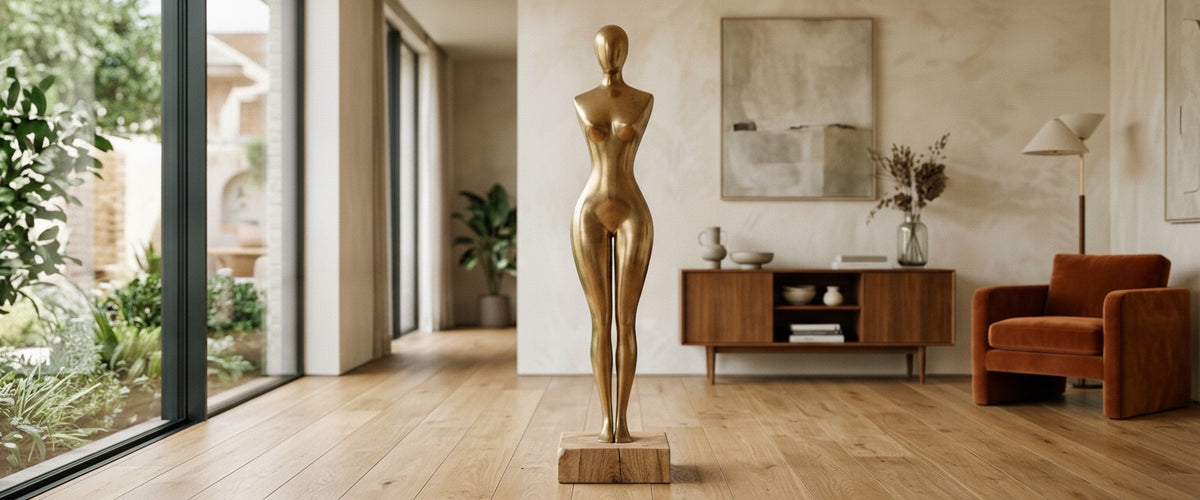

Warm metal is the fastest way to make a space feel considered, and the fastest way to make it feel like a hotel lobby from 2011 if you get the placement wrong. A brass looking modern sculpture lives or dies on context: the wall behind it, the height it sits at, the light hitting its surface late in the afternoon. Get those right and a single golden-toned piece anchors a whole room. Get them wrong and an expensive object reads as an afterthought.
We spend a lot of time on this at the studio, because the same form can look tailored in a Napa entryway and lost in a Texas great room. A brass looking modern commission rewards planning, so here is how we think about it, and how to avoid the errors we see most often.

Key Takeaways
- Backdrop matters more than the piece. Warm metal needs contrast; it disappears against beige and pale wood.
- Height changes everything. Pedestal height and sightline decide whether a figure feels commanding or awkward.
- Indoors rewards reflection; outdoors rewards silhouette. Choose finish and scale accordingly.
- True brass and brass-toned bronze age differently. Know which you are buying before you place it outside.
- Budget depends on material, scale, engineering and finishing. Ask for a tailored quote rather than guessing.

What Brass Looking Modern Actually Looks Like in Real Rooms
The brass looking modern phrase covers a wider range than most buyers expect. Such a piece might be solid brass, but far more often it is bronze finished to a warm gold, or stainless steel with a brushed brass-tone coating. Each reads differently across the day. Polished warm metal throws light and feels glamorous; a satin or brushed surface reads quieter and more architectural.
In a NYC apartment with a lot of glass, a compact golden-toned abstract on a console will pick up window light and glow at certain hours. In a double-height California living room, the same object needs to grow to hold the volume. This is where scale decisions start, and where a lot of first-time buyers underestimate what a big room swallows. For a mid-sized room on a low plinth, a form like the Large Modern Abstract Bronze Sculpture - 94cm sits comfortably, but the same silhouette scaled to 6 ft becomes a different, more architectural proposition entirely.
Outdoors, warm metal behaves differently again. Sunlight flattens polish and pushes you toward form over shine, which is why contemporary abstract modern sculpture in gardens tends to rely on strong outlines rather than surface sparkle.

Scale, Sightlines and Pedestal Height
Three questions decide how a piece reads before you even choose a finish: how tall it sits, where the eye lands, and what you see behind it. A brass looking modern form is especially sensitive to all three.
Sightline first. Walk the approach. Where does the piece first come into view? From a staircase looking down, a reclining or seated form reads better than a tall vertical one. From a long hallway, a vertical figure earns its height. We once reworked a commission for a client in the Hamptons because the sculpture was specified for a formal sightline down a garden axis, but the family actually approached it from the pool terrace at an angle. The form was right; the orientation was wrong. Small fix, huge difference.
Pedestal height. The default instinct is to raise everything to eye level. Resist it. A figure at true standing height often feels more human and less trophy-like on a low base. Abstract and geometric work, by contrast, can take a taller plinth because it invites you to read it as an object rather than a person. Where a room needs a piece to be met rather than looked up at from far below, something like the Monumental Modern Abstract Geometric Figure Bronze Sculpture - 250cm wants a base that feels grounded rather than towering.
Scale to the volume, not the floor space. A room's ceiling height and negative space dictate scale more than square footage. High ceilings can carry a tall vertical piece that would dominate a low-ceilinged den of the same footprint.

Indoor Versus Outdoor: When Each Wins
Indoors is where warm metal shows off surface. Controlled light, clean backdrops and close viewing distances reward a polished or lightly brushed finish. This is the setting for a modern contemporary sculpture meant to be seen from a few feet away, where fine surface work matters more than weather resistance. A brass looking modern piece really earns its keep here.
Outdoors is a tougher environment and a more honest one. Real brass and warm-toned bronze both weather, and how they weather depends on the alloy and any applied patina. Bronze develops a stable patina over time, which is part of its appeal for exterior work; unlacquered brass can shift color noticeably as it oxidizes. If you want the gold tone to stay bright outside, you are committing to periodic maintenance, or you should choose a coated stainless option engineered to hold its finish. The Smithsonian's conservation guidance on outdoor metal sculpture is a sensible reference on how exterior metals age and what upkeep they need.
Our rule of thumb: if the piece is the focal point of a formal room, favor indoors and finish. If it needs to command a lawn, a courtyard or a Napa vineyard vista, favor a larger form and let silhouette do the work. Where the open air asks for line and gesture read against sky rather than close-up shine, a piece such as the Life-Size Modern Abstract Diving Figure Bronze Sculpture - 180cm is closer to the right design language.
Light, Backdrop and Contrast
Warm metal needs something to push against. Against pale limestone, cream plaster or bleached oak, a gold tone can go muddy and lose definition. A brass looking modern object goes flat there. Against charcoal, deep green planting, dark stained wood or a slate wall, it snaps into focus.
Light direction is the other lever. Raking light late in the day exaggerates form and texture, which flatters abstract and geometric pieces. Flat midday light suits smoother, more reflective surfaces. Indoors, a single directional spot does far more for such a piece than even ambient lighting, which tends to wash out the glow that makes the material worth buying.
For gardens, plant behind the sculpture, not just around it. A dark evergreen backdrop turns a warm-toned figure into a clear silhouette from the house. This is where a brass looking modern silhouette pays off. Landscape designers in Aspen and the Hamptons use this constantly, and it costs nothing but planning.
Common Placement Mistakes We See
For wider placement ideas, Modern Abstract Wood Sculpture: How to Place It so the Form Actually Reads is useful companion reading before finalising the setting and sightlines.
Some of these come up on almost every commission conversation about a brass looking modern piece.
- Choosing the piece before the wall. Buy for the backdrop you have, or commit to changing the backdrop. A gold-toned sculpture against beige is the single most common regret.
- Under-scaling for a big room. Objects that look large in a studio photo shrink in a double-height space. When in doubt, size up.
- Over-elevating figures. A tall plinth under a standing figure can make it look stranded. Save the height for abstract forms.
- Ignoring the approach. Design for how people actually walk toward the piece, not the theoretical front view.
- Assuming any warm metal survives outside. Confirm the material and finish for exterior use before you buy. Bronze and coated stainless behave very differently from unlacquered brass.
- Forgetting the base and fixing. Large work needs engineered anchoring. This is not optional at scale, and it should be planned before delivery, not improvised on site.
Commissioning a Warm-Metal Piece That Fits
Most of our warm-toned work at Giant Sculptures is bespoke, which means the form, scale, patina and base can be tuned to a specific room or garden rather than compromised to fit a stock size. If you are drawn to contemporary abstract modern sculpture in a brass tone, send us the sightlines, ceiling heights, backdrop materials and where the light falls. Those details shape a brass looking modern recommendation far more than a style label does.
Budget depends on material, scale, complexity, engineering, installation and finishing, so we quote each commission individually rather than quoting a band. If you want to browse the range of forms first, our Contemporary and Modern Sculptures collection is the best place to start, and the broader Modern Art selection shows how the same modern language runs across figures, animals and pure abstraction. Contemporary American sculpture modernism has always leaned on this vocabulary of simplified form and warm metal, and it still reads as current in the right setting.
Placement is the part buyers control most and think about least. Sort the backdrop, the height and the light before the metal ever arrives, and a brass looking modern sculpture will do exactly what you hoped it would.