





























































































Black eats light. That single fact is why a heavy black indoor sculpture can arrive looking magnificent on the studio floor and then flatten into a featureless black shape once it lands in a client's living room. The mass is still there. The modeling, the folds, the tension in the pose, all of it stops reading because nothing is skimming across the surface to describe it. Get the finish, the backdrop and the light angle right and the same piece turns into the most-photographed object in the house.

Key Takeaways
Finish outranks form indoors. Matte, satin and gloss black behave like three different sculptures in the same room.
Side light, not down light. Grazing illumination describes contours; a ceiling downlight collapses them.
The wall behind matters as much as the piece. A dark wall can erase a dark work or cut it out sharply, depending on sheen contrast.
Daylight shifts the whole reading. North-facing afternoon light drains warmth out of black bronze by late day.
Lamp color temperature changes the color of black. Cool LEDs push black toward gray; warm sources push it toward brown.
Polished black is a mirror. Plan for reflections and fingerprints before you plan for the plinth.

Matte, Satin and Gloss: Three Sculptures in One Room
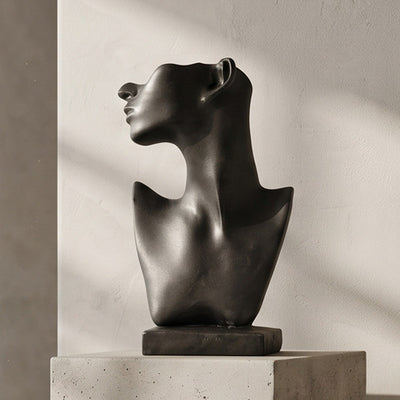
Ask for "black" and you are really choosing a behavior. Matte black gives you pure volume; the eye reads silhouette and weight, and detail only appears where light rakes across it. Satin holds a soft band of highlight that travels as you walk past, which is the most forgiving option for a heavy black indoor sculpture in a room with mixed lighting. Gloss and polished finishes stop being surfaces at all and become reflectors, showing you the window, the floor lamp and the person standing in front of them.
In our studio we make up small finish tiles in matte, satin and semi-gloss and send them out before a bespoke heavy black indoor sculpture goes to patination or powder coat. Clients photograph them on the actual wall, at midday and at 9pm. It sounds fussy. It has saved more commissions than any other step, because a satin that looks refined under showroom track lighting can go greasy under a client's warm floor lamps.
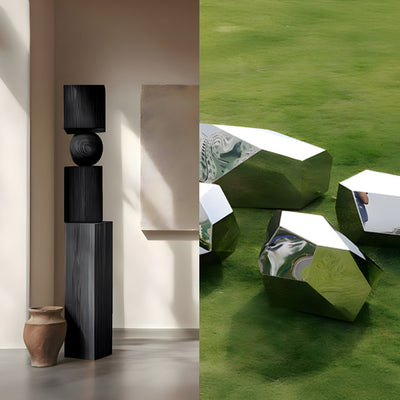
If you are buying off the shelf rather than commissioning, satin on a tall vertical form is the safest default. On something like the Kelsale Black Abstract Sculpture, 148cm (about 4 ft 10 in), the highlight runs as a single continuous line down the body as you move past it, which is exactly what stops mass from going dead in a room.
Grazing light from one side separates mass from shadow. The same form under a ceiling downlight reads as a flat cutout.
Why Mass Reads as One Flat Shadow
A heavy black indoor sculpture usually fails for one specific reason: the light hits it from directly above. Ceiling downlights land on the crown of the form, leave the flanks unlit, and turn everything below the shoulder line into a single continuous shadow. Contact points disappear first, and contact points are where the drama lives.
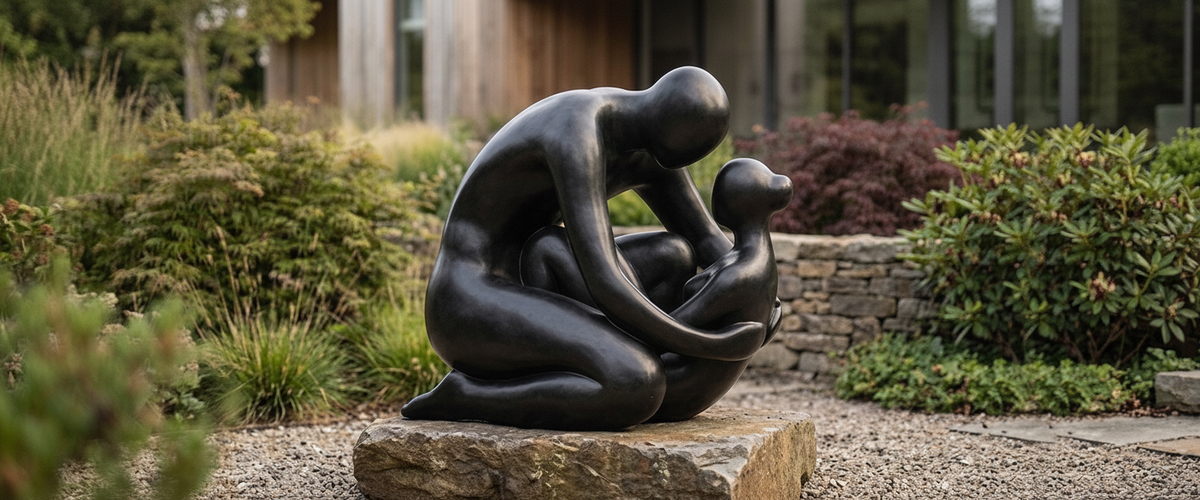
This matters most with entwined figures. One of the forms we quote on most often is a heavy black abstract indoor sculpture, man curled over woman, two bodies folded into a single protective mass. The whole idea of that piece is the seam where the figures meet. A downlight flattens that seam into a black smear. A grazing light, mounted low and off to one side at roughly 20 to 30 degrees from the surface, catches every ridge of the curl and separates the two bodies again. Floor uplighters set a foot or two (30 to 60 cm) out from the base do this better than any ceiling fitting.
A heavy black abstract indoor sculpture, man curled over woman, photographed at 6pm under a single floor uplighter.
The same logic applies to single figures with a strong contour. A piece like the Black Abstract Female Figure on Black Base Metal Sculpture, 139cm (roughly 4 ft 7 in) lives or dies on the line of the spine and hip, and it wants a lamp placed to one side rather than a spot overhead. Light it from the front and you get a paper cutout; light it from the side and the body has volume again.

Dark Walls, Dark Work
Designers love charcoal and near-black walls behind dark sculpture, and it can be superb. It can also swallow the piece whole. The deciding factor is sheen, not color. A matte heavy black indoor sculpture set against a matte charcoal limewash merges into one field of nothing. The same figure against a wall with a slightly different reflectance, or with a low wash of light on the wall behind it, cuts out cleanly as a true silhouette.
We shipped a tall abstract to a home in the Hollywood Hills where the client had already committed to a black plaster feature wall. The fix was not repainting. We lifted the piece onto a plinth so it broke the line of a pale floor, then added a narrow wall grazer behind it so the wall glowed and the sculpture read as pure dark shape against it. Total cost of the change: one light fitting.
North Windows, Warm Lamps and the Gray Cast Nobody Expects
Daylight is not neutral. North-facing rooms in the US receive cool, indirect light that holds steady through the day, which flatters marble and can leave black bronze looking blue-gray and chalky by four o'clock. South and west exposure does the opposite, warming a dark patina into something closer to deep brown-black in the late afternoon. Neither is wrong. You just need to see a heavy black indoor sculpture at both ends of the day before you settle its position.
After dark, lamp color temperature takes over. Warm sources around 2700K bring red and amber back into a patinated surface. Cool LEDs above 4000K strip that warmth and push black toward gray. Color rendering matters too; a low-CRI lamp will mute the subtle green, brown and blue tones patinators build into a black finish, and the Illuminating Engineering Society publishes practical guidance on choosing sources that render color faithfully. For bronze in particular, those layered tones are the work; the Henry Moore Foundation archives show how varied a "black" patina can actually be once light reaches it properly.
Polished Black Is a Mirror
Choose a high polish and your heavy black indoor sculpture becomes a reflective object. It will show the room, and it will show hands. Mirror-finished stainless steel and polished lacquer both hold fingerprints in a way matte never does, which is a real consideration in a hotel lobby or a busy family home. Where the setting needs the room reflected back rather than absorbed, a two-tone piece such as the Fenmoor Silver & Black Abstract Sculpture, 140 to 270cm sits closer to the mark, with the bright passages picking up the light while the black passages hold the form. If you want that effect, budget for a microfiber routine and keep the piece out of primary traffic paths.

Buyer's Checklist Before You Commit
Request finish samples in matte, satin and gloss, and view them in the actual room at three times of day.
Confirm the light source you already own. Track, recessed, floor uplight or daylight only. This changes which finish you should order.
Check wall sheen contrast, not just wall color, if the backdrop is dark.
Plan one grazing light per major face of a figurative or entwined piece, including anything as closely folded as a heavy black abstract indoor sculpture of a man curled over a woman.
Verify floor loading and access for genuine weight. Doorway widths, elevator depth and stair turns decide whether a heavy black indoor sculpture can reach the room at all.
Ask how the finish is repaired. Patinated bronze, powder coat and lacquer all age differently and are touched up differently.
Agree the plinth early. Height sets the sightline and often rescues a dark piece from a dark floor.
Commissioning a Heavy Black Indoor Sculpture
Bespoke work lets you solve the lighting problem at the modeling stage rather than the installation stage. We regularly adjust the depth of a fold, exaggerate a shoulder line or widen the gap between two entwined bodies specifically so that the client's existing lighting can find it. Scale is worked out the same way, against ceiling height, sightlines from the entry door and the distance a viewer will typically stand back. Cost depends on material, scale, complexity, engineering, installation and finishing, so the honest answer is always a tailored quote rather than a headline figure.
Giant Sculptures works on exactly this kind of problem, from bronze and stainless steel commissions to large abstract forms in composite for interiors where weight is constrained. Bring us the room, the wall color and a photo taken at 6pm. That tells us more than a mood board ever will.
For wider placement ideas, Black Gold Wall Art That Still Reads Gold at 4pm is useful companion reading before finalizing the setting and sightlines.