






















































































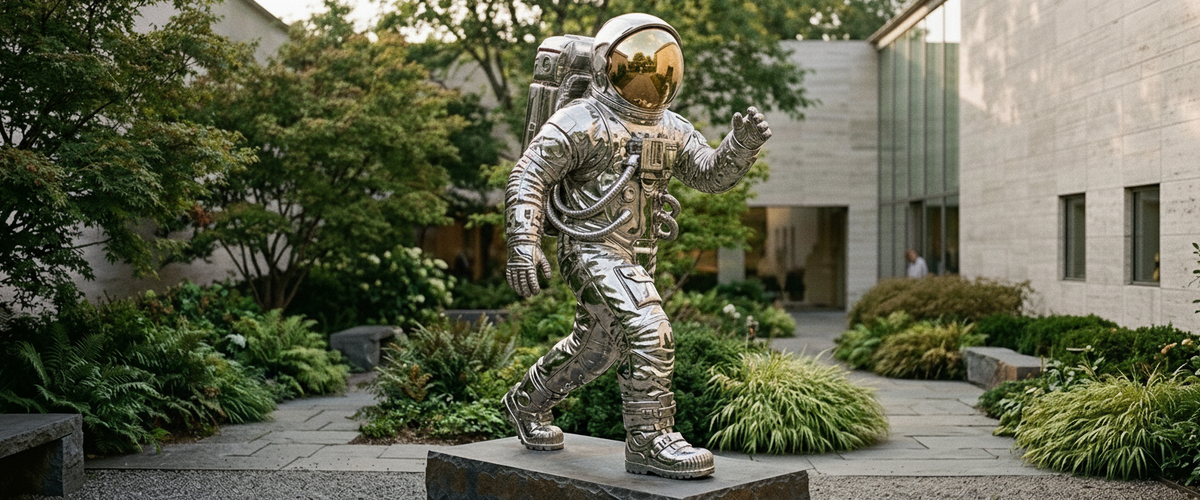

A spacesuit is a hard subject to get right. It reads as either heroic or cartoonish depending on choices made weeks before anyone touches metal, and the gap between those two outcomes is entirely down to judgment. That is the quiet truth about hiring an astronaut sculpture artist: the interesting work happens in the sketching and sample stages, not on the shop floor. By the time a piece is being welded or cast, most of the risk is already locked in.
Looking for the full range in this category? Browse our Astronaut Sculptures & Space Art collection for every available finish, size, and configuration.
We field these commissions regularly at Giant Sculptures, and the same questions come up whether a client wants a 3 ft (91 cm) figure for a home office or a 12 ft (3.7 m) landmark for a science campus. So here is how an astronaut sculpture artist actually thinks it through, and what you should ask before you sign anything.

Key Takeaways Before You Commission
- Pose and helmet visor decide the mood more than any other single choice. A mirrored visor reads mysterious; a visible face reads warm and human.
- Material drives longevity and cost. Stainless steel, bronze, and painted aluminum behave very differently outdoors.
- Scale is not linear. A design that works at 10 ft can fail badly at 30 ft, and the reverse is true too.
- Ask to see a maquette (a scale model) before fabrication. Skipping this stage is the most common way buyers get burned.
- Budget depends on material, size, engineering, finish, and install. Any serious astronaut sculpture artist will quote from a brief, not a menu.

What an Astronaut Sculpture Artist Thinks About Before Taking the Commission
The first thing an astronaut sculpture artist sorts out is intent. Is the astronaut sculpture meant to feel triumphant, reflective, weightless, or slightly surreal? A figure mid-stride on the Moon says something different from one sitting cross-legged and staring at the sky. That decision cascades into everything: the tilt of the helmet, whether the boots are planted or floating, how the suit folds catch light.
Setting matters just as much. An astronaut sculpture in a church, for example, is a real request we take seriously; it usually carries a theme of wonder or human smallness against something vast, and the pose has to hold that tone without tipping into novelty. A lobby piece for a tech firm wants confidence. A garden piece often wants stillness and a bit of humor. We ask where the piece will live before we sketch a single line, because the room or the sky behind it is part of the composition.
Weight and mounting come into the conversation early too. Where the brief calls for a figure that appears to hover, something like the Cosmic Sky Astronaut Glow Hover Sculpture - 60cm shows the design language at play, but it needs a hidden armature that carries real load while looking like it carries none. That engineering is invisible when it works and catastrophic when it does not, which is why an experienced astronaut sculpture artist plans it early.

Craft Decisions That Change the Result and the Price
Once intent is settled, the craft choices begin, and each one moves both the look and the cost.
Material. Bronze gives you permanence and a surface that ages with dignity; it is the traditional choice for a reason and the least fussy over decades outdoors. Stainless steel gives crisp modern edges and a reflective quality that suits the sci-fi subject, though it shows fingerprints and water spotting if neglected. Painted aluminum keeps weight down for large pieces and lets you push bold color, but the coating becomes the maintenance item. The Getty's conservation work on outdoor metal sculpture is a good reminder that the finish, not the metal, is usually what fails first (Getty Conservation Institute).
Finish. A mirrored gold or silver visor changes the whole read of the figure. Where the setting wants a reflective, celebratory tone, a piece like the Celestial Gold Astronaut Glow Moonwalk Sculpture - 110cm turns the suit into almost a light source. A matte finish, by contrast, reads more solemn and sculptural. Neither is right or wrong; they answer different briefs, and any capable astronaut sculpture artist will steer you toward the one your setting needs.
Detail level. Suit seams, hose fittings, glove articulation, tread on the boots. Every added detail is hours of hand finishing. A stylized, smoothed-down figure costs less to fabricate and often ages better outdoors, because there are fewer crevices to trap water and grime.
These are the levers a good astronaut sculpture artist pulls to hit your budget without gutting the design. That is also why nobody credible will hand you a flat price before understanding the brief. Material, scale, engineering, finishing, and installation each move the number.

Why Some Astronaut Sculpture Pieces Read Right at 10 ft and Wrong at 30
Scale is where a lot of astronaut sculpture art goes sideways. A design that charms at desk size can look clumsy at building height, because proportions the eye forgives up close become glaring from across a plaza. The helmet that felt characterful at 3 ft (91 cm) can read as a bobblehead at 30 ft (9 m). Fine surface detail that sells the illusion in a gallery simply vanishes when the viewer is 60 ft (18 m) away, so the money you spent on it is wasted.
The reverse trap is real as well. A pared-back, monumental design engineered for distance can feel cold and empty when shrunk to a tabletop, because there is nothing for the eye to settle on. This is why a seasoned astronaut sculpture artist resizes the concept rather than just scaling the file. A large spaceman figure often needs simplified planes and a stronger silhouette; a small one earns its keep through crisp detail you can inspect at arm's length, the kind of close-range read a desk-scale figure like the Lunar Silver Astronaut Beats Figure - 36cm depends on. If you are weighing options, our large astronaut sculptures and medium astronaut sculptures show how the same subject shifts personality with size.
Wall pieces sit in their own category. An astronaut wall sculpture has to work as relief rather than in the round, which means the maker is composing shadow and depth against a flat backing instead of a full 360-degree read. It is a different discipline, and worth flagging to your astronaut sculpture artist up front so they design for the plane it will hang on.

The Studio Process: Maquette, Sample, Fabrication, Install
Here is the sequence a serious commission follows, and each stage exists to kill a specific risk.
- Concept and reference. Sketches, mood, pose, and where the piece will stand. We lock the emotional read before anything else.
- Maquette. A scaled physical model. This is your last cheap chance to change your mind. Photograph it from the exact angles your visitors will use, including from below if it sits on a plinth.
- Material sample. A finished swatch of the actual metal and coating. Colors and reflectivity almost never look the way people imagine, so any careful astronaut sculpture artist insists on this for outdoor and large work.
- Fabrication. Casting, welding, or forming, then the long hours of finishing. This is where a hollow, headless astronaut sculpture concept, if that is the artistic intent, gets its internal structure and weatherproofing worked out.
- Install. Rigging, base engineering, and anchoring. A tall metal figure catches wind load, so the foundation is not an afterthought; it is structural.
Skip the maquette and you are essentially approving a sculpture from your imagination. We have never regretted the extra week that stage takes.
Honest Red Flags to Raise Before You Commit
A few questions separate an astronaut sculpture artist who will deliver from one who will disappoint.
- Can I see the maquette and a material sample? If the answer is no, walk.
- How is it weatherproofed, and what maintenance does that finish need? Painted surfaces need a care schedule; ask for it in writing.
- What is the base and anchoring spec? Vague answers here are a structural risk, not a detail.
- Who owns the design? Clarify whether your commission is exclusive or a variant of a stock model.
- How does the quote change if I go up a size or switch metal? A transparent maker will talk you through the trade-offs rather than dodging.
Cultural reference points can also sharpen a brief. Some clients arrive citing the so-called aztec astronaut sculpture, the carved lid of Pakal the Great's sarcophagus that pop culture reinterpreted as a figure at controls; it is really a piece of Maya iconography, but it tells your astronaut sculpture artist that the client wants mystery and a sense of the ancient meeting the futuristic. That is useful. The clearer your references, the closer the first maquette lands.
Astronaut sculpture sits in a rich lineage of space commemoration, from lunar memorials to museum installations documented by the Smithsonian (National Air and Space Museum). Whether you want something reverent, playful, or monumental, the same principle holds: decide the feeling first, then let material and scale serve it. Get that order right and the astronaut sculpture artist you hire has everything they need to make something that still looks deliberate in twenty years.
For wider placement ideas, 3d Printed Wall Art: What Sculptors Weigh up Before Saying Yes is useful companion reading before finalizing the setting and sightlines.