






































































































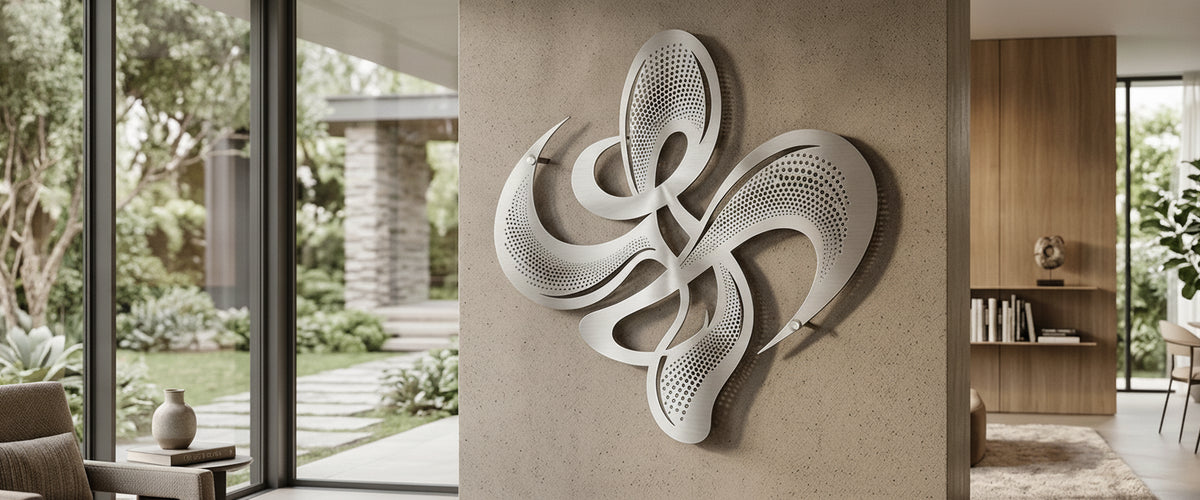

Most outdoor metal art that disappoints was the right design at the wrong size. A rendering on a laptop flatters everything. A wall 40 feet from the garden gate flatters nothing. So before our studio cuts a large commission, we ask clients to do something deeply unglamorous: tape a full-size card template to the wall and live with it for a few days.
Looking for the full range in this category? Browse our Metal Wall Art collection for every available finish, size, and configuration.
It costs a few sheets of corrugated board and a roll of painter's tape. It also prevents the most expensive mistake in metal art outdoor wall decor: discovering after installation that the piece reads as a postage stamp, or that it crowds the window it was meant to frame.

At a Glance
Scale: a card mock-up settles size faster than any rendering, because you judge it from where you actually stand.
Depth: spacers behind the card preview the shadow line a standoff mount will throw.
Finish: an offcut of Corten, stainless or powder-coated aluminum fixed nearby shows how the metal behaves on your wall.
Fixings: mark bolt positions on the card before anyone drills brick, stucco or cladding.
Quotes: a supplier who never mentions a mock-up is usually guessing.
Sizing Outdoor Metal Art: Why Card Beats a Rendering
Renderings put the viewer at a tidy, slightly raised vantage point and light the wall evenly. Real walls have downspouts, a hose reel, a climbing rose and a neighbor's roofline in view. Card drops the proposed outline among all of it. Cut the silhouette roughly; precision does not matter yet. What matters is the outer extent, the weight of the densest areas and where the voids fall.
A rough card silhouette shows scale against the real wall, downspouts and all.
Long horizontal runs of outdoor metal art need the most testing. For a panel on the scale of the Blue Sculptural Metal Wall Panel, which spans 710cm (roughly 23 feet), the template becomes several sheets taped edge to edge. That exercise alone tells a client whether the facade can carry a piece of that length, or whether a shorter run centered on a doorway would sit better.

Gate, Patio and Upstairs Window: Three Distances, Three Verdicts
Walk the template from three positions, and expect them to disagree.
From the gate or driveway, often 40 feet (12 m) or more away, you are judging silhouette. Fine perforation and surface texture disappear; only the outline and its contrast against the wall survive. If the shape vanishes here, it is too small or too close to the wall color.
From the patio, at conversation distance, detail returns and so does the risk of the piece looming over the seating. This is the position where clients most often ask us to take some width out of a design.
From an upstairs window, you see the work foreshortened and in relation to planting beds and paving. A design that looks balanced from the lawn can appear to slide off the corner of the house when viewed from a bedroom window above. Often the fix is simply shifting the piece a short distance toward center, and it is a problem a rendering rarely flags.
Standoff Depth and the Shadow Line Behind the Steel
Most outdoor metal wall art is mounted on standoffs rather than flush, and that gap is a design decision, not a hardware detail. Push foam blocks or offcuts of timber behind the card to hold it off the wall, then look at it mid-morning and again in late afternoon. A shallow gap gives a crisp, tight shadow that reads almost like a drawn line. A deeper one throws a softer second image that moves across the wall through the day.
The card also exposes practical snags. A deep standoff in a narrow side passage invites shoulders and wheelbarrows. Heavily textured stucco can make a shallow mount look uneven where the panel edge meets the high points of the finish.

Corten, Stainless or Powder-Coated Aluminum: Let an Offcut Weather First
Card tells you about size; it says nothing about how outdoor metal art ages in your air. Ask for an offcut in the proposed finish and fix it to the wall beside the template, ideally for several weeks.
A finish offcut on site reveals the drip line and early patina before steel is cut.
Corten builds its protective rust patina over months to a few years, and early runoff can stain pale stone or light stucco below it. Technical guidance on weathering steel from SteelConstruction.info explains why drainage detailing matters. An offcut on your own wall shows exactly where the drip line lands.
Stainless steel stays bright, though near the coast or a chlorinated pool, surface tea staining can appear if the grade is wrong for the site. If you are drawn to a polished finish like the one on the Silver Polished Oval Disc Stainless Steel Wall Art - 120cm, a polished sample on site also tells you what the surface will reflect: sky, pool water, or the neighbor's garage door.
Powder-coated aluminum is light, which helps on cladding and upper stories, and the color is fixed from day one. The test here is fade and chalking on a south- or west-facing wall under Texas or California sun.
Mark Fixing Points Before Anyone Drills
Once scale and depth are agreed, the template becomes a drilling guide. Mark every proposed fixing on the card and check what sits behind each one. On brick, agree with your installer whether anchors go into the brick faces or the mortar joints, then line the marks up before a single hole is made. On stucco, the render is only a skin; the fixing has to reach the block or framing beneath. On cladding, locate the structure and keep the weather barrier sealed.
One detail worth insisting on: specify isolating washers wherever stainless fixings meet Corten or aluminum. Dissimilar metals in contact outdoors can corrode at the joint long before the artwork itself shows any age.

Quotes That Skip the Mock-Up, and What That Silence Means
A quote for large outdoor metal art that arrives with a price, a lead time and no mention of templates, samples or fixing layout usually means one of two things. Either a stock design is being resized without thought for your wall, or the supplier expects the installer to solve problems on the day. At Giant Sculptures, bespoke commissions move through drawings, a template stage and a finish sample before fabrication, because changing card is cheap and changing steel is not. Budget depends on material, scale, complexity, engineering, installation and finishing, so each commission is quoted individually.
Sometimes the mock-up delivers a different verdict entirely: the wall is wrong. When that happens, the better move is often to bring the metal off the facade and into the garden, where a freestanding form such as the Molten Silver Organic Stainless Steel Sculpture, set in front of planting, can do the job the wall could not.
Checklist: Before You Approve Outdoor Metal Wall Art
Full-size card template on the wall for at least a few days.
Viewed from the gate, the main seating area and an upper window.
Spacers behind the card to test standoff depth at two times of day.
Finish offcut fixed on site, with the drip line and reflections checked.
Fixing points marked on the card and checked against the substrate.
Isolating washers specified where dissimilar metals meet.
A written quote that names the template and sample stages.
None of this slows a good project down. It simply moves the hard decisions to a stage where they cost tape instead of steel, and that is where we want them for every large piece of outdoor metal art we ship.
For wider placement ideas, Salt, Sand and Steel: Choosing a Metal Abstract Garden Sculpture for the Coast is useful companion reading before finalising the setting and sightlines.