

























































































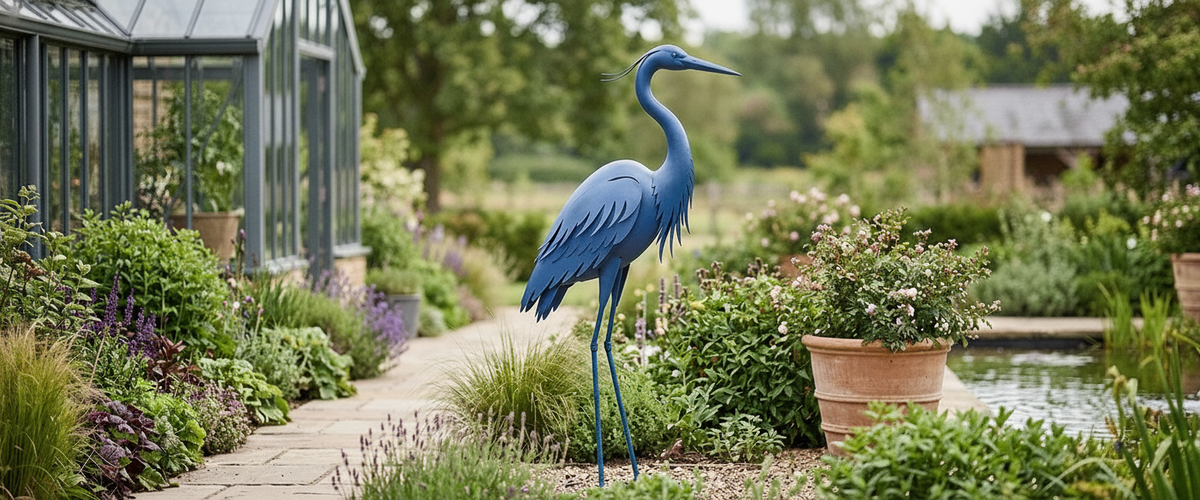

Buy a flock of blue metal bird sculptures for a sunny garden and, five seasons later, the pair on the south-facing terrace will look nothing like the pair under the oak. Same maker, same batch, same coating. One reads cobalt. The other has gone the color of faded denim, with a dusty bloom on the wing tops that rubs off on your thumb. That is not a defect. That is physics, and it hits blue harder than any other color in the garden.
We ship colored metalwork to clients across California, Texas and the Northeast, and blue metal bird sculptures generate more finish questions than every other shade combined. Worth understanding before you commit.
Sun-facing wings lose saturation years before shaded ones.

Key Takeaways
Blue pigments absorb the high-energy end of the light spectrum, so UV degrades them faster than greens, grays or blacks.
Super-durable polyester powder coat outperforms standard powder and most brush-applied enamel outdoors; fluoropolymer systems outperform both.
On blue metal bird sculptures, color fails at edges and contact points first, not across flat surfaces.
Chalking can often be polished and resealed. Fading cannot be reversed, only recoated.
If you want blue with no maintenance cycle at all, patinated copper alloy or a commissioned bronze is the honest answer.
Why the Sun Eats Blue First
Pigment color comes from selective absorption. A blue pigment looks blue because it soaks up the longer wavelengths and reflects the short, blue end back at your eye. The problem is that the absorbed energy has to go somewhere, and organic blue pigments hold onto photons in exactly the band that breaks polymer chains. Conservation databases such as CAMEO, maintained by the Museum of Fine Arts Boston, track lightfastness ratings pigment by pigment, and the spread across blues is wide. Phthalocyanine blues hold up well. Cheaper organic blues and many bright teals do not.
Altitude and reflected light make it worse. A garden in Aspen gets meaningfully more UV than one at sea level, and a Palm Springs courtyard with pale limestone paving effectively double-doses the underside of every wing. The blue metal bird sculptures that survive best are the ones specified with the site in mind, not the ones bought purely on catalog color.

Powder Coat, Two-Pack Enamel and Patinated Copper Blue After Five Seasons
Standard architectural powder coat is the default finish on most blue metal bird sculptures and it is fine, up to a point. On a bright blue heron in full southern exposure, expect visible gloss loss inside three seasons and a color shift you will notice when you compare it to a shaded example. Super-durable polyester powder, specified to the performance tiers the Powder Coating Institute publishes, buys you considerably more. Fluoropolymer coatings, the systems used on curtain walling, hold color longest and cost accordingly.
Three finish systems, five seasons of the same exposure.
Two-pack polyurethane enamel, sprayed by a marine-grade shop, sits close behind super-durable powder and has one real advantage: it can be touched up on site. Powder cannot. Once a powder-coated bird is chipped, a proper repair means stripping and re-baking, which means crating and freight.
Then there is chemically patinated copper alloy. A blue-green patina is not a coating sitting on top of metal; it is a converted surface layer that develops rather than fails. It moves toward green over the years, and it will never give you an electric cobalt. What it will give you is a piece that ages instead of degrading. For clients who hate the idea of a maintenance calendar, that trade is usually worth making.
Four Places the Color Lifts Before Anywhere Else
For wider placement ideas, Metal Bird Sculptures for the Garden: The Rod Gauge Nobody Checks is useful companion reading before finalising the setting and sightlines.
Flat panels are rarely the problem. Look here instead:
Rod tips and leg ends. Powder pulls thin over sharp terminations because of the Faraday effect during coating. Thin film equals early failure. Ask whether ends are radiused or capped.
Wing edges and feather cut lines. Any laser-cut edge left square holds less coating than a dressed one. Run a fingernail along it; if it feels crisp rather than softened, it will lose blue first.
Pivot points on kinetic pieces. Wind-driven birds wear at the bearing collar. Metal on coated metal is an abrasion problem, not a UV one. Bronze bushings or nylon washers solve it.
Base plates and fixings. Water sits where the bird meets the plinth. Standing moisture under a foot creates the blister that eventually undercuts the whole leg.
When our studio masks blue metal bird sculptures for coating, those four zones get discussed before anything reaches the oven. A client in Marin once returned a set of migrating geese from another supplier where the finish had lifted only at the mounting flanges. The flat bodies were perfect. The contact points had been coated wet-on-wet over an unsealed weld.

Chalking versus Fading, and How to Tell Them Apart
Chalking is resin breakdown at the surface. The binder degrades, pigment particles are left loose, and you get a powdery haze. Wipe a hidden section with a dark microfiber cloth. Blue dust on the cloth means chalking, and chalking is often recoverable: a cutting compound and a UV-stable wax or clear sealer can bring back most of the depth.
Fading is different. The pigment itself has broken down, so there is nothing to polish back. Compare a hidden surface (under a wing, behind a leg) with the sun-facing face. If the sheltered area is two or three shades deeper, the exposed color has genuinely gone. Both problems show up on blue metal bird sculptures long before the steel underneath is at any risk. At that point you are choosing between living with a softer blue, which plenty of owners prefer, or a full recoat.
Why the Same Blue Reads Navy against a Hedge and Electric against Gravel
Color is contextual, and this trips up buyers of blue metal bird sculptures more than fading does. A mid-cobalt bird placed against a dense beech or yew hedge loses almost all its punch; the dark green backdrop swallows the value and the bird reads near-navy from twenty feet (6 m). Move the same piece to pale gravel, a rendered wall or a gray decomposed granite path and it snaps forward.
Test it before you plant anything. Cut a large card in the finish color, prop it in the intended spot, and look at it at 9am, noon and dusk. Saturated blues behave the same way whatever the subject, so a strongly pigmented form at head height, such as the Caldridge Blue Abstract Sculpture - 150cm, needs its background chosen as deliberately as its position. Blue metal bird sculptures for the garden work hardest when the backdrop is lighter than the bird, not darker.
The Honest Maintenance Checklist
Twice a year: rinse with clean water and a soft brush. Grit held on a coated surface abrades it under wind.
Annually: inspect the four failure points above with a flashlight, including the underside of the base.
Coastal sites: rinse quarterly. Salt fog in the Hamptons or on the Carolina coast dulls a gloss finish faster than inland UV does.
Keep records: the RAL or custom color reference, the coating system and the applicator. Without them, a matched touch-up is guesswork.
Touch-up kits: only genuinely useful with enamel systems. Ask at point of order whether one is available for your finish.
Recoating: budget for it as a cycle, not an emergency. Frequency depends on coating tier, exposure and how bright you insist the blue stays.

When to Stop Painting and Buy Bronze or Stainless
There is a point where the recoating cycle on blue metal bird sculptures stops making sense, usually when the piece is large, permanently fixed, or somewhere that makes crating awkward. Sculpture park clients reach it faster than domestic buyers do.
Mirror-polished or bead-blasted stainless steel gives you a cool, blue-leaning read that shifts with the sky, with no pigment to lose. Silicon bronze gives you warmth and a patina that deepens rather than dies. For a focal commission on a lawn or courtyard axis, a figurative piece at full height, such as the life-size girl with bird trays at just over 7 feet (220 cm), is the kind of thing a family keeps for two generations without touching a spray gun.
Scale changes the calculation as much as material does. Where the setting calls for something at seated-dog height beside a doorway or gatepost rather than a plinth-mounted figure, the Life-Size Traditional Seated Labrador with Game Bird Bronze Sculpture - 90cm is closer to the right proportion, which is why pieces of that size suit shooting estates and lodge entrances where nobody wants a finish schedule. Buyers heading in that direction usually end up comparing the bronze animal sculptures rather than another coated flock.
None of this means colored metalwork is a mistake. It means blue metal bird sculptures are a material decision and not just a styling one. If you want a specific blue at a specific scale, we will spec the coating tier, radius the vulnerable edges and quote it properly; budget depends on material, scale, complexity, engineering, installation and finishing, so ask for a tailored quote rather than working from a guess. It is worth comparing the bird sculptures against the wider metal sculptures to see how the same subject changes character across finishes, then telling us where the piece is going and which direction it faces. That last detail matters more than most buyers expect.