





































































































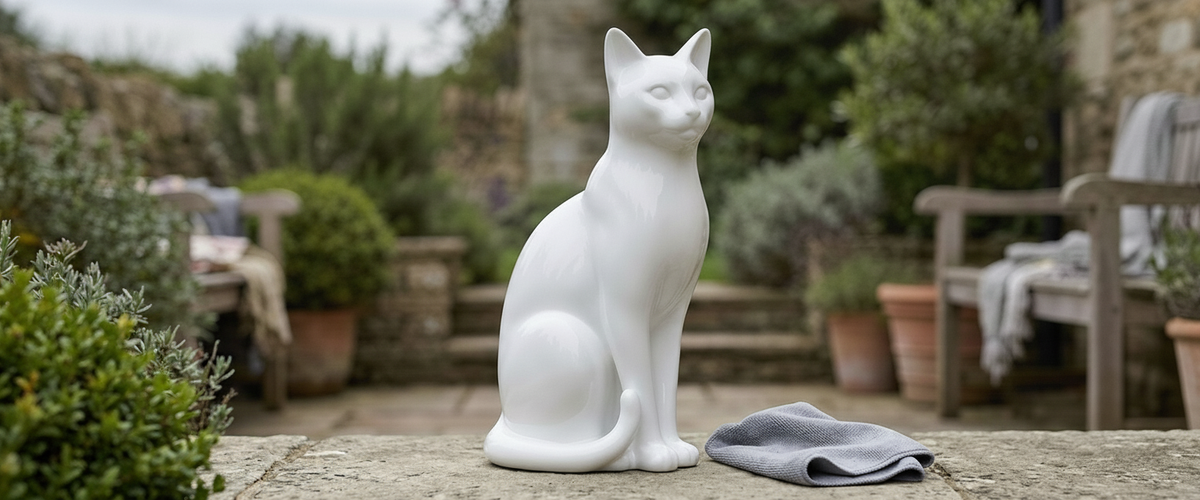

The fastest way to wreck a resin piece is a kitchen degreaser and thirty seconds of enthusiasm. Resin holds a fine gloss, and that gloss sits on the surface rather than running through the material, so every shortcut shows. Learn to clean resin sculpture the gentle way and a cast piece can look showroom-fresh for years. Get it wrong once with solvent or a scouring pad and you are left with a dull gray bloom that polishing never fully recovers.
Giant Sculptures builds most of its large-scale commissions in bronze, stainless steel, Corten and stone, but plenty of our clients live with resin indoors and on covered terraces, where it earns its place: light, sharply detailed, and easy to place on a floating shelf or a plinth that would groan under cast metal. A 5 ft (1.5 m) resin figure weighs a fraction of the same form in bronze. That advantage comes with a softer surface, and the care routine has to respect it. Knowing how to clean resin sculpture without cutting into that surface is most of the ownership skill.

Key Takeaways
Water and a soft cloth do almost all of the work. Warm water, a drop of pH-neutral soap, no solvent.
Never use an abrasive pad, melamine sponge, or alcohol wipe. All three cut into the clear top layer.
Green film outdoors is biological, not staining. Lift it with a soft brush and diluted soap before it grips.
UV yellowing is chemical. Light hazing can be polished back; deep yellowing needs recoating or relocation.
Fine crazing is cosmetic. A chip with a pale core needs a proper repair. Stop and ask before you fill anything.
Resin Is Softer Than Your Cleaning Cupboard Assumes
Cast polyester and epoxy resins sit far lower on the hardness scale than marble or bronze. Museum conservators treat cast plastics as a sensitive category for exactly this reason: solvents can soften binders, and surfactants left to dry can leave a permanent haze. The V&A's guidance on caring for plastics is blunt about it, recommending a dry soft brush or a barely damp cloth and warning off solvents entirely, and the same logic applies to a decorative cast figure in a hallway at home.
The practical translation: anything marketed as a degreaser, glass cleaner, bathroom spray, or all-purpose kitchen cleaner is off the list. So is anything containing ammonia, acetone, bleach or isopropyl alcohol. Painted and pigmented finishes are the most vulnerable, because the color often lives in a thin coat rather than through the body of the cast. The safest way to clean resin sculpture finishes is also the dullest one: warm water, a trace of mild soap, and patience.

How to Clean Resin Sculpture: The Five-Minute Weekly Pass
Indoor resin needs dust control more than deep cleaning. Dust is mildly abrasive, and a dry cloth dragged across a dusty gloss surface is effectively fine sandpaper.
Dry-dust first: a clean resin sculpture starts with lifting grit, not grinding it in.
Dry-dust first with a clean microfiber cloth or a soft makeup brush for detail areas. Lift, do not scrub.
Mix warm water with a single drop of pH-neutral liquid soap. Wring the cloth almost dry.
Wipe in the direction of the form, following limbs, curves and edges rather than circling.
Rinse the cloth, wipe again with plain water to remove soap residue, then dry immediately with a second soft cloth.
Check crevices. Trapped moisture in a deep undercut is what starts the dull white spotting people mistake for wear.
Finish and placement decide how often you do this. Gloss white and cream casts hold fingerprints and skin oils far more visibly than a matte bronze-effect surface, and a seated animal form at knee height, such as Holtholme White Cat Sculpture - 42cm, collects them across the head and shoulders where hands naturally land. Set pieces like that slightly out of traffic and the weekly pass stays a five-minute habit rather than a chore.

Green Film on Garden Resin, and How to Lift It
Outdoor resin collects algae, pollen and rain-borne grit. On a covered porch through a humid August, a clean cast can turn faintly green inside a fortnight. Caught early, that film lifts with warm soapy water and a soft nail brush. Left a full season, it bonds into the surface texture and needs far more work to shift.
Algae lifts easily in the first fortnight and fights you after a full season outside.
To clean resin sculpture casts that live outside, work in shade, never in direct sun, so the water does not dry on the surface. Soft brush, mild soap, rinse with a hose on low pressure. Skip the pressure washer entirely; on a resin cast it can lift paint at seam lines and force water into hairline gaps. Bleach and patio cleaner will strip pigment and leave a chalky ghost, especially on colored or antiqued finishes.
If a piece keeps greening, the placement is the problem, not the cleaning. Deep shade under evergreens with poor airflow will fight you every year. That is usually the moment buyers ask us about a permanent outdoor material instead.
UV Yellowing: What Polishing Recovers and What Does Not
Clear and pale resins yellow under ultraviolet light. It is a chemical change in the polymer, not dirt, so no cleaner touches it. Light surface hazing in the topcoat can often be brought back with a fine automotive plastic polish, worked by hand on a test patch first. Genuine yellowing that has gone into the casting is permanent; the fix is recoating with a UV-stable clear, or moving the piece.
Placement decides the outcome. A pale resin abstract on a south-facing terrace in desert sun can shift tone noticeably within two summers, and by then the only honest options are relocating it indoors or replacing it outside with metal. For anyone choosing between the two, the resin collection is the right call for sheltered and interior settings, while high-UV, high-exposure sites reward metal or stone.
Hairline Crazing Versus a Real Chip
Fine surface crazing looks like a web of shallow lines, usually where the piece flexes with temperature. It is cosmetic and stable. A real chip exposes a paler, matte core under the finish, and edges feel sharp to a fingernail.
Stop at that point. Household fillers shrink, superglue frosts gloss surfaces, and an over-sanded repair leaves a flat patch that reads worse than the original damage. Our studio would rather advise on a color-matched touch-in than repair someone's repair.
Pigmented finishes raise the stakes again. On a warm-toned figure like Cawsand Brown Torso Sculpture - 50–60cm, the color deepens and lightens across the modeling of the form, so putting a mark right is a blending job rather than a filling one, and it is worth a conversation before anything goes near the surface.

A Season-by-Season Care Calendar
A clean resin sculpture stays that way on a schedule rather than on inspiration, and the schedule shifts with the weather.
Spring: full wash after pollen season; check plinth fixings and felt pads; inspect seams for new hairlines.
Summer: in dry US climates, watch for UV hazing and rotate or shade exposed pieces; rinse dust weekly.
Fall: clear leaf litter from bases, since decaying leaves hold moisture against the cast.
Winter: in wet British gardens and freeze-thaw US regions, move resin under cover or indoors. Water in a hairline crack expands when it freezes.
Annually: apply a light coat of non-silicone wax or UV-protective plastic polish to sealed, sound surfaces only.
A Buyer's Checklist Before You Choose Resin
Three questions settle most decisions. How many hours of direct sun will the spot get? Will the piece live through winter outdoors? Do you want it to look the same in twenty years, or are you happy to refresh it? Resin wins on weight, detail and interior placement. Bronze and stainless win on permanence, and a Corten piece will patinate quietly in a Texas yard for decades with no intervention beyond drainage.
If you are weighing a cast piece against a commission, the contemporary sculpture collection is a useful place to judge scale, then talk to us about material. We regularly take a resin form a client already loves and rebuild it larger in metal for a driveway or entry courtyard, with engineered fixings and a finish specified for that climate. Budget depends on material, scale, complexity, engineering, installation and finishing, so ask for a tailored quote rather than working from a guess.
For wider placement ideas, Garden Deer Statues Resin: What Lasts Outdoors and What Quietly Fails is useful companion reading before finalising the setting and sightlines.