
































































































Some sites defeat a sculpture before it ever arrives. A side return five feet wide (1.5 m). A courtyard boxed in by three walls. A deep border that has gone flat and green by August. Horizontal work drowns in those spaces. An abstract totem sculpture solves the problem by going the one direction the site still has available, which is up, and by carrying serious visual weight on a footprint you could cover with a door mat.

Quick Answer: What Makes an Abstract Totem Sculpture Work
Stacked forms read upward. The eye climbs a column the way it climbs a staircase, segment by segment, which buys you attention in a space too tight for a reclining figure.
Small footprint, big presence. A totem can hold a 400 square foot courtyard from a base under two feet square.
Material decides the next thirty years. Corten darkens, bronze shifts through brown to green, carved stone erodes and softens.
Joints are the failure point. Ask what runs through the middle of the stack before you ask about the finish.
Site it on one sightline. Totems reward a single strong approach far more than a 360-degree lawn position.
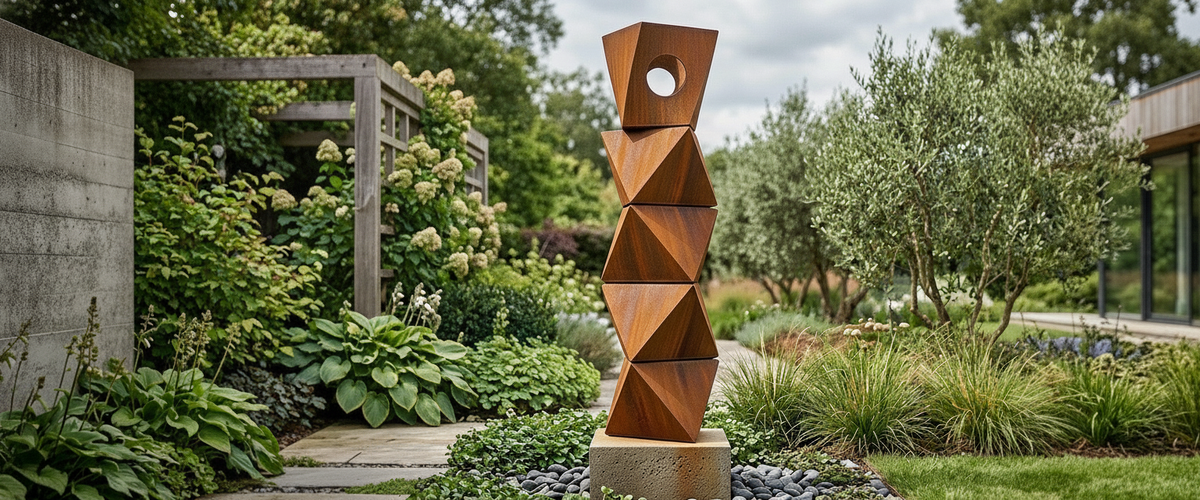
A stacked Corten column holding a three-walled courtyard.
Stacked Forms Read Upward: The Geometry That Does the Work
An abstract totem sculpture is a rhythm problem before it is a fabrication problem. Stack five identical cubes and you get a pillar nobody looks at twice. Vary the segment heights, rotate every second block a few degrees, pinch the waist near two thirds of the way up, and suddenly the eye has a reason to travel. The classic modernist lesson here is Brancusi's Endless Column, where repetition with slight variation reads as infinite rather than repetitive.
Three geometric moves do most of the heavy lifting. Rotation between sections creates shadow lines that change through the day. Taper narrows the top so the piece does not look top-heavy against sky. Void, meaning a gap or pierced section, lets light through and stops the column reading as a bollard. When clients send us a reference image they like and cannot explain why, it is usually one of those three doing the work.
Not every vertical abstract needs to be segmented, either. A single continuous form can achieve the same upward pull, and where the setting wants gesture rather than repetition, something like the Bronze Abstract Organic Wave Sculpture Brass - 91cm (about 3 ft) reaches the result from a plinth instead: the plinth supplies the height, the bronze supplies the movement. Totems and single forms are two routes to the same vertical answer, and the choice usually comes down to whether you want rhythm or a single sweep.

The Narrow Side Return, the Courtyard and the Awkward Border
We have shipped totems into places that would swallow anything else. A Napa hillside garden with a retaining wall problem, where the client needed something to interrupt a long run of board-formed concrete without eating terrace space. A Manhattan roof terrace with a strict point-load limit and a view corridor nobody was allowed to block. A Texas courtyard with four feet of usable ground between a pool coping and a boundary wall.
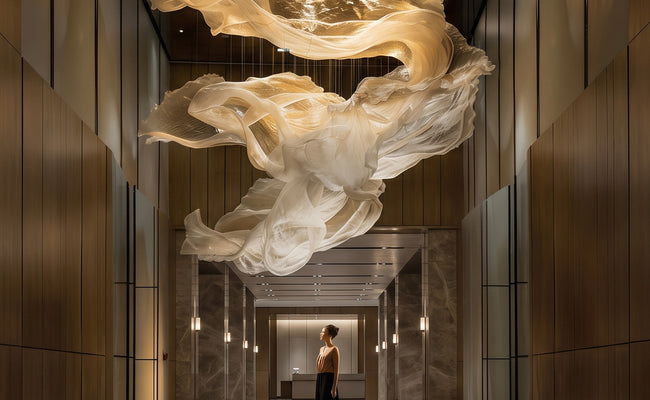
The pattern is consistent. An abstract totem sculpture earns its place where the ground plane is spoken for and the air is free. That includes stairwell voids and double-height entrance halls indoors, where a piece past six feet, on the order of the Dunhall Silver Abstract Sculpture - 191cm (roughly 6 ft 3 in), gives a lobby a vertical anchor without eating into circulation space. Outdoors, they also fix the winter problem: when perennials collapse, a vertical column is still standing there doing its job in February.
Corten, Bronze and Carved Stone Age in Three Different Directions
This is the decision buyers most often get wrong, because samples look nothing like year ten. An abstract totem sculpture is a thirty-year object, so judge the material on how it ages rather than how it arrives.
Corten
Weathering steel forms a stable oxide layer that slows further corrosion, and it does so only in environments with genuine wet and dry cycles. Permanently damp conditions, salt spray and sheltered spots that never dry out undermine the process, as the technical guidance on weathering steel sets out clearly. Plan for runoff staining in the first two years too; pale limestone paving under a new Corten totem will pick up orange tea-staining that is very hard to remove.
Bronze
Bronze is the long-horizon choice. An applied patina will shift with exposure, and a waxed piece in a coastal Hamptons garden will want attention more often than the same piece in Aspen. The American Institute for Conservation publishes sensible guidance on caring for outdoor bronze, and the short version is that annual washing and re-waxing beats occasional heroic restoration. The bronze abstract sculptures range is a useful way to see how patina choice changes the read of a form.

Carved Stone
Granite barely moves in a human lifetime. Limestone and marble soften at the arrises, collect lichen and gain character, which some clients love and others read as neglect. Be honest with yourself about which camp you are in before commissioning a carved stone totem.
Section Joints Are Where a Stacked Column Fails
An abstract totem sculpture is a column of dead weight sitting on itself, and the joints carry everything. The question to ask any supplier is simple: what runs through the middle? A sound stacked piece has a continuous internal spine, usually stainless steel, with each section located onto it and bedded rather than balanced. Dry-stacked blocks held by gravity alone are fine in a gallery and a liability outdoors.
Warning signs we tell clients to look for: visible mastic squeeze-out at the joints, mismatched section faces that leave a gap you can see daylight through, dissimilar metals in contact without isolation, and any hollow fabricated section without a drainage path. Water that gets into a stack and cannot get out will freeze, and freeze-thaw has split more sculpture than vandalism ever has.
Height Against Footprint: The Ratio That Keeps a Totem Upright
Slenderness is the whole appeal of an abstract totem sculpture and the whole risk. As a rough working principle, the taller and narrower the stack, the more the base and foundation have to do. A totem is effectively a sail; wind load rises sharply with height and exposed face area, which is why any piece over about eight feet (2.4 m) in an open site should be engineered to local wind criteria rather than eyeballed.
Practical outcomes look like this. A concrete pad sized well beyond the visible base. A galvanized or stainless base plate with resin anchors rather than expansion bolts in older masonry. Ballast built into the lower sections so the center of gravity sits low. On roof terraces, a load calculation agreed with the building engineer before fabrication starts. Our studio would rather redesign the bottom third of a piece than watch it get rejected at the approvals stage.
Vertical work reads best when it ends a view.
Site It on One Sightline, Not All Six
For wider placement ideas, Abstract Gold Face Sculpture: How to Read the Finish Before You Buy is useful companion reading before finalising the setting and sightlines.
The common mistake is centering an abstract totem sculpture in open lawn where it has to satisfy every angle and ends up satisfying none. Vertical work is at its best terminating a view: the end of a gravel path, the far side of a lap pool, framed by a doorway, or set against a hedge or dark wall that gives the silhouette something to bite into.
Distance matters as much as position. Stand back roughly three times the sculpture's height for your primary viewpoint and check the outline against whatever is behind it. Color choice follows from the same test. A saturated piece such as the Caldridge Blue Abstract Sculpture - 150cm (about 4 ft 11 in) needs a quiet background to hold its shape, while a dark bronze or weathered Corten column can take a busier planting scheme behind it.

Commissioning Checklist for an Abstract Totem Sculpture
Confirm the primary sightline and viewing distance before choosing height.
Measure the delivery route, including gate widths, overhead branches and crane or hoist access.
Ask what the internal spine is made of and how sections are located and bedded.
Check drainage on any hollow section and isolation between dissimilar metals.
Ask for aged reference images of the material, not just new samples.
Agree foundation design and wind criteria with an engineer for anything tall or exposed.
Plan the first year of care: wash, inspect joints, re-wax bronze as advised.
Request a tailored quote; budget depends on material, scale, complexity, engineering, installation and finishing, so a single number without those details is guesswork.
One note on language. The word totem carries real meaning in Northwest Coast Indigenous carving traditions, where poles record lineage and story. A contemporary abstract totem sculpture borrows the vertical stacked format, not the iconography, and it is worth describing your piece accurately when you talk about it.
If you are working out whether a stacked column or a single sweeping form suits your site better, the abstract sculptures and contemporary and modern sculptures collections are the fastest way to compare proportions at a glance. Giant Sculptures builds bespoke pieces to site conditions as well, so if nothing off the shelf fits your sightline, send us the measurements and a photo taken from where people will actually stand.