






































































































Take away the face, the hands and the feet, and most people will still tell you a sculpture is a woman. Take away the wrong curve and they will tell you it is a vase. Every female abstract figure sculpture succeeds or fails in that gap, and learning to see it is the most useful skill a buyer can bring to a piece that will stand in a garden or lobby for decades.

Key Takeaways
The hip, the shoulder and the tilt between them carry more identity than any facial feature.
Material changes how much detail can go. Bronze forgives, marble suggests and polished steel punishes.
The farther away the viewer stands, the more the sculptor can safely leave out.
Any serious commission should prove its reduction at maquette scale first.
Hip, Shoulder and Tilt: What Every Female Abstract Figure Sculpture Keeps
Reduction has an ancient pedigree. The marble figurines of the Cycladic islands, carved roughly 4,500 to 5,000 years ago, have folded arms, a ridge for a nose and almost nothing else. Yet nobody mistakes their gender. The Museum of Cycladic Art in Athens holds one of the finest groups. They work because they keep the ratios: the width of the shoulders against the swell of the hip, with breasts and pubic triangle marked in the lightest relief.
Cycladic figures stand rigidly frontal, so modern abstraction borrows a second cue from later Greek sculpture: the lean. A contrapposto shift of only a few degrees, with the weight resting on one leg, reads as a living body. Stand the same mass bolt upright and it reads as a column. This is the cue buyers overlook. When we review designs for a female abstract human figure sculpture, the first question in the studio is whether the hip-to-shoulder line still tilts. The head comes later.
Where Abstraction Tips into Blob
When a female abstract figure sculpture fails, it fails in a pattern. Remove the waist and the torso becomes a barrel. Fuse the legs without a hint of the gap between them and the base swallows the figure. Smooth over the neck and the head floats like a cap on a post. A piece can survive any one of these. Two together usually sink it.
Here is a quick test for any female abstract figure sculpture you find listed online. Cover the top third of the product photo with your hand. If the remaining shape still suggests a woman standing, the reduction is sound. If it suggests a tree stump or a bollard, the sculptor has cut something load-bearing.

Bronze Patina Lets a Reduced Form Shed Detail
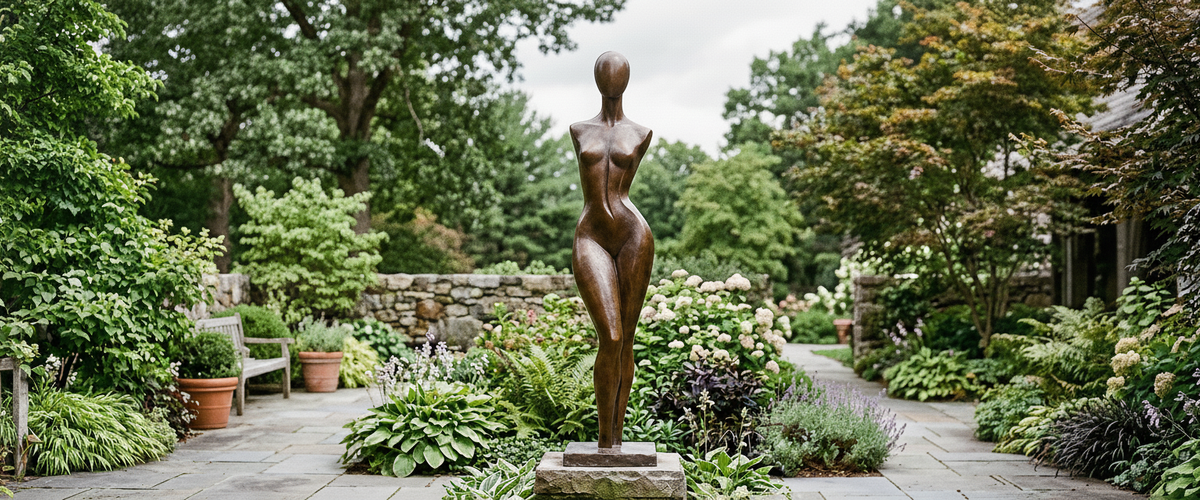
Bronze is the most forgiving material for abstraction, because the patina picks up the work the modeling has stopped doing. A chemically applied brown or verdigris pools in the hollows and wears thin on the high points, so a plain belly or a smoothed thigh still shows its planes under light. That effect holds even at close range: a reduced bronze such as the Modern Abstract Female Figure Bronze Sculpture - 100cm leans on its patina rather than on modeled anatomy, and still rewards a viewer standing beside it in a library, on a console or on a covered terrace. Outdoors, patina deepens with weather, so a reduced bronze often looks warmer in year ten than on delivery day. For that reason bronze remains our default recommendation for a female abstract figure sculpture headed outside. More examples sit in our bronze abstract sculptures.
Marble Translucence Can Stand in for the Face
Fine white marble lets light travel a short way into the stone before it scatters, which gives the surface a soft glow close to skin. That lets a carver remove the face entirely and still leave the head feeling inhabited. The catch is that translucence needs a slow, continuous surface. Sharp facets and heavy tool marks break the glow, so a heavily faceted marble figure is working against its own material. For exterior placement in freeze-thaw climates such as Aspen, ask about stone selection and drainage at the base before you ask about finish.
Polished Steel Strips Away the Most
Mirror-polished stainless steel is the most extreme reducer we work with. It reflects sky, hedge and viewer, so the figure's own contours compete with everything around it. In a busy garden a polished torso can vanish. The usual fix is to add form: deeper concavities, a stronger hip and a more pronounced tilt, so the silhouette survives the reflections. Dark matte metal goes the other way, because its surface throws nothing back and the outline stays crisp. Against a pale wall or in a gallery-white interior, a dark figure such as the Black Abstract Female Figure on Black Base Metal Sculpture - 139cm holds its silhouette where a polished torso would dissolve into the room.

Viewing Distance Sets the Limit
The rule we give landscape designers is simple: the farther the nearest viewing point, the more you can remove. A figure seen down a 60-foot (18 m) lawn needs little more than a silhouette and a lean. A figure in a hallway, seen from 4 feet (1.2 m), needs surface interest up close or it feels unfinished. The common mistake is judging a heavily reduced piece from across a showroom, then installing it beside a front door where every visitor passes at arm's length. Decide where people will actually stand before you decide how much the sculptor should leave out. For a long sightline across a courtyard or a Hamptons lawn, a figure at the scale of the Contemporary Abstract Female Figure Bronze Sculpture - 210cm still carries from the far end, where a tabletop-scale piece would shrink to an ornament.
Proving the Reduction at Maquette Scale
For a bespoke female abstract figure sculpture, Giant Sculptures works through a scaled maquette before anything is cast, carved or fabricated full size. We photograph it from the scaled equivalent of the real viewing distance, check it under low raking light, and then decide what else can go. Trimming a hip at maquette stage takes an afternoon. Changing it in full-size bronze means a new mold.
Buyer Checklist Before You Commit
Tilt test: does the hip-to-shoulder line lean, or does the figure stand bolt upright?
Hand test: cover the top third of a photo and check that a woman remains.
Material match: bronze for subtle planes, marble for soft continuous surfaces, polished steel only with a strong silhouette.
Distance: measure the nearest and most common viewing points before choosing scale.
Backdrop: set dark figures against pale walls or open sky, and polished ones against simple planting.
Commission route: ask to see maquette photographs and approve them before production starts.
Budget: cost depends on material, scale, complexity, engineering, installation and finishing, so request a tailored quote instead of comparing headline sizes.
A good female abstract figure sculpture leaves out a great deal and still holds onto the woman. Explore our wider abstract sculptures for reduced forms, compare them with the more literal pieces in bronze figures and statues, or talk to us about a commission sized to your own sightlines.
For wider placement ideas, The Same Large Metal Abstract Sculpture in Three Metals, Ten Years on is useful companion reading before finalising the setting and sightlines.