






























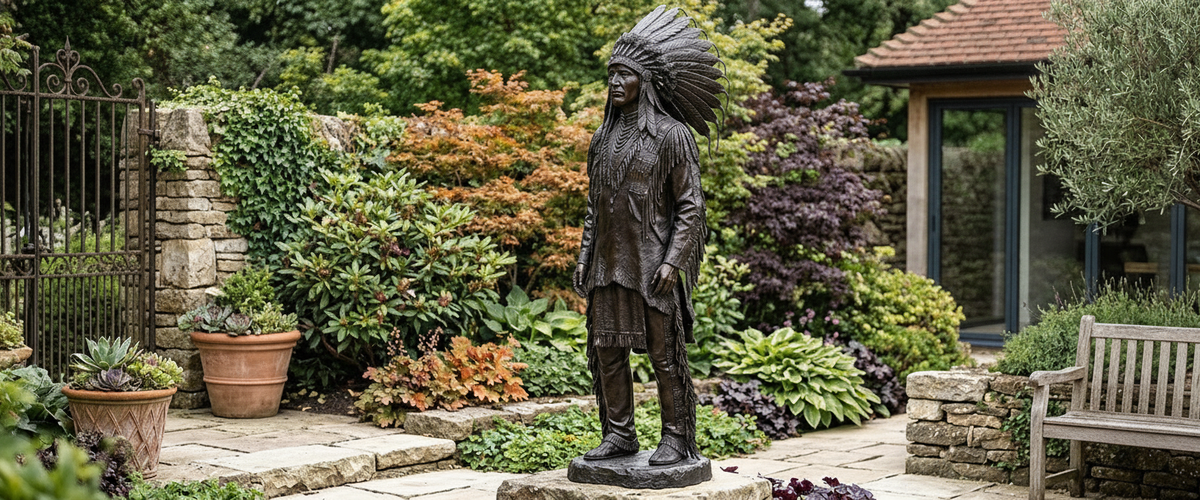

Most statues sold as "tribal" cannot tell you which tribe they mean. That gap decides whether a bronze tribal figural statue earns its place in a collection or ends up looking like set dressing from a theme restaurant. The difference shows in four places: the headdress, the costume, the surface of the metal and the color of the patina. A buyer who knows where to look can read all four in a few minutes.
Key Takeaways
"Tribal" is a marketing word. Ask which culture, period and sources a bronze tribal figural statue is based on.
Regalia should be consistent. The headdress, ornaments and garments should belong together.
Crisp, undercut feathers and beadwork usually point to lost-wax casting.
Dark brown patinas suit detailed regalia. High-polish gold flattens it.
Measure the ceiling with the plinth included before you commit to a tall figure.

What "Tribal" Means on a Bronze Figural Statue Listing
On a sales page, "tribal" describes a mood: feathers, bare shoulders, a spear, a hint of the frontier or the savanna. It rarely names a people, a region or a century. That vagueness is why so many figures pair a Plains-style war bonnet with West African body ornaments and a costume borrowed from a film. A serious buyer should start with a simple question: who is this, and how do you know? A good maker answers with a culture, a rough period and the references used. A weak one answers with adjectives.
Museums set a useful benchmark. The Smithsonian's National Museum of the American Indian presents regalia within the community it belongs to, with care over what is ceremonial and what is everyday dress. A bronze figure should hold itself to a similar standard.
Headdress and Regalia, Worn Correctly or Invented at Random
A bronze tribal figural statue with headdress and costume carries the most risk, because regalia has rules. Among many Plains nations, a feathered bonnet was earned and worn on specific occasions. It was never a generic hat. Beaded collars, arm bands and sashes sit in particular places and combinations. When a sculptor invents freely, the errors are easy to spot once you look for them: feathers splaying in every direction, a headdress floating above the skull instead of sitting on it, jewelry from three continents on one body.
Fit matters too. On a well-modeled figure the headdress has weight. The brow band presses slightly into the hair, the trailers fall with gravity, and the shoulders carry the drape of a robe or hide. These small physical truths make the figure read as a person. Without them it reads as a mannequin.
Costume Texture as Evidence: Lost-Wax and Sand Casting
The surface of the bronze tells you how it was made, and the method tells you how much detail survived. Lost-wax casting reproduces the wax model almost exactly, undercuts included, so individual feather barbs, the stitching on a hide garment and the raised dots of beadwork come through sharp. The technique has a long record in regalia. The cast plaques and heads from the Kingdom of Benin, many of them held by the British Museum, show how precisely court dress can be rendered in metal.
Sand casting suits broad, simple forms. Deep undercuts are hard to pull from a sand mold, though, so fine costume texture tends to soften or get simplified into shallow lines. Run a thumb along the edge of a feather. Sharp and layered usually means lost wax; rounded and slightly blurred often means sand casting or a worn mold. On a bronze tribal figural statue, our chasers spend more hours on headdress feathers than on the face, because that is where a casting most often loses definition.
Why Dark Brown Patina Suits Detailed Regalia
Patina decides how the detail reads from across a room. A dark brown or deep chocolate patina settles into the recesses and lifts slightly on the high points, so each feather and bead gets its own shadow. Polished gold does the opposite. Every surface throws back the same light, the texture disappears, and the figure starts to look like a trophy or a souvenir. Outdoors, a brown patina also weathers more gracefully, deepening slowly over the years.
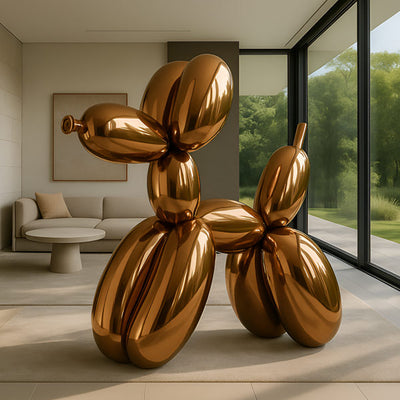
Gold still has a place on modern, abstracted figures with no regalia to flatten. On a stylized pose with smooth, simplified planes, a bronze-and-gold finish like the one on the Cranwold Bronze Figure Sculpture - 51cm, at 51cm (about 20 inches), can look deliberate rather than flashy, because nothing on the figure depends on fine surface reading. On a costumed bronze tribal figural statue, keep gold to a restrained, hand-rubbed accent.

Building a Bronze Tribal Figural Statue on Real Sources
For a bespoke bronze tribal figural statue, the research happens before the clay. At Giant Sculptures we ask clients which culture they want to honor and why. Then we build a reference file from museum photographs, historic photography and published ethnographies, with guidance from a cultural advisor connected to the community wherever we can arrange it. Advisors catch things a sculptor will miss, such as a pattern reserved for a particular role or a feather arrangement that should never appear on a public piece.
One lesson came from a ranch commission in Texas. The first concept sketch combined a headdress from one nation with a breastplate from another. The advisor flagged it within a day, we revised the maquette, and the finished figure is better for it. The fix cost a week. Getting it wrong would have cost the piece its credibility for good.
If honoring a specific people does not suit the brief, a figure inspired by a mood can be honest too, as long as it is presented that way. Pose and drape can carry a great deal of character without borrowed regalia, and the range of bronze figures and statues is a good place to see how far that approach can go.
Displaying a Tall Headdress With Dignity
Headdresses add height fast. A life-size bronze tribal figural statue of 6 feet (1.8m) can reach 7 feet (2.1m) at the tip of the feathers, and a 24-inch (61cm) plinth pushes it toward 9 feet (2.7m). We once rerouted a figure for a Scottsdale home because figure plus plinth would have cleared the entrance hall ceiling by only about two inches. It went into the double-height living room instead and looks far better there. As a rule of thumb, leave 18 to 24 inches (45 to 60cm) of air above the highest point.
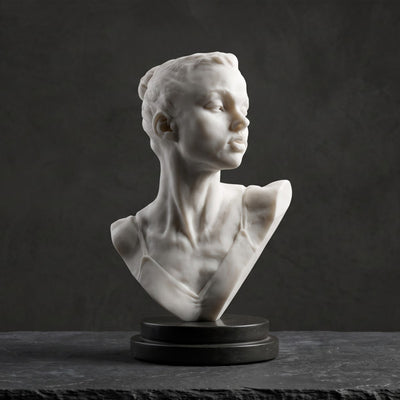
It helps to feel that height before committing. A freestanding vertical piece such as the Hazewold Bronze Abstract Sculpture - 209cm, at 209cm (about 6 feet 10 inches), is already close to a life-size figure in full headdress before any plinth goes under it, which is a sobering way to test a ceiling. Where the room simply cannot take that much height, the regalia can still be honored at head-and-shoulders scale: a tabletop bust around the size of the Ashgate Bronze Bust Sculpture - 35cm, at 35cm, sits on a console or pedestal and brings every feather and bead close to the eye.
Set the plinth so the face sits close to adult eye level, and light the figure from the side. Raking side light pulls shadow through feathers and fringe; flat front light erases them almost as badly as a gold finish. In a garden, place the figure where morning or late sun crosses it, and look through the bronze garden statues for a sense of outdoor scale and footing.

Buyer Checklist for a Bronze Tribal Figural Statue
Named source: the seller can state the culture, period and references.
Consistent regalia: headdress, ornaments and garments belong to one tradition.
Sharp casting: undercut feathers and beadwork, no blurred edges.
Patina: dark brown or deep bronze with controlled highlights, not all-over polish.
Height: figure, plinth and clearance all fit the room.
Lighting: a side light source is available, indoors or out.
Commission process: room for advisor input and maquette approval before casting.
Budget depends on scale, casting method, complexity, engineering, installation and finishing, so a tailored quote is the honest route. If you want a figure built on real sources, talk to Giant Sculptures about a bespoke commission, or compare surfaces and patinas across our bronze sculptures first.
For wider placement ideas, Best Bronze Tabletop Sculptures: What Holds up at Arm's Length is useful companion reading before finalising the setting and sightlines.