






































































































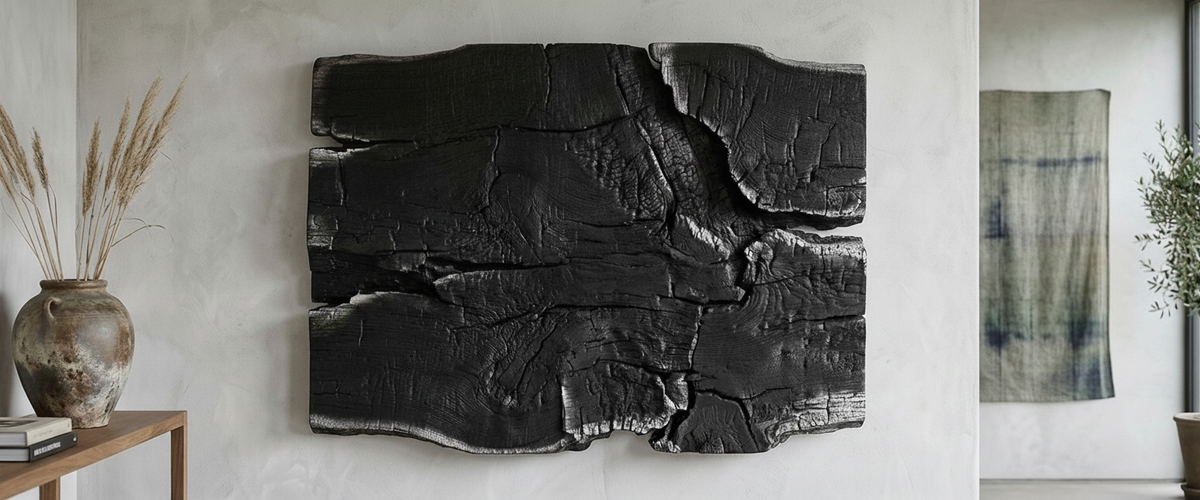

Most of what sells as wabi sabi wall art is beige, softly textured and finished last Tuesday. The palette is right. The idea is missing. Wabi-sabi art is about honest age: surfaces that show weathering, wear and repair because time actually happened to them. A spray gun set to "rustic" does not count. If you are buying a statement piece for a wall you will look at for 20 years, that difference decides whether it gets better with time or simply gets older.

Quick Answer
Wabi sabi wall art values impermanence, asymmetry and visible age. The point is a surface that changes.
Check listing photos for repeated cracks, evenly spread distressing and edges that are suspiciously crisp.
Favor materials that age for real: raw clay, charred timber, lime plaster, stone and unsealed metal patinas.
Ask to see the piece under low side light before you commit.
For commissions, brief the studio on how the surface should behave first, and on shape second.
What Wabi Sabi Wall Art Actually Asks For
The idea grew out of 16th-century Japanese tea culture, where masters such as Sen no Rikyū (1522 to 1591) favored rough, locally made ceramics over polished imported wares. The Metropolitan Museum's essay on the Japanese tea ceremony gives useful background on that shift in taste. Muted color was a side effect of honest materials, never the goal.
So a sun-bleached cedar board on a Montecito terrace qualifies as wabi-sabi. A gray-painted panel scuffed with sandpaper is just gray. Buyers who shop for wabi sabi wall art by palette end up with the second; buyers who start from material tend to end up with the first.

Factory Distressing Repeats Itself: Three Tells in a Listing Photo
Mass-produced "aged" wabi sabi wall art comes off molds and templates, and templates leave fingerprints. Zoom in on any listing and look for these:
Repetition. The same crack shape, pit cluster or drip appears at regular intervals, or across several pieces in the same range. Real weathering never rhymes.
Wear in the wrong places. Genuine age concentrates where water runs, hands touch and sun lands: edges, lower corners, the top lip. Factory wear is spread evenly across the face like seasoning.
Machine-clean edges and backs. A front that looks a century old sitting on a sharply routed edge or a spotless back panel tells you exactly where the aging stopped.
Materials That Age Into the Idea
Raw clay. Unglazed stoneware absorbs oils and moisture, darkens where it is touched and can throw a faint salt bloom. It changes slowly, which suits clay wabi sabi wall art in a living room better than on an exposed exterior.
Charred timber. Yakisugi-style charring protects the wood, then wears away unevenly, opening checks and drifting from black toward silver. Orientation sets the pace: a west-facing panel can turn pewter within a couple of years while a shaded twin stays close to black. That mismatch is worth keeping, not correcting. Our wood wall art collection is a good place to compare grain, depth and finish before you brief anything custom.
Lime plaster. Lime keeps curing as it absorbs carbon dioxide, hardening and shifting in tone for years. Repairs blend into the surface rather than sitting on it as patches. That is the opposite of kintsugi's gold seams, but just as honest.
Resin crackle. This is a cast photograph of age, and the most common shortcut in budget wabi sabi wall art. It may yellow, but it does not weather in any way that reads as honest, and the crackle pattern is usually the first thing to repeat.

Patinated Metal Earns the Name Only If the Patina Keeps Moving
Bronze, copper and Corten can all carry real wabi-sabi character, but only when the patina is allowed to keep working. A heavy lacquer freezes it on day one. Ask the maker what sealer, if any, has been applied, and whether a light wax that can be refreshed is an option.
Placement matters too. Corten on an open patio in Austin typically settles into a stable rust layer over roughly 1 to 3 years of wet and dry cycles, then keeps deepening slowly after that; the same panel in a dry, climate-controlled Manhattan loft barely moves and behaves like a finished surface. Neither is wrong, but with metal wabi sabi wall art you should know which one you are buying. Large metal panels also get heavy quickly, so plan structural fixings with your contractor before the crate arrives. For relief depth in metal and mixed media, browse our 3D wall art.
Raking Light Exposes a Fake Faster Than Any Close-Up
Hold a flashlight almost flat against the surface, at roughly 10 to 15 degrees, or view the piece at dusk with a single lamp off to one side. Real texture throws irregular shadows with genuine depth. Printed or shallow-cast texture goes flat, or reveals a rhythm you could not see head-on. When buying remotely, ask the seller for a short raking-light video; a good studio will happily send one.
The same trick tells you where to hang it. Put wabi sabi wall art on a wall perpendicular to a window, as in a Hamptons living room where morning light grazes across the plaster, and the surface does the work. Flood it with front-facing downlights and you erase it. As a starting point, center the piece about 57 to 60 inches (145 to 152 cm) above the floor, the standard gallery eye line, then adjust for furniture and ceiling height.
Buyer Checklist Before You Commit
Does the material age by itself, or is the age applied?
Is any patina open, waxed or lacquered?
Do marks repeat across the piece or the product range?
Is the wall rated for the weight, and who is fitting it?
Will the wall get side light, or only overhead light?
How much change can you live with in 5 years?
Can the surface be repaired visibly and gracefully if it chips?

Commissioning Imperfection: Brief the Studio on Surface, Not Shape
The most common mistake we see in bespoke briefs for wabi sabi wall art is a detailed sketch of the outline and one line about "organic texture." Flip that. Tell the studio how you want the piece to age, the room's humidity and light, whether people will touch it, and how much drift in color you welcome. Let the maker resolve the shape inside those terms.
At Giant Sculptures we treat large wall pieces the way we treat outdoor sculpture: material and exposure first. Budget depends on material, scale, complexity, engineering, installation and finishing, so the useful next step is a tailored quote rather than a guess. Start with our wabi sabi art collection to compare surfaces and materials, then use the wider wall art and wall decor range to sense-check scale against your room.
For wider placement ideas beyond wabi sabi wall art, Wood Wall Art for the Bedroom Is Judged From the Pillow is useful companion reading before finalizing the setting and sightlines.