

































































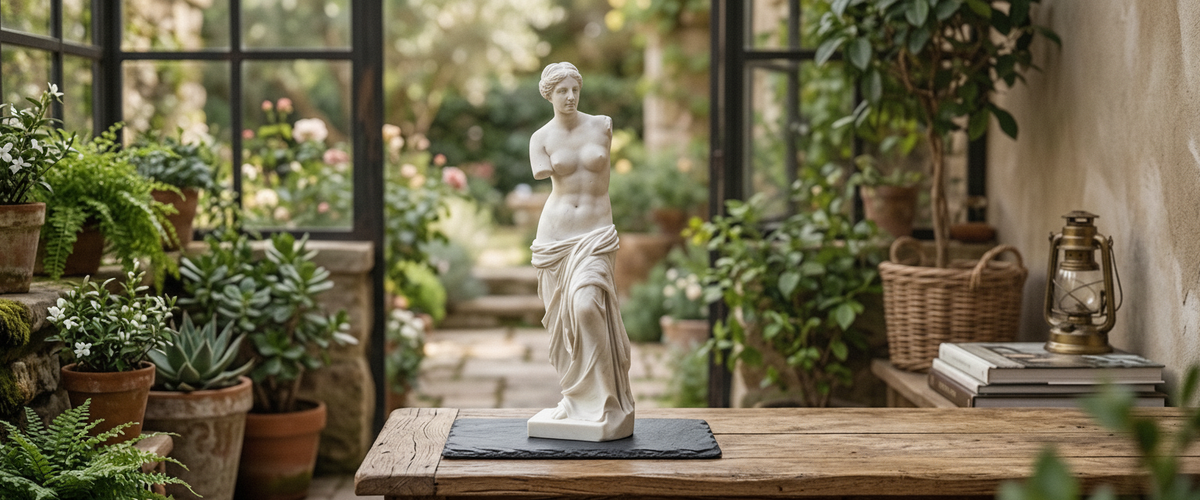

Shrink the Venus de Milo to bookshelf height and the knot of drapery at her hips goes soft long before her face does. That is the quiet problem with almost every Venus de Milo small statue on the market. Sellers often shorten the listing to "Venus de small statue," and the clipped name fits, because something always goes missing in the reduction. The proportions survive; the carving that makes the original read as flesh and falling cloth often does not. The Louvre original stands a little over 6 feet 8 inches (about 2.04m), and every inch you take away forces the maker to decide what to keep. This guide shows you how to judge a small copy of the Venus de Milo detail by detail and where she will actually look right once she is home.
At Giant Sculptures we spend most of our studio time on life-size and larger classical work. That is exactly why we notice what goes wrong when the figure gets small. Here is what to check first on any Venus de small statue reproduction, starting with the details that fail earliest.

At a Glance
Below about 24 inches (60cm), check the drapery knot first. It is the earliest detail to blur.
On a Venus de small statue, the broken shoulders should end in crisp, deliberate planes, not rounded stubs.
Bronze holds the finest folds at small scale. Bonded marble works if the mold is fresh. Cheap plain resin rarely does.
Around 12 inches (30cm), a good maker subtly deepens the brow so the face still reads.
If she needs to hold a room, a half-size or larger piece is usually the honest choice.
Below 24 Inches, the Drapery Knot Blurs First
The himation slung around her hips gathers in a twisted roll just below the navel, with deep channels of cloth falling to the plinth. On the full-size marble those channels are cut inches deep, so shadow does the modeling. Reduce the figure by two thirds and the same channels shrink to a few millimeters. Molds struggle to release undercuts that tight, so on a typical Venus de small statue the knot arrives filled in and smoothed over. You get a soft sausage of stone where there should be a twist.
On a well-made small copy you can still see where one fold passes behind another.
Look at close-up photographs of the knot before anything else. If you cannot see where one fold passes behind another, the rest of the carving has almost certainly been simplified too.
Why the Broken Shoulders Need Sharper Edges
Her missing arms are part of her identity, and the breaks carry more information than buyers expect. On the original, the arms stop at uneven, angular fractures just below the shoulders, and those surfaces catch light as hard planes. The figure spent centuries in the ground on Milos before its discovery in 1820, a history well documented on the Louvre collection record, and the breaks are the visible proof of that past.
A crisp break reads as an ancient fragment; a rounded one reads as a mannequin.
On a Venus de small statue, the fractures tend to get rounded by casting and over-polishing into something closer to a mannequin than an ancient marble. A skilled finisher sharpens the edges slightly beyond what a mechanical reduction produces, because a crisp break is what tells the eye this is a fragment of something larger.

Marble Dust, Bonded Resin or Bronze: Which Holds a Fold?
Material matters more as the figure shrinks, because on a Venus de small statue the finest detail starts competing with the grain of the material itself.
Bronze. Lost-wax bronze reproduces fingertip-sized folds with the least loss, and a patina settles into the channels and deepens their shadow. It is also the only material we would trust on a covered porch or courtyard at this size.
Bonded marble. Marble dust set in resin takes detail well from a fresh mold and has the cool weight of stone. The catch is mold wear: edges soften with every pull, so ask how established the mold is.
Plain resin. Light and inexpensive to produce, with detail that varies wildly. Fine for a desk, not for a Venus de small statue collectors plan to keep for decades.
Carved marble. Hand-carving a tiny fold is possible but slow, and the crystal size of some marbles makes small drapery look sugary. Carved stone comes into its own at larger sizes: on a full-height figure such as the Venus de Milo Marble Sculpture, 180cm (about 71 inches), the channels are cut deep enough to hold shadow from across a room, which is precisely the effect no tabletop copy can reproduce.
At 12 Inches, the Face Needs a Deeper Brow
For a 12-inch (30cm) Venus de small statue, the head is barely an inch high. A faithful reduction produces a face that reads as a smudge from more than arm's length, because the original relies on shallow transitions around the eyes and mouth. The better small copies cheat, slightly. The brow ridge is deepened, the eye sockets pushed back a touch, the corners of the mouth given a firmer line. Our carvers call this drawing for distance, and we apply the same logic in reverse on oversized commissions.
One client in Austin, who later commissioned a larger figure from us for a library niche, sent photos of the small copy she had bought first. Under recessed downlights, the face on that Venus de small statue, her most famous feature after the arms, disappeared entirely. A deeper brow would have saved it.
Where a Small Venus de Milo Statue Actually Works
A small Venus de Milo statue wants to be seen at close range and slightly below eye level: a library shelf, a console in a Manhattan entryway, a lit wall niche. Side light from a window or a directional spot flatters the drapery far more than overhead cans. Avoid tall pedestals in big rooms; a 20-inch figure on a plinth in a double-height Texas living room simply looks lost. Outdoors, only bronze makes sense at this scale; a Venus de small statue in bronze suits a sheltered corner of a Napa terrace better than the middle of a lawn.
How to Read a Venus de Milo Small Statue Listing
Search for a Venus de Milo small statue for sale and you will find hundreds of near-identical photos. Use this checklist before you commit to any Venus de small statue; sellers rarely volunteer these details:
Seams: check the sides of the torso and inside the drapery for mold lines. A well-finished piece has them chased out.
Polish: skin should be smoother than cloth. If everything shines equally, the finisher took a shortcut.
The knot: insist on a close-up. No close-up, no purchase.
Shoulder breaks: crisp planes, not rounded lumps.
The base: it should echo the original's rough, sloping plinth, sit in proportion to the figure, and carry enough weight that she will not tip when dusted.
Material wording: marble and bonded marble are different things. Ask which you are getting.
Weight: ask for it in pounds. It tells you more about the material than the description does.

When a Half-Size Piece Is the Honest Choice
There is a point where shrinking stops being a sensible compromise. If the figure is meant to anchor a room, close a garden path or read from across a hotel lobby, a Venus de small statue (or any small figure) will disappoint however well it is made. Around 3 feet (roughly 1m), the drapery and face hold without any cheating at all.
If the Milo pose feels too familiar at that size, Canova's more private, drapery-clutching figure is worth considering; at about 47 inches, the Venus Italica Marble Sculpture, 120cm reads clearly from a doorway without overwhelming a library or stair landing.
Where the setting is a pool terrace or water garden in the Hamptons rather than an interior, a bathing pose such as the Venus Bathing Marble Sculpture, 160cm makes more narrative sense beside water than the standing Milo, and at that height carved marble carries its detail comfortably outdoors.
Giant Sculptures makes bespoke classical figures to the size a space actually needs, and we are happy to talk through whether you want a 20-inch Venus de small statue or a 6-foot figure. Explore our Greek and Roman statues or the wider classic sculptures collection, then request a tailored quote. Budget depends on material, scale, complexity, finishing and installation, so we price each commission on its own terms.
For wider placement ideas, Venus De Milo Marble Sculptures and the Quarter-turn Most Homes Get Wrong is useful companion reading before finalizing the setting and sightlines.