





























































Most people judge a marble statue group from the photograph the seller chose, which is the one view the carver worked hardest on. That is exactly the wrong place to start. A group is a three-dimensional argument between figures, and it either holds together from every approach in your garden or it falls apart the moment you walk past it. Learning to read joins, struts, undercutting and grain takes minutes, and it separates a piece you will still admire in twenty years from one that looks tired by the second summer.

Key Takeaways Before You Shortlist
Joins are not automatically a fault. Assembled groups are normal at scale; badly disguised joins across a face or a shoulder are the problem.
Every marble statue group has one governing view. Find it, then check whether the other three sides still earn their keep.
Arms and drapery are where weak carving confesses. Thick wrists, fused fingers and clumsy support struts are the tell.
Judge undercutting in hard overhead light. Midday sun shows whether there is real air between the figures.
Grain matters. A gray vein running diagonally through a face will always draw the eye before the modeling does.
Plinth height is a design decision, not a delivery detail. Set it from your main approach, then check walk-around clearance.
One Block or Assembled: The Joins That Tell You Which You Are Looking At
A large marble statue group carved from a single block is rare, and for good reason: the block has to be flawless, oversized and expensive to quarry, and one hidden fissure can destroy months of work. Most groups above roughly 5 feet (150 cm) are carved in sections and assembled with stainless steel dowels and structural adhesive. Done well, you will struggle to find the seam without running a fingertip along it. Done badly, you get a hairline running through a cheek or across a collarbone where the eye naturally travels.

A well-placed seam disappears into the shadow of a fold.
Look for joins in the places a carver would deliberately choose to hide them: under drapery folds, at the base of a neck behind hair, inside the shadow where two bodies overlap, or at a plinth line. Joins placed in the open, on a thigh or a shoulder, say the piece was cut to suit the stone available rather than the composition. Ask any supplier, including us, where the sections of a marble statue group meet and what the pins are made of. Ferrous pins in an outdoor group will eventually rust-jack the stone apart, which is one of the more expensive lessons in garden sculpture.
The Three Graces Test: Every Group Has One View That Carries the Composition
For wider placement ideas, Why a Turning Torso Marble Sculpture Needs a Bigger Block Than You Think is useful companion reading before finalising the setting and sightlines.
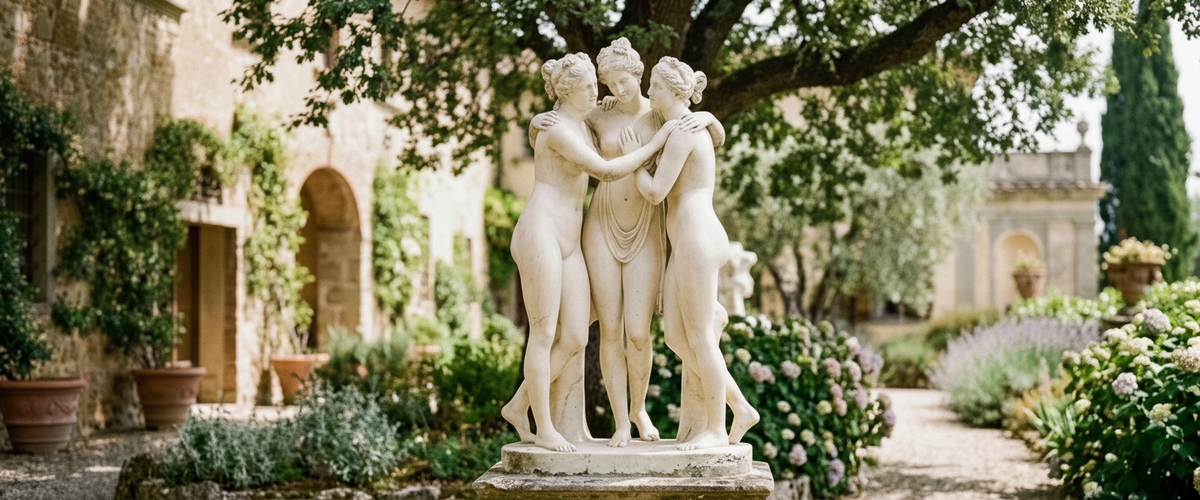
Antonio Canova's version of the subject, jointly owned by the National Galleries of Scotland and the V&A, is the benchmark most carvers measure themselves against, and it demonstrates the test. Three figures lean inward, arms interlocking, heads tilting toward a shared center. From the front, the sculpture reads as one form with a rhythm running through it. Step 90 degrees and the rhythm should change, not collapse.
The rear view of the 230 cm Three Graces, fully carved and modeled.
Apply that to any marble statue group of the Three Graces you are considering. Rotate the piece, or ask for photographs at 0, 90, 180 and 270 degrees. A strong marble statue group gives you a new relationship at each turn: one figure withdrawing, another opening, a limb crossing a void. A weak one gives you a single good view and three arrangements of backs. Scale decides how much this matters: at roughly 7 ft 6 in, The Three Graces Marble Sculpture - 230cm sits in open ground and gets walked around, so the secondary views carry as much weight as the front. A 100 cm version tucked into a terrace corner is read from a narrower arc, and can be judged accordingly.

Arms, Drapery and Hidden Struts: Where Weak Carving Gives Itself Away
Marble has almost no tensile strength, so in any marble statue group a raised arm or an extended hand has to be supported or thickened. Skilled carvers hide the support: a fall of drapery, a tree stump, a lyre, a fold that happens to touch a wrist. Less skilled work simply makes the forearm heavier than nature allows, and once you notice it, you cannot unsee it. Check wrists, ankles, fingers and any extended attribute. Fingers should be separated with real space between them, not suggested by grooves.
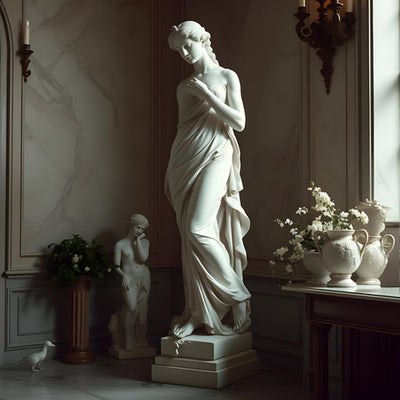
Drapery is the second confessional. Good carving shows cloth with weight and direction, with deep folds that go somewhere and thin edges that catch light. Flat, symmetrical, parallel folds mean the carver was copying a shape rather than describing fabric. Allegorical groups place the heaviest demand here: in something like the Four Seasons Group Marble Statue at 220 cm, four figures wearing four distinct treatments of cloth is the entire subject, so any slackness in the folds undoes the piece before you reach the faces.
Undercutting and the Air Between Figures, Judged at Midday
Undercutting means cutting behind a form so light passes through and shadow defines the edge. It is slow, risky work, and it is the first thing dropped when a workshop is racing. Photograph or view the marble statue group in hard overhead light. Real gaps between shoulders, between an arm and a torso, between two heads, will throw crisp shadows. Shallow relief pretending to be a gap will flatten into gray mush at noon. In a Texas courtyard or on an Aspen terrace with strong high sun, that difference decides whether the piece looks carved or molded.
When a Vein Runs Through a Face
White statuary marble is never perfectly uniform, and a soft gray vein through a hip or the folds of a robe can be beautiful. Through a face, it is a scar. Ask for close photographs of every head before you commit, and look at how the veining sits relative to the leading lines of the marble statue group. Grain also affects durability: marble is calcitic and slowly dissolves in acidic rain, and conservation guidance from Historic England explains why exposed carved detail weathers faster than flat surfaces. For coastal or high-rainfall sites, that argues for denser stone, a sheltered position, and annual inspection of upward-facing details where water sits.
The Back View Most Buyers Never Check
We once shipped a group to a Hamptons garden where the intended viewpoint was the terrace, but the path guests actually used ran behind the planting. The client saw the back of the piece several times a day for weeks before mentioning it. The back was properly finished, which saved the installation, though it did force a rethink of the approach. The back of a marble statue group should be fully carved: hair rendered, spines modeled, drapery continued. If a supplier's photography avoids the rear entirely, that is your answer. This holds even for pieces destined to sit tight against planting or masonry. A group at around 4 ft 11 in, such as Zeus Athena and Victory Marble Group Sculpture - 150cm, is often set against a hedge or wall, and the three-quarter rear view stays in play even if the true back never does.

Plinth Height and Walk-Around Clearance
Set plinth height from your main approach, not from a showroom photograph. If people meet the group from below, on steps or a sloping lawn, a tall plinth throws the heads back and you lose the faces. On a flat lawn viewed from 30 feet (about 9 m), lifting the piece 18 to 24 inches (45 to 60 cm) usually recovers the silhouette against planting. Then walk the perimeter. A marble statue group needs more clearance than a single figure because the composition only resolves at certain angles, and you need room to find them. Leave enough space that a person can pass on all viewable sides without brushing the stone.
Quick Checklist for Buying a Marble Statue Group
Ask where the joins are and whether pins are stainless steel.
Request photographs from four sides plus close-ups of every face.
Check fingers, wrists and ankles for separation and proportion.
Identify support struts and judge whether they are disguised or dumped in.
View or request images in strong overhead light to test undercutting.
Look for veining crossing faces, hands or the composition's leading lines.
Confirm the back is fully carved, not blocked out.
Decide plinth height from the real approach line and sight height.
Confirm base loading, access route and lifting method before ordering.
Ask for a written specification covering stone type, finish and fixing method.
Commissioning a Group Rather than Buying from Stock
Bespoke work makes sense when the site dictates the answer: a specific height to clear a hedge line, a fourth figure, a family subject, a pose adjusted so the governing view faces your terrace rather than the driveway. At Giant Sculptures we work through maquettes and scaled drawings first, then agree the carving sequence and join strategy before stone is cut. Budget depends on scale, stone selection, the number of figures, the amount of undercutting, engineering for the base and the installation itself, so the sensible route is a tailored quote against a real site plan. Working through the wider marble sculptures range is the quickest way to fix your subject and scale before you send us the approach photographs. The marble statue group you end up with should reward the walk around it.