





































































































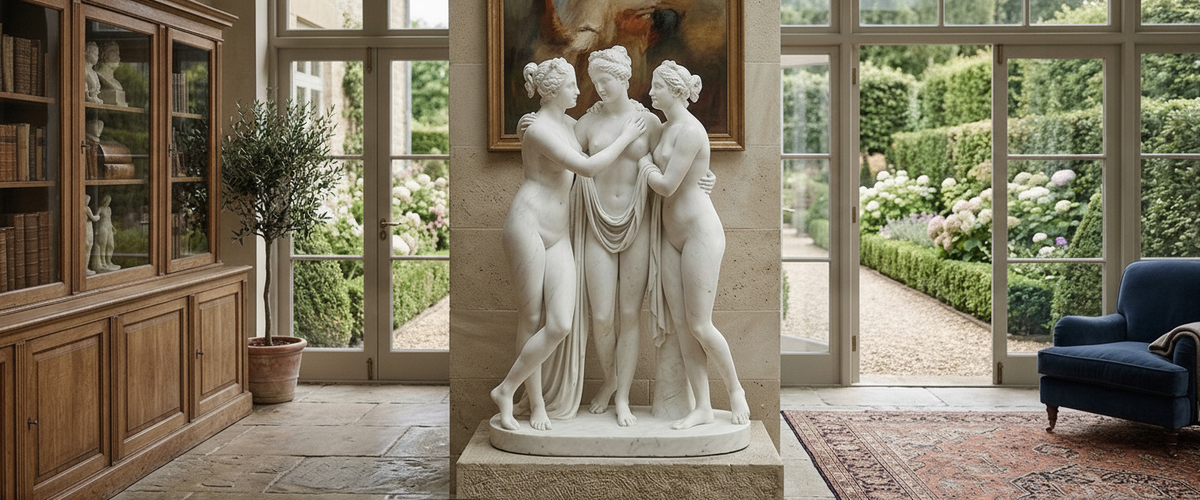

Three bodies, six arms and almost nowhere for a chisel to go. Of every classical group you can order in stone, the marble statue Three Graces group separates serious carving from souvenir work fastest. Faces can be flattered in a photograph. Interlocked limbs cannot. This guide shows how to tell a skilled copy from a weak one: which original it follows, where the joins hide, what the gaps between the figures give away, and how to judge a piece before you pay. Our studio has carved the group at several scales and assessed plenty of older copies for clients, and the same weak points come up every time. Check them before you commit to a marble statue of the Three Graces for a hall or a garden terrace.

At a Glance
Identify the model first: every marble statue Three Graces copy follows Canova, Thorvaldsen or the antique Roman type, and they look very different once you know the tells.
Expect some joins: at larger sizes, pieced arms are normal. Hidden, well-pinned joins are the goal.
Judge the gaps: the negative space between hands, hips and drapery shows the carver's skill more honestly than any face.
Plan for 360 degrees: this is a group made to be walked around, so placement against a wall wastes half of it.
Never buy from photographs alone: ask for raking-light shots from every side, or see it in person.
Why Interlocked Arms Make the Three Graces So Hard to Carve
Most figure sculpture lets the carver work steadily from the outside in. The Graces complicate that. Arms wrap across shoulders and waists, so the stone between them must be removed through narrow openings, often from behind. One slip inside an embrace means a broken forearm with no spare marble to recut it from. That is why cheaper workshops thicken the arms, fuse the hands into the torsos, or leave lumpy bridges of stone where the figures touch. The result reads fine at ten paces and clumsy at two, which is exactly why a bargain marble statue Three Graces copy so often disappoints once it is uncrated.
Canova, Thorvaldsen or the Antique Type: Which Original Is Your Copy Following?
The antique type, known from Roman copies of a Hellenistic model, is the easiest to spot on any marble statue Three Graces piece: the two outer figures face you while the central Grace turns her back. It is a flatter, frieze-like arrangement with little overlap.
Antonio Canova's version, carved in the 1810s for the Duke of Bedford and now jointly owned by the V&A and the National Galleries of Scotland, turns all three inward into a close embrace, with a single scarf of drapery running between them and a small garlanded altar at one side. Bertel Thorvaldsen's answer, held at the Thorvaldsens Museum in Copenhagen, stands the women more upright and places a small Cupid at their feet. Most modern marble statue Three Graces versions follow Canova, largely because his linked hands and shared drapery reward close viewing in a way the flatter antique arrangement does not.
Canova's arrangement turns all three figures inward, so the linked arms and shared drapery carry the whole composition.

One Block or Pieced Together? Finding Joins, Dowels and Hidden Struts
Carving a large marble statue Three Graces group from a single flawless block is rare and not always wise. Good marble workshops, historic and modern, often carve an extended arm separately and pin it with a dowel. Look for a fine hairline at the shoulder or wrist where the vein pattern jumps slightly. On older copies, rust-colored staining around a join usually means an iron pin is corroding inside, and that joint will eventually crack. Modern commissions should use stainless steel pins.
Struts are the other thing to find. Carvers leave small marble bridges, called puntelli, between a hanging hand and a thigh to stop it snapping in transit. On a fine marble statue Three Graces copy they are few, tucked out of sight and cleanly shaped. On a poor one they are everywhere.
Tool Marks, Weathering and Base Moldings That Date a Vintage Copy
Nineteenth-century marble statue Three Graces copies were usually made with a pointing machine, and the small drilled measuring points sometimes survive in hollows under the arms. Claw-chisel hatching on the back of the base and rasp marks inside the drapery folds are normal on hand-finished work. A surface that is uniformly glassy everywhere, including places no one would ever see, can point to heavy machine finishing. Outdoor weathering adds evidence: gray sugaring on the upward-facing shoulders is hard to fake convincingly. Base moldings help too. A crisp Neoclassical ovolo profile suits a period copy, while a generic rounded plinth often belongs to recent export work.
The Gaps Between the Figures Are the Real Test
Here is the studio observation we repeat most often: the negative space is finished last and tells you everything. On our own marble statue Three Graces commissions, the carvers finish between the fingers and under the linked forearms with rifflers barely wider than a pencil. If you can see daylight between a hand and a hip, and the fingertips have real separation, the copyist knew what they were doing. If the gaps are filled, blurred or left rough while the faces are polished, time ran out where it mattered. Compact versions are the harder test, because tight gaps at small scale are more difficult to carve cleanly than generous ones.
Clear daylight between fingertips and hips is the most reliable sign of a skilled copyist.
Walk the Group Round in Raking Light Before You Trust Any Photograph
Straight-on studio photography flatters marble. Raking light, held low and to one side, shows every filled crack, thickened limb and patch repair. We once had a collector in the Hamptons send six photographs of an auction lot. We asked for a seventh from behind in afternoon sun, and it showed a filled break running through the central figure's wrist. Ask for the back view and at least two three-quarter views of any marble statue Three Graces lot before you pay a deposit.

Choosing and Placing a Three Graces Marble Statue: A Buyer's Checklist
Sightlines: give a marble statue Three Graces group clear space on all sides, ideally at the center of a room, an open courtyard or a garden roundel.
Plinth height: raise it so the linked hands sit near eye level. That is where the carving earns its keep.
Climate: marble does well in Napa or Southern California. In freeze-thaw country such as Aspen, plan winter covers, or consider cast bronze: a group such as the Large Classical Three Graces Bronze Sculpture, 220cm keeps the classical embrace while shrugging off hard winters that would stress stone.
Scale to setting: compare the group's height against doorways, ceiling heights and planting at maturity. A double-height entrance or formal garden axis can carry a full-height Canova-type group like The Three Graces Marble Sculpture, 230cm, where the drapery and linked hands have room for real depth. For a library, stair landing or intimate courtyard, a smaller marble statue Three Graces piece such as The Three Graces Marble Sculpture, 100cm keeps the embrace legible without crowding the space, though it is worth checking the finish between the fingers closely at that size.
Access: confirm crane, forklift or hand-truck routes before delivery, not on the day.
Budget: cost depends on marble grade, scale, carving complexity, pinning, crating, shipping and installation. Request a tailored quote rather than comparing headline figures.
If you want a different stone, pose or scale for your marble statue Three Graces commission, Giant Sculptures carves bespoke versions to order, and our wider marble sculptures and garden statues collections show how groups sit alongside single figures.
For wider placement ideas, Garden Deer Statues Resin: What Lasts Outdoors and What Quietly Fails is useful companion reading before finalizing the setting and sightlines for a marble statue Three Graces group.