





































































































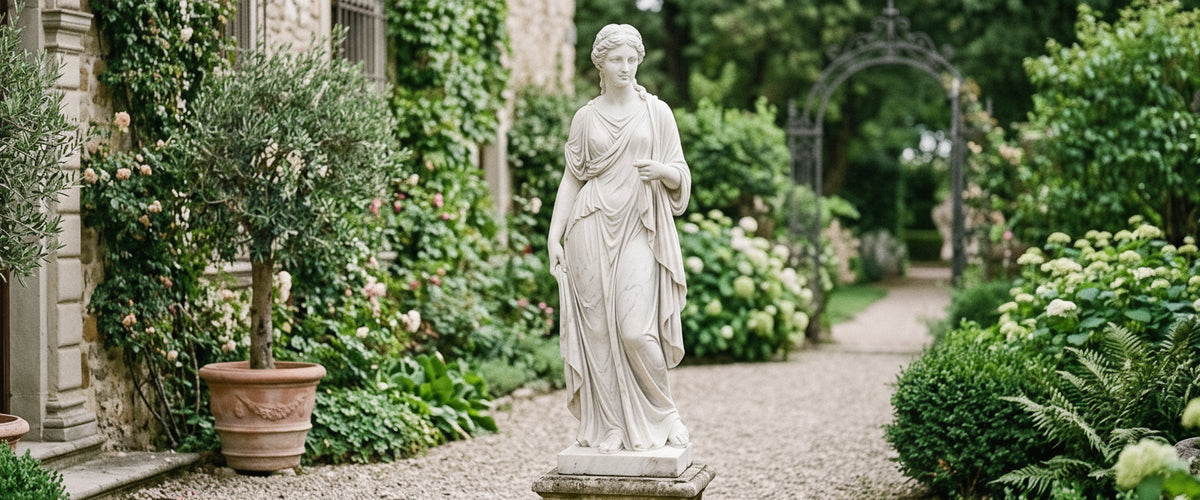

Most people searching for a marble sculpture quyang piece do not realize they are looking at the output of a single carving town in northern China, one that has produced hand-cut stone figures for centuries. Quyang County built its reputation on skilled chisel work, and a lot of the marble statuary sold worldwide, including figures branded under names like Blue Ville Landscaping Sculpture Co, traces back to that tradition of hand carving. The name has become shorthand for a style: classical figures, cherubs, lions, fountains and busts, cut from white or lightly veined marble.
The trouble is that "Quyang" tells you where a piece was likely carved. It does not tell you whether the stone is sound, the proportions are right, or the finish will survive a hard winter. That is what this quyang marble sculpture guide sorts out.

Marble Sculpture Quyang at a Glance
- What it is: hand-carved marble statuary in the Quyang tradition, usually classical or decorative in subject.
- Best for: buyers who want the look of carved stone; figures, fountains, busts, garden ornament and lamp-holding pieces.
- Judge it on: stone density, carving crispness, veining, finish and how the piece is scaled to its setting.
- Watch for: filler-patched cracks, soft detail, and marble that stains or spalls outdoors in freeze-thaw climates.
- How to buy well: ask for close photos of stone and joins, confirm dimensions and weight, and commission a quyang marble sculpture when you want a specific size or subject.

What Is Marble Sculpture, and Who Does the Quyang Style Suit?
So what is marble sculpture in the first place? Marble is a metamorphic stone, limestone recrystallized under heat and pressure, which is why it holds fine detail and takes a polish. The crystalline structure of marble is also what makes it vulnerable: acidic rain and repeated freezing can open the grain over decades. Quyang carvers work this stone the traditional way, roughing out mass with heavier tools and refining faces, drapery and hands by hand. A marble sculpture quyang studio produces still relies on this method.
A carved figure in this tradition suits a buyer who wants the classical language of stone: a draped figure, a pair of guardian lions, a cherub fountain, a portrait bust. Some of the most famous marble sculptures in Western art, from Renaissance nudes to Baroque saints, share this same vocabulary. If your taste runs to polished stainless steel or weathering Corten, this is not your material. But for a formal garden, an entrance court, or a hotel lobby that wants gravity, hand-carved stone still does something machine-cut resin never will. Pieces branded under a marble sculpture quyang Blue Ville Landscaping Sculpture Co label sit squarely in this camp.

How to Compare Options Before Buying
Two figures can look identical in a thumbnail and be worlds apart in the flesh. Here is what actually separates a good carving from a mediocre one when you shortlist a quyang marble sculpture.
Stone quality and veining
Ask what marble is being used. Whiter, denser stone with tight, even grain holds detail and resists staining better than soft, chalky stone. Light gray veining is normal and often desirable; heavy fracture-like veining can be a weakness waiting to open. Request raw daylight photos rather than filtered studio shots.
Carving crispness
Look at the hard parts: fingers, eyelids, curls of hair, the edge of drapery where it folds back on itself. Crisp, confident cuts signal a skilled hand. Soft, blurry transitions often mean the piece was rushed or that filler was used to hide a flaw. A well-carved marble sculpture veil effect, where stone is worked thin enough to suggest fabric over a face, is one of the clearest tests of carving skill; it is genuinely hard to do and separates real craft from production work.
Joins, repairs and bases
Large figures are often carved from more than one block. Ask where the joins are and how they are pinned. A discreet join at the ankles of a striding figure is normal engineering; a filled crack across a face is not. Confirm whether the base is integral or separate, and how the piece is doweled to it. A quyang marble sculpture built from clean blocks ages far better.

Key Materials, Finishes and Scale Decisions
Marble takes several finishes, and the choice changes the mood of the piece. A high polish reads formal and reflective; a honed matte finish reads softer and older; a lightly tooled surface keeps the mark of the chisel and reads more sculptural. For outdoor work in a wet or freezing climate, a honed finish tends to weather more gracefully than a mirror polish, which shows etching sooner. Finish choice matters as much on a quyang marble sculpture as on any other stone.
Scale is where buyers most often misjudge. A figure that commands a studio floor can look lost on a wide lawn or against a tall facade. We shipped a classical figure to a client with a long driveway who had measured the plinth but not the sightline; from the road it read as knee-high because the surrounding oaks dwarfed it. The fix on the next quyang marble sculpture commission was to size up by roughly a third. As a rough rule, a freestanding garden figure wants to be at least 6 to 7 feet (1.8 to 2.1 m) tall to hold its own in open ground.
Lamp-holding figures are a Quyang specialty and a smart way to add both light and sculpture at once. For an evening focal point on a terrace, a piece at a domestic scale such as the Cherub Group Two-Arm Lamp Marble Sculpture - 250cm holds proportion without overwhelming the space, whereas the center of a formal parterre asks for the extra height and reach of the Classical Lady Five-Arm Lamp Marble Sculpture - 300cm. When marble is paired with metal, as in a Large Traditional Striding Bull Bronze Sculpture (Marble Base) - 120cm, the stone does the grounding work and the bronze carries the movement.
Where to Place a Carved Marble Figure for the Strongest Impact
For wider placement ideas, Buying an Italian Marble Sculpture: How Placement Decides Everything is useful companion reading before finalizing the setting and sightlines for your quyang marble sculpture.
Marble likes to be seen against contrast. White stone glows against dark yew hedging, weathered brick, or a still reflecting pool. Set the same figure against a pale rendered wall and it disappears. Indoors, a portrait bust or a small draped figure earns its keep on a console in an entrance hall, at eye level, where the carving detail actually reads.
Three placement habits worth stealing:
- Frame the approach. Paired figures or lions flanking steps or a gate give a formal entrance real ceremony. Our lion statues are a common request for exactly this.
- Give it a stop. Place a single figure at the end of an axis, a path, allée or sightline, so the eye travels to it. This is the oldest trick in classical garden design and it still works.
- Mind the ground. Marble outdoors should sit on a drained, level footing, not directly on wet soil. Standing damp is what starts staining and spalling.
Budget, Commissioning and Delivery Considerations
Pricing is not a fixed number, and anyone quoting you a flat figure sight unseen is guessing. Cost of a quyang marble sculpture is driven by the grade of stone, the size and weight, the complexity of the carving (a plain urn is worlds cheaper than a multi-figure group with pierced drapery), the finish, and then crating, freight and installation. A large piece can weigh well over a ton, so shipping and rigging are real line items, not afterthoughts. The honest advice is to describe your subject, size and setting and ask for a tailored quote.
Commissioning a quyang marble sculpture is worth it when you want a specific size, a subject that is not in the catalog, or a matched pair. At Giant Sculptures we brief the carving studio with references, agree proportions and finish, and review progress photos at the clay or rough-block stage so surprises get caught early. Lead times run to months for hand-carved work; that is the nature of the craft, and rushing it is how detail gets lost.
How Giant Sculptures Helps With Bespoke Marble Projects
We specialize in large-scale and bespoke sculpture, so most of our stone conversations start with a difficult question: how big, how heavy, how do we get it there, and how will it survive the climate it is going to. We advise on stone selection and finish for the site, engineer the base and fixings for the weight, and manage crating and worldwide freight. A marble sculpture quyang carvers hand-cut can be spectacular value, but only if it is matched to the right setting and specified with care. If you are weighing marble against bronze or stainless steel for a particular spot, we will say so honestly rather than sell you the material you asked for by default.
Browse the marble sculptures and statues collection to see the range of figures, busts and fountains, or start a quyang marble sculpture commission conversation if the piece in your head does not exist yet. Either way, the goal is the same: a carved stone sculpture that looks right on day one and still looks right in thirty years.