






































































































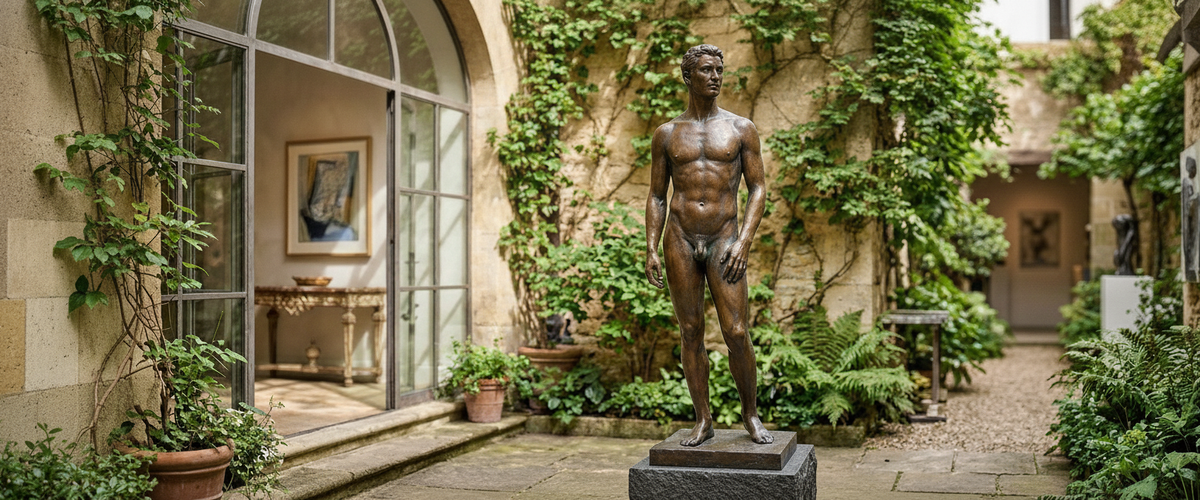

A six-foot man cast in bronze can look like a teenager the moment he stands on a lawn in Aspen. That is the quiet problem with life size bronze statues: the tape measure is accurate, and the eye disagrees. Before you shortlist life size bronze statues for sale, it helps to know what the scale terms on a quote actually mean, why open settings swallow true-scale figures, and when a commission at an adjusted scale is the smarter buy.

At a Glance
Life size means 1:1 with an adult human. Heroic has no fixed industry definition, but on most quotes it means roughly 110 to 125 percent. Monumental is larger again and is engineered more like architecture than décor.
Outdoors, open sky, viewing distance and plinth height make a true-scale figure read smaller than it measures.
A modest heroic bump often fixes this, but it raises weight, footing requirements and foundry time.
A trustworthy listing explains wall thickness, armature and scale. A vague one usually has a reason to be vague.
Life Size, Heroic, Monumental: What Each Term Means on a Bronze Quote
Foundries use these words loosely, so pin them down in writing. On a Giant Sculptures quote, life size means the figure matches adult human proportion at 1:1, measured on the figure itself rather than the figure plus base. That distinction matters: some sellers quote overall height including the plinth, which can quietly knock several inches off the body you are paying for.
Heroic scale has a long history in public figurative work. Many figurative sculptors, including members of the National Sculpture Society, have worked above life size for the same reason this article exists: true scale rarely holds its own in a public square. Monumental scale begins where a figure needs structural calculations, a dedicated foundation and often a crane on installation day.

Sky, Distance and Plinth Height: Why a True-Scale Figure Shrinks Outdoors
Indoors, a figure has walls, doorways and ceilings to measure itself against. Outside, those reference points disappear. Sky has no scale, a long lawn pushes the viewer back, and mature trees in a Hamptons garden can turn a six-foot figure into an ornament.
Plinth height adds a second distortion. Raise a figure and the viewer looks up, so the head foreshortens and the body reads shorter. Non-figurative work is not immune either: at 180cm (about 5 ft 11 in), the Clear Resin & Verdant Bronze Scholar Tree Sculpture - 180cm feels generous in an enclosed courtyard yet noticeably more modest against an open Napa hillside. Height on paper is only half the story; the setting writes the rest.
The Heroic Bump: When 110 to 125 Percent Finally Reads as Human
A six-foot figure at 115 percent stands about 6 ft 11 in (2.1 m). At 125 percent it reaches roughly 7 ft 6 in (2.3 m). On a lawn, that second figure simply looks like a confident adult. Up close on a terrace, it can feel imposing, which is why we rarely recommend a single number without seeing the site.
The catch is physics. Bronze volume scales with the cube of size, so a figure at 125 percent carries nearly twice the metal of the same figure at 100 percent. Footings, anchor bolts and shipping crates all grow accordingly.
The cheapest test we know: cut a full-size plywood silhouette of the proposed life size figure and stand it on the lawn. Then walk to the terrace or wherever the figure will most often be seen, and turn around. Many clients ask for it bigger at that moment, without any prompting. A silhouette costs far less than a regret, and it settles the scale question faster than any drawing.
Stock Life Size Bronze Statues Versus an Adjusted-Scale Commission
Stock life size bronze statues make sense when the figure will be seen at close range: a poolside terrace in Texas, a lobby in New York, an entrance court where visitors walk right past. Our life size bronze statues collection suits these placements, and the existing model means no enlargement stage.
A commission at an adjusted scale is the better call when:
The main viewing point is more than about 30 feet (9 m) away.
The figure will sit on a plinth taller than knee height.
It competes with large architecture, water or mature planting.
You want a specific pose, subject or likeness that no stock model offers.
If you are weighing several sizes at once, the life size and large statues range is a useful way to compare proportions before a commission brief.

Enlargement Adds Weeks: Where a Scale Change Hits the Foundry Schedule
Changing scale is not a photocopier setting. The original model is scanned or pointed up to the new size, and the enlarged form then needs hand reworking, because detail that reads at 100 percent looks soft at 125 percent. New molds follow, then new waxes, ceramic shell investment and the pour itself.
Larger figures are cast in more sections, so welding and chasing take longer, and patina work covers more surface. None of this is dramatic on its own, but each stage stretches. If you have an event date or a landscaping schedule, raise scale early so the foundry can plan around it.
Listing Red Flags: Thin Walls, Vague Armature and a Scale Nobody Explains
When browsing life size bronze statues for sale online, a low listing weight is the first warning. Thin walls save metal and money, then dent, crack at welds or ring hollow when tapped. Ask for the approximate wall thickness and the shipping weight.
Next, ask about the internal armature. A standing figure with a slender ankle needs stainless steel support carried through to the base; a seller who cannot describe it may not know it is there. Watch for photographs with no person or doorway for scale, and for patina descriptions with no mention of protective wax, which the American Institute for Conservation community treats as basic outdoor bronze care.
Also note that some bronze-effect pieces sold online are composite, so confirm the material before anything else. Composite is not a flaw in itself: on a roof terrace or upper-floor balcony where load limits rule out cast metal, a lighter bronze-finish piece can still deliver real height. The Hazewold Bronze Abstract Sculpture - 209cm, for example, stands around 209cm; as with any rooftop candidate, check its material and weight before planning the placement. What matters is that the listing names the material plainly rather than leaving you to assume.

Before You Buy: A Scale Checklist
Confirm whether quoted height covers the figure alone or includes the base.
Stand at your main viewing point and measure the distance.
Mock up the figure with a silhouette or poles at the proposed height.
Decide plinth height before final scale, not after.
Ask for wall thickness, armature details and estimated weight.
Check footing and access for delivery and lifting equipment.
Agree the patina and waxing routine in writing.
Budget depends on material, scale, pose complexity, engineering, installation and finishing, so we quote each piece individually. Browse our bronze garden statues for outdoor placements or the wider bronze sculptures range, then send us photos of your site. Giant Sculptures will tell you honestly whether life size will hold the space or whether your figure needs the heroic bump.
For wider placement ideas, Planning a Life Size Gorilla Statue? Start With the Shoulders is useful companion reading before finalising the setting and sightlines.