





































































































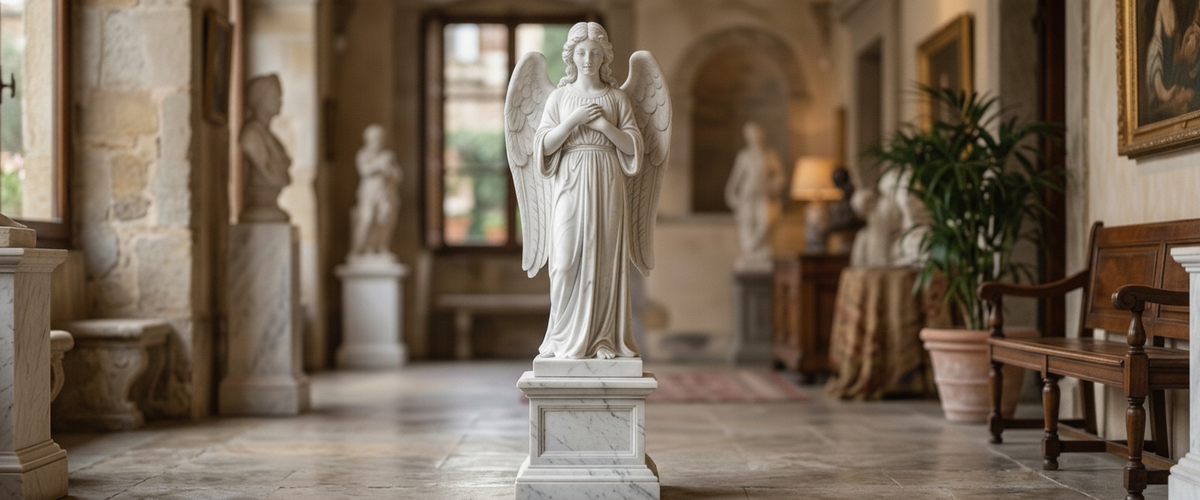

When large marble angel statues fail, the break almost always runs through a wing, usually where a fan of stone no thicker than a paperback meets the shoulder blade. Past about five feet (1.5 m), a marble angel is a cantilever problem first and a sculpture second. How a studio solves that problem tells you more about quality than any close-up of the finished face.
We commission and ship large marble angel statues to private gardens, estates and memorial sites, and the question buyers ask most is how the wings stay on. Here is the honest answer.

At a Glance
Wings carved from the same block need hidden supports. Check where they meet the body and the drapery.
Separately carved wings should be pinned with stainless steel, never mild steel, and the joint should be fine enough that you feel it before you see it.
Bold veining limits how thin a wing can safely be carved.
Wingtips and fingers erode and snap first outdoors, so placement matters.
The plinth and footing carry the real load and deserve the same scrutiny as the carving.
Why Large Marble Angel Statues Are a Cantilever Problem
Marble is strong in compression and weak in tension. A wing projecting from the back behaves like a diving board: the top edge at the root is pulled apart every time wind, frost or a curious hand loads the tip. Scale makes this worse. Double the span and the use at the shoulder climbs much faster than the extra thickness a carver can add before the wing starts to look like a slab.
That is why the tallest large marble angel statues tend to keep their wings close to the body or let them rest against another carved element. At 170cm (about 5 ft 7 in), a composition such as the Angel Resting on a Heart Marble Memorial Statue - 170cm lets the wings and the heart share the load rather than leaving stone hanging in the air. It reads as a gesture of tenderness. It is also sound engineering.

The Struts and Bridges Carvers Leave Behind the Wings
When a wing is cut from the same block as the figure, carvers leave bridges of stone: a strut from the back of the wing to the shoulder, a web between feather tips and the robe, sometimes a column hidden inside a fall of drapery. Hurried work leaves these as obvious lumps. Good work makes them disappear into the composition, so a fold of fabric just happens to meet the trailing edge, or overlapping feathers happen to rest on the hip.
Always walk around to the back. The reverse of a figure deserves the same finish as the front, because garden angels so often end up sited where guests walk behind them. A strut you can see from the terrace becomes the only thing anyone remembers.
Pinned Wings: Stainless Dowels, Resin and the Joint Line
For large marble angel statues with wide spreads, carving the wings separately and pinning them is the honest solution. Stainless steel dowels (grade 316 for outdoor and coastal sites) sit in drilled sockets bonded with a structural stone adhesive. Mild steel is the villain here. It rusts, expands and splits the marble from the inside, which is exactly the damage you see on older repaired monuments.
Run a fingertip along the join. A well-made joint is hairline, color-matched and continuous with the feather pattern, so you feel it before you see it. A thick, glossy seam of filler will yellow in sunlight and open up after a few freeze-thaw winters.
Statuario, Carrara or a Grayer White
To a carver, veining is a map of where the stone wants to split. Statuario, with its bright ground and bold veins, is glorious across a face and risky across a thin wing if a vein runs along the root. Standard Carrara has finer, grayer veining that is more forgiving. A plainer gray-white can often be carved thinner still. Ask which way the veins run through each wing: one lying parallel to the shoulder line is a weakness waiting for the first hard frost.

What Snapped Wingtips in Victorian Cemeteries Reveal
Walk any old cemetery in Brooklyn, Boston or Philadelphia and the pattern repeats: angels with legible faces and missing wingtips, fingers gone, torches broken at their narrowest point. Acidic rain slowly dissolves the calcite in marble, and thin sections lose strength first, a process the US Geological Survey has documented on monuments in Washington, DC. Frost then pries at the weakened edges. If you want to study how carved memorials age over a century, the Association for Gravestone Studies is a useful place to start.
The lesson for anyone siting large marble angel statues is practical. Keep the thinnest parts of any carving away from roof drip lines, sprinkler heads and busy paths, and orient delicate wingtips away from prevailing weather where you can. A low, kneeling pose such as the Kneeling Angel With an Inverted Torch Marble Memorial - 100cm keeps its wings tucked and its mass near the ground, but the torch is exactly the slender element worth turning away from the weather.
The Plinth Is Part of the Angel
Large marble angel statues can easily weigh 1,000 pounds (about 450 kg) or more before the base is even counted. Each one needs a concrete footing sized by the installer, taken below the frost line in places like Colorado or upstate New York, plus stainless fixing pins from figure to plinth and from plinth to footing. A tall pedestal raises the center of gravity, so when a figure is lifted high, as with the Grieving Angel on a Tall Plinth Marble Memorial - 130cm, the fixings deserve as much attention as the carving. Nobody admires a footing, but every long-lived angel stands on a good one.

Five Questions That Expose a Weak Wing
Are the wings carved in one piece with the body, or pinned? Either can be right; a vague answer is wrong.
If pinned, what metal and what grade? You want stainless steel, ideally 316 outdoors.
Where are the support bridges, and can you see them from the main viewpoint?
Which way does the veining run through each wing? Ask for photos of the back and the wing roots.
How does the figure fix to its plinth, and how does the plinth fix to the ground?
Commissioning a Large Marble Angel With Giant Sculptures
Every large marble angel we make is planned around its site, from wing span and stone selection to the crate it travels in. Budget depends on material, scale, complexity, engineering, installation and finishing, so we prepare a tailored quote rather than a list price. Our angel statues and marble sculptures are good starting points, and bronze angels are worth considering if you want a wide open wingspan that marble would struggle to carry. For memorial settings, our marble headstones show how angels pair with tablets and chest tombs.
For wider placement ideas, Large Flying Eagle Statues: Why the Wings Are the Easy Part is useful companion reading before finalising the setting and sightlines.