

































































Pick up a piece sold as wrought iron wall art and you are almost certainly holding mild steel. The label is a trade habit older than most of the houses these pieces hang in. It also hides the questions that matter more: was this shaped by hand, how will it age, and what will it ask of your wall? We handle a lot of iron in our studio, and the honest answer is usually written on the metal itself.

Quick Answer
True wrought iron has not been made commercially for decades. Today's "wrought iron" almost always means mild steel worked to look traditional.
Forged work shows hammer texture, tapered ends and wrapped collars. Laser-cut work shows crisp, uniform, perfectly flat edges.
On iron and wood pieces, look for bolts, rivets or through-tenons. Glued scrolls tend to split.
Outdoors, the finish decides the lifespan more than the metal does.
Weight tracks bar thickness, and heavy pieces need studs or masonry behind them, never drywall anchors alone.
Why Wrought Iron Wall Art Is Mostly Mild Steel
Genuine wrought iron is a low-carbon iron full of fibrous slag threads. That grain gave it its toughness and its slow, flaky way of rusting. It came out of puddling furnaces, a labor-heavy process, and once cheap mild steel arrived, the furnaces closed one by one. Britannica's entry on wrought iron traces that decline. By the late twentieth century, commercial production had all but stopped.
So when a gallery or retailer describes wrought iron wall art, read it as a style rather than a metallurgy claim. Real wrought iron survives mainly as reclaimed bar used by heritage smiths. That is fine. Mild steel forges beautifully. The useful question is how the piece was made, because a hand-forged steel scroll and a stamped one share a label and very little else.

Read the Forge: Hammer Marks, Tapers and Collars
When a metal piece arrives in our studio, the first thing we do is turn it over. The back never lies. Forged work carries small, irregular facets where the hammer landed, slightly different on every strike. Scroll ends taper to a point or flare into a leaf because the smith drew them out hot. Where two bars meet, look for a collar: a short band of metal wrapped around the joint while red hot, then clinched tight as it cooled.
Uneven hammer facets and a clinched collar are the clearest signs of hand forging.
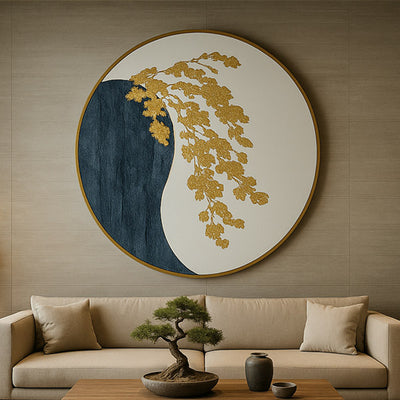
Filigree and disc compositions reward this kind of close reading. On a 120 cm (about 47 inch) design such as the Gold Filigree Lotus Disc Wrought Iron Wall Art, the place to look is where the curls meet the rim. A neat weld or a wrapped band there tells you something real about how carefully it was put together.
How Laser-Cut Profiles Give Themselves Away
Laser and plasma cutting make clean silhouettes quickly, and plenty of good contemporary metal art uses them openly. The problem comes when a cut profile is dressed up as forged work. Run a finger along the edge. A cut piece has a flat, square edge of identical thickness everywhere, often with faint vertical striations from the beam. A forged scroll is rounded, and it thins as it curls. A "twisted" bar that is perfectly flat on two faces was cut from sheet, not twisted at all.
Wrought Iron and Wood Wall Art: Check the Joints
Wrought iron and wood wall art is where the shortcuts hide best. Wood moves with humidity across the grain; iron barely moves at all. A scroll glued into a routed slot will either crack the timber or pop loose within a few seasons, especially in centrally heated homes in Denver or Phoenix. Honest makers use mechanical fixings: through-bolts, square-headed rivets, iron straps that wrap the board, or tenons that pass right through. Those joints let the wood breathe.
A through-bolt holds the iron firmly while letting the timber move with the seasons.
One more trap: oak and other tannin-rich woods react with bare steel and leave black stains around every fixing. A good maker seals the timber or isolates the metal. If you are pairing pieces, our wood wall art collection is a useful place to compare grain and finish before you commit.

Porch, Patio or Living Room: How Finish Decides Weathering
Hand-forged iron left bare develops a dark, stable skin indoors and rusts honestly outdoors. Powder-coated steel looks crisp on day one, but it is only as good as the preparation underneath. A client on a screened porch outside Savannah once sent us photos of a three-year-old powder-coated panel blistering at every weld. The coating had gone over unprepared steel, and that Georgia humidity found the seams.
For covered outdoor walls in the Hamptons or along the Gulf Coast, ask for zinc protection under the paint. The American Galvanizers Association explains why galvanizing plus a topcoat outlasts either one alone. Layered, hand-colored finishes belong on a living room wall or deep under a porch roof, which is why a multi-tone design such as the Multi-Colour Disc & Filigree Wrought Iron Wall Art suits a sheltered setting better than a sun- and rain-facing fence. For exposed walls, start with our outdoor wall art.
Lift It: What Weight Tells You About the Wall
Weight is the quickest honesty test there is. Half-inch square steel bar weighs roughly 0.85 pounds per foot (about 1.3 kg per meter), so a forged piece built from real bar feels dense for its size. A large panel that lifts like a tray is probably thin sheet. Once a composition reaches around 141 cm (about 4 feet 7 inches), as with the Blue & Gold Lotus Pad Wrought Iron Wall Art, it deserves a proper fixing plan: screws into studs, sleeve anchors into brick or stone, and a cleat or at least two hanging points so it cannot rotate.

A Buyer's Checklist Before You Commit
Ask how it was made: forged, fabricated, cut or cast. A good maker answers plainly.
Inspect the back: look for clean welds or collars, not blobs of filler.
Check edges: rounded and tapering suggests forging; square and uniform suggests cutting.
Confirm the finish system: bare, waxed, painted, powder-coated or galvanized, and where it is rated to hang.
Get the weight: plan studs, masonry or a cleat before delivery day.
For wood pieces: ask what holds the iron to the timber.
Commissioning a Forged Piece
If the catalog does not fit your wall, a commission usually will. Giant Sculptures works with designers and homeowners on bespoke metalwork sized to a specific elevation, from a stair void in a Napa farmhouse to a courtyard wall in Austin. Budget depends on material, scale, complexity, engineering, installation and finishing, so we quote each project individually. Send dimensions, photos and the exposure, and we can advise from there. Browse our iron art collection and wider metal wall art to sharpen the brief first.
For wider placement ideas, Large Wooden Wall Art Is Heavier Than You Think: How to Hang It Right is useful companion reading before finalising the setting and sightlines.