





































































































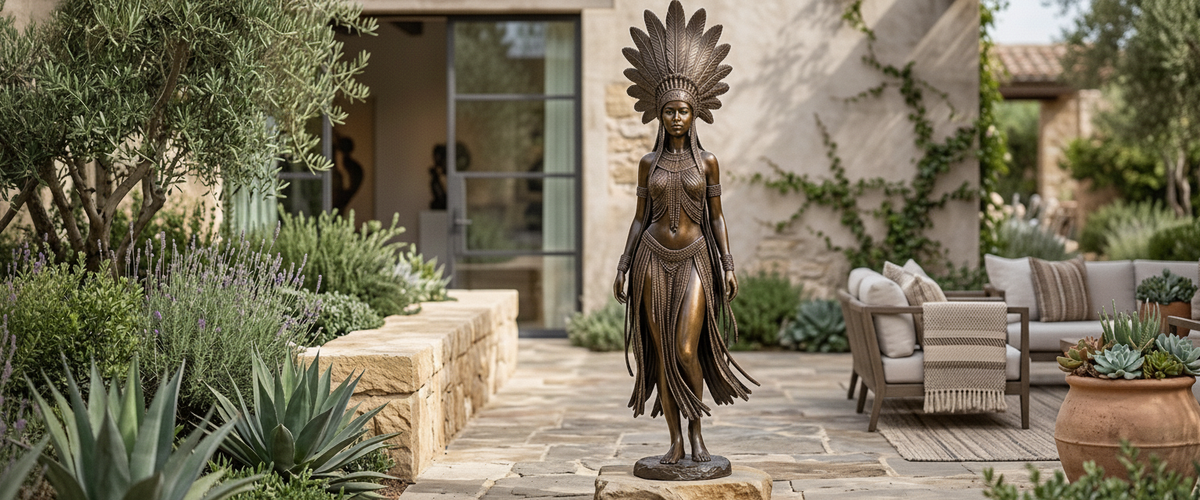

Turn a bronze tribal figural statue around and look at the back of the headdress first. The face gets the attention in the workshop and in the product photos. The rear feathers, the underside of the beadwork and the fringe hanging behind the shoulders tell you how much care the foundry actually put into the cast. We have turned down figures that looked convincing from the front and fell apart as soon as they were viewed from behind.
This buying guide explains how to read those details on a bronze tribal figural statue, so you can separate a serious cast from a decorative shortcut before the crate arrives.

At a Glance
Check the undercuts: feathers and beads should cast shadows, not merge into a single lump.
Look for chasing marks: hand-finished costume folds show tool work that a raw casting never has.
Read the patina: color should darken in recesses and lift on high points.
Ask about the original: a carved-wood model changes character in metal, for better and for worse.
Get foundry and edition facts in writing, with specific photos of the headdress.
Why Feathers, Beads and Fringe Are the Hardest Parts of the Wax
In lost-wax casting, every detail has to survive three stages: the wax positive, the ceramic shell and the pour. Thin, projecting forms are the weak point at each one. A single feather in wax may be only a fraction of an inch thick, and it can sag in a warm studio, crack when the shell is dipped, or fail to fill when molten bronze reaches it last.
Our studio sees this every time a figure with an elaborate headdress goes through the process. The wax chaser often spends more hours on the plumes than on the torso, and the sprue layout has to feed metal into the crown from several points. A foundry that rushes this stage produces feathers that are shorter, thicker and fewer than the sculptor intended. That is the first thing to check on any bronze tribal figural statue with headdress and costume.
Crisp Undercuts or Soft Blobs: Reading a Headdress Up Close
Stand close and look for daylight. On a well-made bronze tribal figural statue, you should be able to see gaps between individual feathers, with sharp edges and a clear shadow line underneath each one. Beadwork should read as separate spheres or cylinders, not a textured band. Fringe should hang as distinct strands with space between them.
From behind, each feather should cast its own shadow line.
Soft, rounded blobs usually mean one of two things: the mold was taken from an earlier casting (each generation loses sharpness), or the undercuts were filled in to make the wax easier to release. Either way the headdress will look muddy from ten feet (about 3 m) away, which is a typical viewing distance in a garden or lobby.

Hand-Chased Costume Folds Versus Detail Left Straight from the Mold
Chasing is the metalwork done after casting: removing seams, recutting lines and restoring texture with chisels, punches and files. On costume, it shows up as crisp fold edges, clean breaks between layers of cloth or hide, and small tool marks that follow the form.
Hand chasing leaves defined fold edges and small tool marks that follow the form.
Detail left straight from the mold has a telltale sameness. Folds lack a defined edge, the seam line may still be faintly visible along the side of the figure, and surface texture looks uniform everywhere. Drapery is a useful comparison even outside tribal subjects: on a tall classical figure such as the Large Classical Draped Female Figure Candelabra Bronze Sculpture - 210cm, deep, well-chased folds keep a defined edge and catch light cleanly at nearly 7 feet (2.1 m) tall. Hold any costumed figure to that standard.
Patina Pooling in Recesses Shows Real Depth
A properly applied hot patina settles differently across the surface. Recesses stay darker, high points get relieved or lightly waxed back, and the result reads as depth. The Getty Conservation Institute's research on outdoor bronze is a good primer on why patina and wax layers behave the way they do over time.
Flat, even color from top to toe is a warning sign. It often means a thick paint-like coating that disguises porosity or shallow detail. On a dark finish, look at how the tone gathers in the deepest folds. A dark-patinated piece like the Classical Centaur and Nude Female Figure Bronze Sculpture (Dark Patina) - 100cm shows the kind of variation to expect: near-black in the hollows, warmer brown across the raised forms. On a bronze tribal figural statue, headdress recesses are where this matters most, because that is where weak detail hides.
What Carved-Wood Originals Lose and Gain in Bronze
Many designs for a bronze tribal figural statue begin as carved wood, a medium with deep roots in African and Oceanic sculpture traditions. The Smithsonian's National Museum of African Art holds useful examples of how carvers handle grain, adze marks and applied materials. Those applied materials are part of the challenge. Real feathers, cloth, raffia and shell cannot be cast directly; they have to be reinterpreted in wax.
Bronze loses the warmth of grain and the mixed-material contrast. It gains permanence, outdoor durability and the ability to hold finer, thinner projections than wood could safely support. Treat these subjects with care: ask whether the design is a considered interpretation or a direct copy of a specific cultural object, and let the answer shape your decision.

Buying a Bronze Tribal Figural Statue: Questions for the Seller
Ask for photos of the headdress from behind and from below, not just the hero angle. Then get clear answers to these:
Which foundry cast it? A named foundry or studio is accountable; an anonymous source is not.
Is it an edition? Ask for the edition size and whether molds are taken from the original model or a later cast.
Where was it chased? Ask specifically about the headdress and fringe.
What alloy and wall thickness? Thin walls in projecting feathers are the first to crack or bend in transit.
How is the patina sealed? This affects outdoor care and how often you re-wax.
How will it be crated? Delicate crowns need internal bracing, not just foam.
For a costumed figure with long projecting plumes, consider asking for the headdress to be crated separately and pinned on site. It can add a day to installation, but it removes the single biggest transit risk. The same questions apply to any life-size figure with a tall crest or crown. A helmeted piece such as the Life-Size Classical Roman Commander Bronze Statue - 150cm raises identical decisions about crest thickness, internal bracing and whether the top section travels on its own.
If a catalog piece does not fit, Giant Sculptures can quote a bespoke commission to your scale, finish and setting. Budget depends on material, size, detail complexity, engineering, installation and finishing, so ask for a tailored quote rather than working from assumptions. Browse our bronze figures and statues to compare how different subjects handle costume and ornament, and see bronze garden statues if the piece is heading outdoors.
For wider placement ideas, Buying Life Size Bronze Statues: What the Listing Photo Won't Tell You is useful companion reading before finalising the setting and sightlines.