





































































































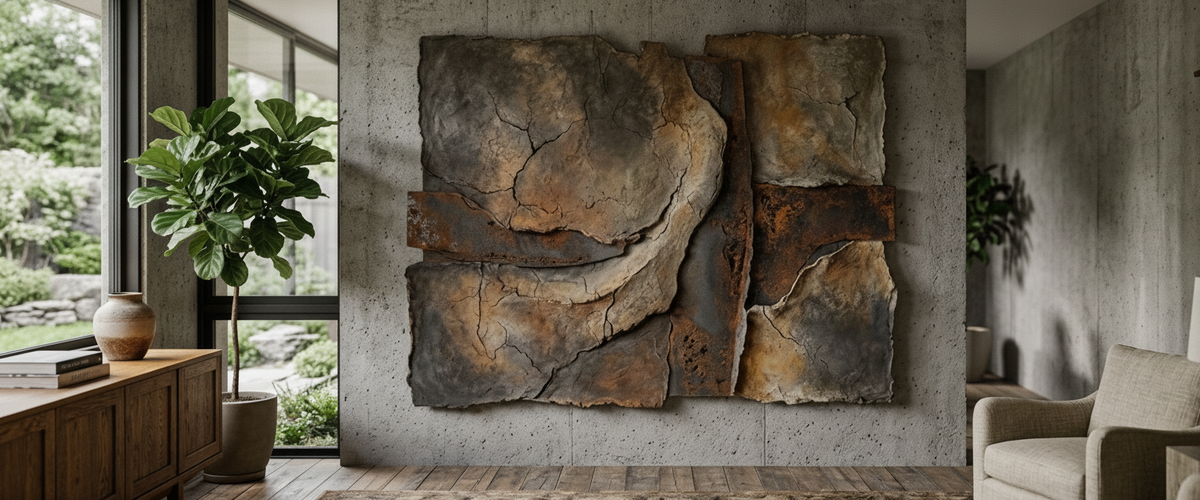

Most of what gets sold as wabi sabi art is wearing a costume. The crack stops where the mold line stops. The "kiln blush" sits in the same three spots on every panel in the warehouse. Real wabi sabi art records something that actually happened to a material over time, and once you know how to read that record, the fakes stop being convincing from across the room, never mind up close.

Key Takeaways Before You Buy
Wear follows use and weather. Look for damage concentrated where hands, rain, or gravity would logically land, not scattered evenly for composition.
Repetition is the giveaway. Compare two units of the same design. Identical chips mean a mold, not a moment.
Material decides the aging curve. Unglazed clay, lime plaster, weathered oak and oxidized steel each earn their patina differently; resin imitates all four and earns none.
Check the edges and the back. An honest wabi sabi wall art panel admits exactly how it was made.
Light is the test. Flat north daylight flatters genuine wabi sabi art and kills printed texture.
Wear That Happened Versus Wear That Was Applied
Authentic age is unevenly distributed because life is unevenly distributed. A bronze handrail wears bright on the grip and stays dark in the hollows. A stone trough erodes hardest under the drip line. Weathered oak silvers on the exposed face and keeps its warm color where a batten covered it. All of that is information, and it is why a genuinely aged surface reads as calm rather than busy.
Trowel chatter and knocks that land where hands and gravity would put them.
Factory distress does the opposite. It spreads wear across the whole piece so every photograph looks the same, adds cracks in the middle of a plane where no stress would ever concentrate, and finishes with a uniform dark glaze in the crevices to fake accumulated grime. Once you see that even distribution, you cannot unsee it. Wabi sabi art grew out of the rough tea bowls prized in sixteenth-century Japan, now held in collections such as the Smithsonian's National Museum of Asian Art, and that tradition valued accidents of the kiln precisely because nobody could repeat them on demand.
Spotting the Repeat: Stamped Cracks, Cloned Chips and Mold Seams
Most mass-market wabi sabi art comes out of a mold, so ask the seller for photographs of two units from the same run. If the retailer only has stock imagery, that itself is an answer. Then check three things. Run a fingernail along any crack; a cast crack has a rounded, slightly soft profile because the mold surface rounded it, while a real one has a crisp edge and grit inside. Look at the perimeter for a faint raised line running continuously around the piece, the seam where two mold halves met. And hold the work at a grazing angle to a window so the surface texture throws shadows. Printed or sprayed texture goes visually silent at that angle; modeled texture gets deeper.

What Materials in Wabi Sabi Art Earn With Age
Unglazed clay darkens where it absorbs, holds fingerprints from throwing or hand-building, and shows real color shift from flame path. Raw lime plaster carries trowel chatter and a slight chalky bloom as it carbonates, and takes knocks as bright white scars, not brown ones. Weathered oak silvers, checks along the grain, and lifts its medullary rays into relief as softer fibers erode first. Oxidized steel is the one buyers most often misjudge. Corten needs genuine wet and dry cycling to build the stable protective layer it is famous for; under permanent shelter or constant damp it simply keeps rusting, as the technical guidance on weathering steel sets out. That matters when a client wants a Corten piece under a deep loggia. We usually recommend a different metal or a genuinely exposed position rather than pretending the patina will behave.
Bronze belongs in this conversation too. A chemically applied patina on a fresh casting is a starting point, not an ending; over years outdoors it shifts toward green or deep brown depending on rain chemistry and how often it gets waxed. That slow drift is the most genuinely wabi sabi thing a metal sculpture does, and it is a strong argument for choosing cast bronze over any composite when you want a piece that keeps changing on your watch.
Why Real Irregularity Holds Flat Northern Daylight
North-facing rooms give you soft, directionless light with almost no shadow contrast. That light is unforgiving to fake texture, because printed grain has no depth to catch it and simply reads as a gray photograph of a surface. Genuine wabi sabi art still works in it, since even a millimeter of modeled variation produces its own micro-shadow. If you are furnishing a north-facing living room or a permanently shaded hallway, buy depth. Two or three millimeters of real modeling will outperform any amount of printed patina.

What the Edges and the Back of Wabi Sabi Wall Art Admit
Low relief in oxidized steel holding its shadows under soft northern light.
Turn the panel over. Hand-built wabi sabi wall art has an inconsistent back: trowel drag, fiber reinforcement, a batten or subframe fixed with real hardware, maybe a maker's mark scratched in while the material was green. Mass-produced panels have a smooth, sprayed reverse and a molded keyhole boss. Weight tells the same story. A plaster-on-panel or clay-bodied piece is heavy in a way that instantly rules out picture hooks and drywall anchors, and a heavy panel needs blocking or a French cleat into studs. That is not a downside. It is the physical honesty you are paying for, and it is worth confirming your wall build before you commit to scale. Browse the wabi sabi art collection with wall construction in mind rather than picking by image alone.
Rooms That Reward Restraint, and Rooms Where It Goes Mute
Quiet surfaces need quiet company. They work beautifully on plaster and limewash walls, in double-height entries where a single large panel can hold the full wall, above a long low sideboard, and in spa or wellness spaces where nothing else is competing. They go mute against heavily patterned wallpaper, in rooms lit by multiple warm point sources that flatten the relief, and anywhere a high-gloss finish nearby steals all the reflected light.
Outdoors, the same logic scales up. A weathered steel form in a mountain courtyard reads against snow all winter and against green all summer, which is exactly the kind of slow annual change the aesthetic is built around. Larger abstract sculptures in Corten or stone often carry a garden better than a cluster of small objects, because one confident mass gives the eye somewhere to rest.
A Practical Checklist for Buying Wabi Sabi Art
Request photos of the exact piece you will receive, not the design.
Compare two units for cloned cracks or chips.
Feel for mold seams around the full perimeter.
Confirm the core material, not just the surface treatment.
Ask how the finish will change over five and ten years.
Check weight and get a fixing method in writing before delivery.
For outdoor pieces, confirm the position gives the patina what it needs.
View it in your own light before committing to the wall.

Commissioning Rather Than Choosing From a Shelf
The honest fix for cloned distress is a one-off. Bespoke wabi sabi art at Giant Sculptures starts with the wall or the site, the ceiling height, the light direction and the material you want to live with, then our makers build a single piece rather than pulling one from a mold. Scale is usually where commissions earn their keep: a 7 ft (2.1 m) panel that fills a stairwell wall, or a freestanding form sized against a house elevation rather than a showroom plinth. Budget depends on material, size, surface complexity, engineering, finishing and installation, so the sensible next step is a tailored quote with your dimensions and location attached. If you are weighing metal against stone for an exterior piece, the Corten steel sculptures are the quickest way to see how a single material changes character across different forms.
For wider placement ideas, Black Gold Wall Art That Still Reads Gold at 4pm is useful companion reading before finalising the setting and sightlines.