






































































































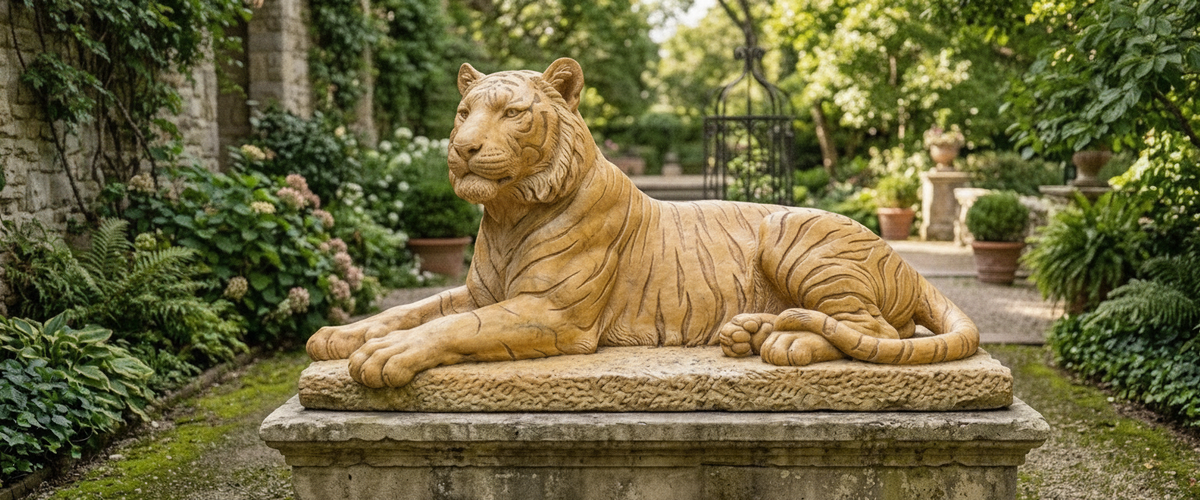

Every tiger looks magnificent under a softbox. Listings for garden tiger statues for sale are shot so the stripes glow and the muscles ripple. Little of that survives a July afternoon on an unshaded lawn in Texas. The listing photo is a sales tool, and every garden tiger statue sale leans on it hard. What you actually need sits behind it: weight, material, how the pattern was made and how big the animal really reads next to a boxwood hedge.
Looking for the full range in this category? Browse our Tiger Statues & Sculptures collection for every available finish, size, and configuration, then hold it up against any garden tiger statue sale you find elsewhere.

Quick Answer
Weight tells you more about material than any adjective in the description.
Painted stripes on resin or fiberglass fade and chalk outdoors. Carved or cast-in pattern lasts.
Measure against your garden, including hedges, steps and paths, before you trust the word "life-size."
Inspect the close-ups of seams, whiskers and tail joints, not the hero shot.
Ask about crating, fixing and finish care before anything ships, whatever the garden tiger statue sale price.
Studio Lighting Flatters, Sunlight Edits
Resin tigers photograph beautifully, which is why they fill so many garden tiger statues sale pages. A warm key light lifts the painted orange, a cooler fill deepens the black, and a gloss topcoat passes for fur sheen. Put the same piece in full sun and ultraviolet light starts working on the pigment and binder at once. Within a few seasons the orange can drift toward salmon, the blacks go gray and the clear coat turns milky. In a coastal garden, salt air speeds all of it up.
Stone and bronze age differently. Marble softens slightly and can collect lichen in damp shade. Bronze darkens and builds a patina that most owners come to prefer. Neither loses its pattern, because neither depends on paint to carry it.
Weight Is the Honest Spec
If a seller running a garden tiger statue sale won't give you a shipping weight, treat that as your answer. Resin and fiberglass tigers are hollow shells. Two people can carry a large one across a lawn, which also means wind and curious guests can move it unless it is anchored. Hollow-cast bronze is far heavier for its size and usually wants a bolted plinth and a small crew to place. Solid carved marble is the heavyweight: the stone runs at roughly 170 pounds per cubic foot (about 2,700 kg per cubic meter), and a tiger carved from a single block keeps much of that mass.
That weight is a feature. A carved marble tiger at 150cm (about 59 inches), such as the Roaring Rock Tiger in marble, arrives crated, goes into position with lifting equipment and stays exactly where you put it. When you compare garden tiger statues for sale, ask for both net and crated weight. A figure that seems implausibly low for the stated material and size usually means the material is not what the headline claims.
The Roaring Rock Tiger in carved marble: stripes cut into the stone, not painted on.

Painted Stripes Versus Cast-In Pattern
On any garden tiger statue sale listing, scroll past the hero image to the detail shots. On a painted tiger the stripes sit on a smooth surface: crisp edges, uniform depth, sometimes a faint brush line or overspray where black meets orange. On carved and cast pieces the pattern belongs to the form itself. In marble, the carver cuts stripe channels and fur direction into the stone, so low evening light picks them out without any color at all.
In bronze, the markings are modeled in the original clay, cast into the metal and then deepened with patina. Where a pair has to read from the far end of a wide drive or gateway, a cast set such as the life-size traditional tiger pair in bronze holds its stripes in relief, so the pattern stays legible at a distance whether the patina is refreshed or left to weather. One quick test before you buy from a garden tiger statue sale: ask for an unretouched photo taken outdoors in daylight. Sellers who trust their finish will send it.
A cast bronze pair keeps its stripes in relief, legible from the far end of a drive.
Life-Size in the Photo, Oversized on Your Terrace
"Life-size" is a slippery claim for a tiger, and it turns up in nearly every garden tiger statue sale. A large adult can measure around 9 feet (2.7 m) from nose to tail tip (the Smithsonian's National Zoo tiger profile breaks down size by subspecies), so most garden tigers are scaled, and the listed number might be height, length or something in between. Ask which. Then mock it up: stack cardboard boxes to the stated height and length, set them where the tiger will live and look from the house, the gate and the terrace.
Hedges are the reality check. At the foot of a clipped yew hedge, or at the edge of a lawn viewed from a terrace above, a reclining marble tiger at 120cm (about 47 inches), such as the Majestic Lying Tiger, sits low and long and lets the planting stay in charge. A roaring pose of the same length takes far more visual room, because the head lifts and the open mouth faces the viewer. Narrow entrance walks are where scale mistakes from a hasty garden tiger statue sale show most. A pair of standing tigers flanking a 6-foot (1.8 m) path will look like bouncers. A single reclining tiger at the end of the axis usually does the job better.

Seams, Whiskers and Tail Joints
Cheaper tigers in a discount garden tiger statues sale give themselves away at the extremities. Look closely at these spots:
Seams: mold lines along the spine, belly or legs of resin and fiberglass pieces, often filled and painted over. They are the first place cracks open after a freeze-thaw winter.
Whiskers: plastic or wire whiskers glued into drilled holes snap and vanish. Stone whiskers are usually suggested in relief, and bronze whiskers should be cast or welded and chased.
Tail joints: a separately attached tail is normal in bronze and stone, but the join should be pinned and invisible. A visible glue line, or a tail that flexes under your hand, is a warning.
Paws and base: hairline cracks where stone feet meet the base, or flex in a composite one, suggest the piece was never designed to carry its own weight outdoors.
Garden Tiger Statues for Sale: Questions to Ask Before One Ships
Before you commit to any of the garden tiger statues for sale on your shortlist, send the seller this list. Good answers come back quickly and in writing; a garden tiger statue sale that dodges them is telling you something.
What is the exact material, and is it solid, hollow-cast or a shell over a core?
What are the net and crated weights?
Is the listed size height, length or depth? Can I have all three?
Is the stripe pattern carved, cast or painted?
How does the sculpture fix to a base, and is a plinth or anchor kit included or recommended?
Can you send unretouched outdoor photos of this specific piece, including joint close-ups?
How is it crated, and what lifting equipment will I need on delivery day?
What care does the finish need in my climate, especially freeze-thaw cycles or coastal salt?

When a Commission Makes More Sense
The garden tiger statues for sale in our catalog suit most gardens. If your site has an awkward sightline, a stone color to match or a view the tiger should face, and no garden tiger statue sale offers the right piece, a bespoke commission with Giant Sculptures is worth the conversation. Our studio can adjust scale, pose and material, from white or yellow marble to patinated bronze, and plan the base and installation around your ground conditions. Budget depends on material, scale, complexity, engineering, installation and finishing, so a tailored quote beats a guess every time.
Whichever route you take, from a garden tiger statues sale to a full commission, buy the tiger you will still like after ten winters. That is usually the heavier one.
For wider placement ideas, Choosing a Tiger Statue for Garden Weather: Where the Stripes Go First is useful companion reading before finalizing the setting and sightlines.