





































































































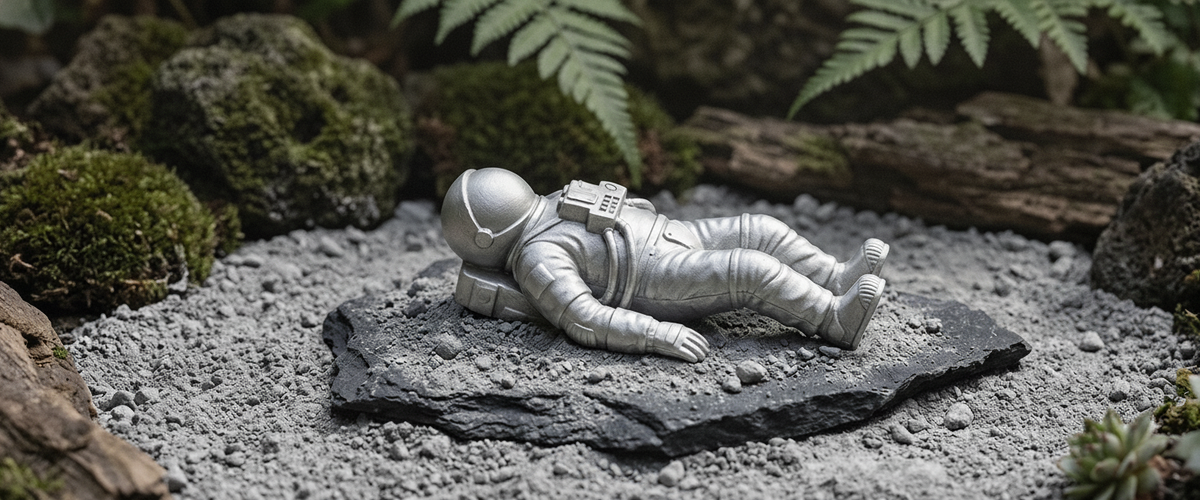

The only genuine Fallen Astronaut is roughly 238,000 miles away, lying in gray dust at the edge of Hadley Rille, and it is never coming home. That one fact should shape how you read every listing that surfaces under a fallen astronaut sculpture sale search. Almost everything offered online is a replica, an homage, or a loose reinterpretation, and those three categories carry wildly different value, paperwork and legitimacy. Knowing which one is in front of you is the whole game.

Quick Answer for Buyers
Short on time? These are the points that decide any fallen astronaut sculpture sale.
The original 3.3 inch (8.5 cm) aluminum figure was left on the Moon in August 1971 and cannot be bought at any price.
Paul Van Hoeydonck, the Belgian artist behind it, produced authorized replica editions; documented, signed examples are the only pieces that can honestly be called authorized originals.
Unsigned resin casts with no foundry mark, no edition number and no gallery history are decorative objects, not collectibles.
Scale changes the meaning completely. A palm-sized memorial figure reads as intimate; the same pose at 7 feet becomes public sculpture and needs different engineering.
If you want a large-scale space figure with real presence, a bespoke commission in bronze, cast aluminum or stainless steel is usually the honest route rather than an oversized copy of someone else's work.

The 8.5 cm Figure Still Lying Beside Hadley Rille
Apollo 15 commander David Scott set the little aluminum figure into the lunar soil on the last of his three moonwalks, next to a plaque naming fourteen astronauts and cosmonauts who had died. The figure is deliberately anonymous: no face, no flag, no gender, no nation. It reads as a body in a suit, which is exactly why it works. NASA's own Apollo Lunar Surface Journal preserves the crew transcripts from that final EVA, and the plainness of the moment in the record is part of its power.
Understand the object and you immediately understand the market. This was a memorial, kept small enough to disappear into a mass budget measured in grams. Any version sold as a monument has already changed its argument.
Van Hoeydonck's Signed Editions and the Row That Froze Them
What happened next is why provenance matters so much in a fallen astronaut sculpture sale. Van Hoeydonck planned a replica edition through a New York gallery. NASA, already embarrassed by the Apollo 15 postal cover affair, took a hard line on crew members and commercial gain, and the plan collapsed. Copies were pulled, the artist's role went publicly unacknowledged for years, and the two men's accounts of the original agreement never quite matched. Journalists Corey S. Powell and Laurie Gwen Shapiro reconstructed the whole dispute in their long-form account of the sculpture on the Moon, which is worth reading before you bid on anything.
Later in his life Van Hoeydonck authorized further replica editions, and a replica also entered the Smithsonian's national collection as a donation. Those two facts are the anchor points. Everything else circulating is downstream of them.

Replica, Homage or Reinterpretation
Three very different things get listed under the same phrase.
Replica. A direct copy of the lunar figure, ideally from the artist's authorized editions, with a signature and edition number. Value sits almost entirely in documentation.
Homage. A new work that references the pose or the idea without copying the form. Legally clean, artistically honest, and often more interesting in a contemporary interior.
Reinterpretation. A commissioned piece that borrows the theme of the lone figure in a suit and takes it somewhere else in material, posture and scale. This is where most of our clients land once they understand the first two.
Questions That Separate a Documented Edition From an Unmarked Cast
Work through this list before you commit to any fallen astronaut sculpture sale.
Is the artist's signature present, and where is it placed on the figure?
Is there an edition number, and does the seller state the total edition size?
Which foundry cast it, and is the foundry mark visible?
What is the material, confirmed by weight and testing rather than description alone? Aluminum, bronze and painted resin are easy to tell apart in the hand.
Is there a chain of ownership, gallery invoice, or auction record?
Does the seller describe it as a replica, or quietly imply it flew?
Are the photographs of the actual item, including the base and underside?
If four or more of those answers are missing, treat the piece as decorative. That is not automatically a problem. It just changes what a fair offer looks like.

Why Scale Rewrites the Meaning
Enlarge the pose and the emotional register shifts. At desk size, the figure is a private object you lean toward. Past about 4 feet (1.2 m), it becomes something people walk around, and a prone or reclining pose starts to lose legibility from standing height unless the plinth is tilted toward the viewer. We saw that on a stairwell commission where the first maquette read beautifully on the studio bench and almost disappeared when viewed from the landing above. A five degree tilt on the base fixed it.
Standing space figures survive scaling far more easily. In a double-height lobby, a full-height standing figure such as the Galactic Blue Astronaut Beats on Moon Sculpture at 210 cm (about 6 ft 11 in) keeps its silhouette readable from every approach, where a reclining figure at the same height would flatten out. For a console, a shelf or a home office, an 86 cm piece along the lines of the Celestial Gold Astronaut Glow Moon Sculpture carries the theme without taking over the room. The wider astronaut sculptures collection is a useful way to calibrate your eye before committing to a size.
Foundry Marks, Edition Numbers and the Paperwork Worth Insisting On
Ask for a certificate that names the artist, the edition, the year of casting and the foundry. Ask for high-resolution photographs of the mark itself. For bronze, a good foundry stamps discreetly and consistently; a cast with a suspiciously crisp signature and soft surface detail usually means a copy taken from a copy, which loses definition at every generation. Conservation bodies such as the American Institute for Conservation publish sensible guidance on documenting and caring for metal artworks, and a seller who cannot supply basic identification is telling you something.
What Value Looks Like at Each Tier of Provenance
Pricing in a fallen astronaut sculpture sale follows provenance, not size. Rather than quoting figures, think in tiers. A signed, numbered, documented replica from the artist's authorized editions is a collector item, priced by the market and by auction comparables. An unsigned aftermarket cast is worth what a decorative object of that material and finish is worth, no more. A commissioned original sits in a different category entirely, because you are paying for design, engineering, casting and finishing rather than for a name attached to a historic event. For bespoke work, budget follows material, scale, engineering, installation and finish, so the only useful number is a tailored quote.

Commissioning Instead of Chasing a Copy
Plenty of people who start with a fallen astronaut sculpture for sale search finish somewhere better. They want the idea of the solitary figure, not a licensing headache. That is where Giant Sculptures tends to come in: bronze or cast aluminum for permanence and patina, mirror-polished stainless steel when a client wants sky and landscape reflected back, and Corten when the piece sits in an arid garden and should look weathered by its environment. We have crated space-themed commissions for private terraces and corporate campuses, and the deciding factors were always wind load, mounting method and sightlines rather than the sculpture itself.
Finish is the hardest thing to judge from a render, and it is worth testing before a monumental cast is signed off. Living with a chrome-finished piece at domestic scale, such as the 80 cm Cosmic Chrome Astronaut Bear Moon Sculpture, tells you quickly whether a reflective surface suits your light and your walls, or whether a matte patina would sit more comfortably.
If you want scale, start with the large astronaut sculptures range to see how monumental pieces sit against real architecture, then bring us a reference image, a site photo and a ceiling or skyline height. We will tell you honestly whether the piece you have in mind works at that size, or whether the pose needs rethinking before a single mold is made.
For wider placement ideas, Why a Chrome Bear Statue Works When a Chrome Deer Does Not is useful companion reading before finalising the setting and sightlines.