

































































































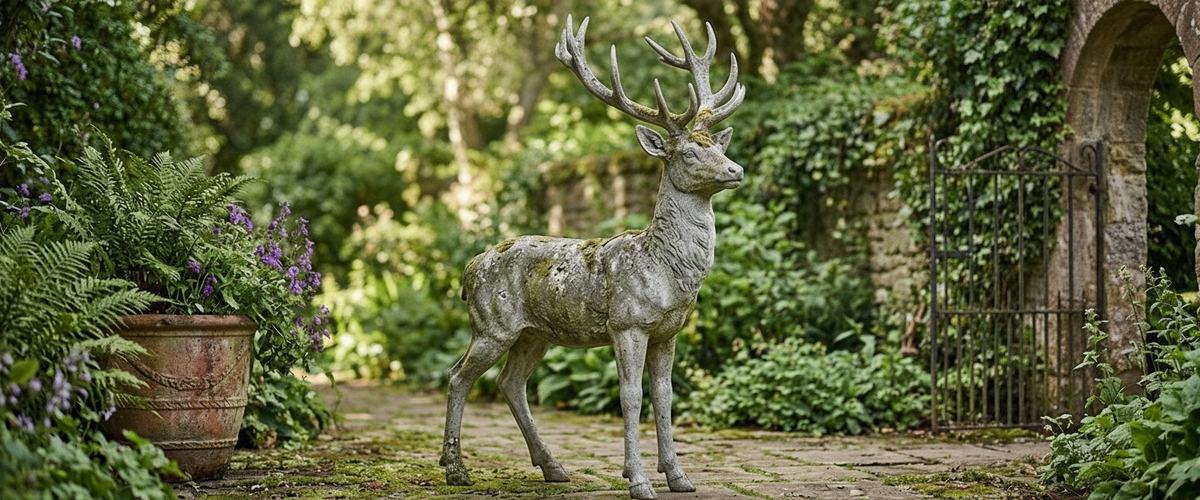

Most concrete deer statues for sale look identical in the listing photo and nothing alike after their third winter. The difference sits inside the legs, in the mix, and in one label on the product page that most buyers skim. At Giant Sculptures we work mainly in bronze, marble and stainless steel. Clients still send us concrete listings to sanity-check before they buy, and the same handful of questions sorts the good pieces from the ones that shed an antler by spring.

At a Glance
Cast stone usually means a denser, finer mix than generic "concrete" or "cement." Ask which one you are actually getting.
Thin sections fail first: ankles, antler tips and ear edges take freeze-thaw damage before the body does.
Ask what reinforces the legs. Shallow steel rebar rusts and splits the concrete from inside.
Weight is your friend. A heavy deer resists wind, pets and rutting bucks.
Use a breathable sealer, never a glossy film that traps water.
Concrete suits woodland edges. Formal lawns usually call for bronze, marble or steel.
Concrete, Cement or Cast Stone: What Each Label Promises
Concrete deer statues for sale tend to carry one of three labels, and they are not interchangeable. "Concrete" is cement, sand and coarse aggregate. It is strong in bulk and fairly porous at the surface, which is why budget garden deer often feel gritty. "Cement" on a listing is loose shorthand; cement is the binder, and nobody casts a deer from cement alone. Treat it as a sign the seller is not thinking hard about materials.
"Cast stone" ("reconstituted stone" in the UK) should mean a refined concrete with fine aggregate, low water content and tighter compaction, made to read like quarried limestone. In the US, serious makers will reference ASTM C1364, the standard specification for architectural cast stone. If a seller can name the standard or describe their mix and curing, you are dealing with a manufacturer rather than a reseller.

Ankles, Antler Tips and Ear Edges: Where Winter Opens the First Crack
Water soaks into the pores, freezes and expands by roughly nine percent. Repeat that enough times and the surface pops away. The Portland Cement Association explains why air-entrained mixes cope far better. The number of cycles matters more than the depth of cold: a UK winter that bounces above and below freezing does more harm than a steady Minnesota deep freeze, and much of Pennsylvania and Virginia sees the same repeated thawing.
A deer is almost designed to fail here. The body is thick; the ankles, antler tines and ear rims are thin and exposed on every side. The typical failure is a stag that loses a tine in its second February, with an orange rust streak running down from the break. That stain tells you the reinforcement was too close to the surface.
Thin tines and ankles are where cheaper concrete deer statues for sale show frost damage first.
Rebar, Steel Pins or Glass Fiber: What's Inside the Legs
Every standing deer needs reinforcement through the legs. Plain steel rebar works only when it has enough concrete cover; too close to the surface and moisture reaches it, rust swells, and the leg splits from the inside. Stainless pins cost the maker more and do not rust. Glass fiber reinforced concrete (GFRC) is lighter and rust-free, but it is often cast as a thin hollow shell, which leaves the antlers vulnerable to knocks.
When you shortlist concrete deer statues for sale, ask the seller three things: what reinforces the legs, whether the antlers are cast in one piece or pinned on, and the finished weight. Vague answers are an answer.
If slender legs and full antlers are the whole point of the piece, bronze sidesteps the reinforcement question altogether. In a cast pair such as the Life-Size Traditional Deer Pair Bronze Sculpture (Doe Companion) - 170cm, the ankles and tines are metal through and through, so there is no rebar to rust and no surface to spall in a hard February.

Why 175 Pounds of Concrete Works in a Deer Statue's Favor
A life-size deer has a tall silhouette on four slim legs, which is a top-heavy shape. A piece around 80 kilograms (about 175 pounds) stays put in a gale, ignores the Labrador, and survives the real buck who decides in October that your statue is a rival. Hunters who use decoys know that rutting bucks will charge and spar with them. A lightweight resin or hollow shell gets knocked flat.
Weight does mean planning. Confirm liftgate delivery, measure gates, and set the base on a compacted gravel or concrete pad, pinned down if the ground is soft. That is a morning's work, done once.
Moss Is Welcome, Flaking Isn't: Sealing a Concrete Stag
Green moss and gray lichen are what make concrete deer look as if they wandered in from the trees. Lichens are slow growers, as the British Lichen Society points out, so an established crust is years in the making; let them come. Flaking, crumbling or pitted ankles are a different matter; that is water damage.
Apply a breathable silane or siloxane penetrating sealer when the statue is dry, then reapply every few years. Skip glossy acrylic coatings, which trap moisture and peel. Never pressure wash; it strips the surface and opens pores for next winter.
Woodland Edge or Striped Lawn: Where Concrete Belongs
Concrete reads like weathered stone under oaks, beside a meadow path or at the edge of a Vermont tree line. On a freshly striped lawn in the Hamptons or a gravel forecourt in Napa, the same deer starts to look like a garden-center purchase. Formal and contemporary settings need a material that holds its own against clipped hedges and clean architecture.
Concrete deer statues for sale look most at home where trees, moss and lichen soften the cast stone.
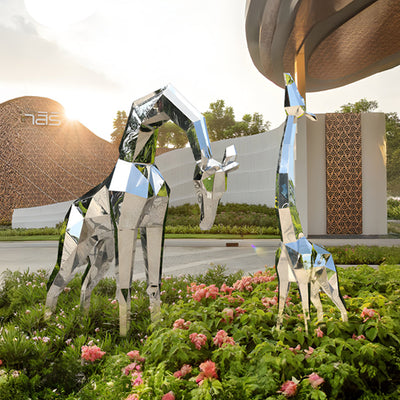
Where a modern lawn needs a contemporary reflection rather than weathered gray, a faceted stainless piece such as Noble Deer II is closer to the right design language, catching light the way concrete never will. A long axial view toward a terrace suits carved stone instead, and at 220cm a grouped composition like the Stag and Three Deer White Marble Statue - 220cm has the mass to hold a formal vista that a single garden deer would leave looking empty. If you want the woodland look without frost worries, cast bronze develops its own patina and does not crack in winter.

How to Judge Concrete Deer Statues for Sale: A Checklist
Does the listing say cast stone, and can the seller describe the mix or standard?
Are ankles and antler tips thick enough to survive your winters?
What reinforces the legs, and is it stainless or well covered?
Is the finished weight stated, and does it suit your site and access?
Is the piece sealed, and with what?
Does the setting suit weathered gray, or does it ask for metal or marble?
If three or more answers worry you, widen the search beyond concrete deer statues for sale. Explore our deer statues or our bronze deer statues, or ask Giant Sculptures about a bespoke commission sized to your garden. Budget depends on material, scale, complexity, engineering, installation and finishing, so request a tailored quote.
For wider placement ideas, Buying Life Size Bronze Statues: What the Listing Photo Won't Tell You is useful companion reading before finalising the setting and sightlines.