






































































































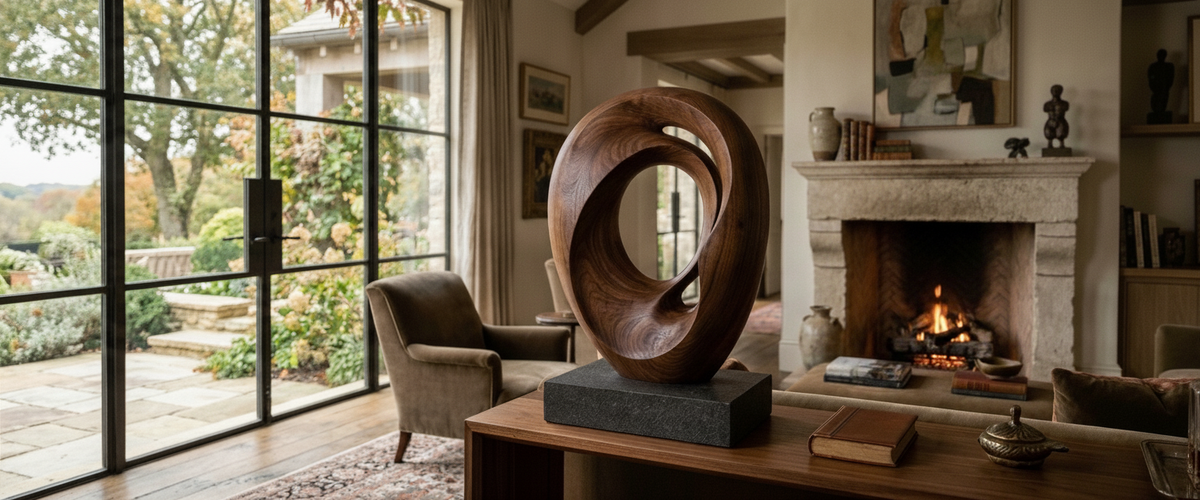

The abstract pieces that photograph best in a sale listing are often the ones most likely to split by February. Anyone browsing an abstract wood sculpture is buying two things at once: a form, and a piece of timber that will keep moving for years after it leaves the workshop. Get the second part wrong and the first part opens a crack straight through its most elegant curve.
We see the aftermath more often than we would like. Collectors send us photos of a hairline check that has crept along a sweeping arm and ask whether it can be closed. It can usually be stabilized. It can rarely be undone. Before you add anything to the cart, here is how we read carved wood as specialists in large-scale, bespoke sculpture.

Key Takeaways Before You Buy
Abstract forms with thin walls, holes and long unsupported spans crack more readily than compact figurative carvings.
Ask every seller how the timber was dried and what its moisture content was at finishing.
Keep wood away from radiators, underfloor heating and hot south-facing glass, especially in the first heating season.
Finishes control how quickly moisture moves. None of them stop it.
For large or heavily pierced designs, a commission lets the maker choose species and grain to suit the form.
Thin Sections, Open Voids, Long Spans: Why Abstract Forms Crack More Than Figures
Wood shrinks unevenly. It moves roughly twice as much around the growth rings as it does across them, and barely at all along the grain. A chunky figurative carving has enough mass to absorb those competing stresses. An abstract piece that thins to a blade-like edge, wraps around a void or throws a long arm into space does not. Stress concentrates where the section changes fastest, which is exactly where abstract sculptors love to work.
Long spans add a second problem. A curve that cuts across the grain over any real distance has short fibers along much of its length, so it is weakest in the direction you need it strongest. The conservation notes in the U.S. National Park Service's Conserve O Gram series keep returning to the same culprit behind cracking in wooden objects: swings in relative humidity, far more than age.
Reading End Grain, Sweeping Curves and Pierced Forms in a Listing Photo
Listing photos in an abstract wood sculpture sale are lit to flatter, so look for what the lighting cannot hide. End grain shows as rings or a dense, slightly darker patch where the growth layers are cut across. If you can see the pith (the dark center of the tree) anywhere in the piece, treat it as a warning. Pieces carved with the heart inside are prone to radial checks that open from the center outward.
Rings and a darker patch mark end grain; a fine line running out from the pith is an early radial check.
Sweeping curves should ideally follow the grain lines, the way a bent branch does. When the figure of the wood runs straight while the form bends away from it, that curve is cut across short grain. Pierced forms deserve a closer look still. Zoom in on the inner edge of each hole, where checks first show as fine dark lines, and ask for photos of the underside and base, because that is where cracks get tucked against a plinth.

Kiln-Dried, Air-Dried or Green-Turned: The Moisture Question to Ask Every Seller
This is the most useful question you can put to any abstract wood sculpture for sale: how was the timber dried, and what was its moisture content when the piece was finished? Kiln-dried stock for interior work is typically brought to around 6 to 8 percent, close to where a heated American home settles. Air-dried timber can be perfectly sound but often sits higher, and dense hardwoods in thick sections can take years to equalize.
Green-turned or green-carved work is shaped while wet and allowed to distort as it dries. That can be beautiful, but the movement should be over before you buy. A seller who answers with a figure and a date knows the material. A seller who says "it's seasoned" is guessing.
Radiators, Underfloor Heating and South Windows: Where Checks Open in the First Winter
Most of the cracks we hear about appear between November and March. Central heating pulls indoor humidity down hard, and a sculpture that arrived in a humid September dries fast. The pattern repeats: a carved elm form set on a console above a cast-iron radiator, or a pale ash piece standing on radiant floor heating beside a wall of glass, can open a check along its thinnest edge within weeks.
A console above a radiator is one of the fastest ways to open a check in carved timber during the first heating season.
Keep wood a few feet from heat sources, out of direct afternoon sun through south- or west-facing glass, and in rooms held around 40 to 55 percent relative humidity. A small hygrometer costs far less than a restoration. If the room cannot offer that, the honest answer may be a different material. Beside a fireplace or on a mantel above a radiator, a wood-grain finish on stainless steel, such as the Brown & Blue Wood-Grain Abstract Bird Stainless Steel Sculpture - 50cm, keeps the warm, figured look of timber without any of the seasonal movement.

Oil, Wax or Lacquer: Which Finish Slows Timber Movement and Which Only Hides It
Finish is where abstract wood sculpture sale listings get misleading. Penetrating oils such as tung or Danish oil soak into the surface and slow moisture exchange a little, while leaving the wood breathable and easy to refresh. Paste wax adds a thin, renewable barrier and a soft sheen. A film finish like lacquer or varnish slows exchange the most, but when the wood moves underneath a hard film, the film crazes or lifts.
Be wary of heavy, glossy coatings on older pieces. Filler and thick lacquer can make a check vanish in a photograph and reappear once the sculpture acclimatizes in your home. Ask directly whether any cracks have been filled or stabilized. A reputable seller will tell you without hesitation.
Choosing the Timber for the Form: When a Commission Beats an Abstract Wood Sculpture Sale
Ready-made pieces from an abstract wood sculpture sale work well for compact, closed shapes. A pebble-like silhouette along the lines of the White Abstract Organic Blob Sculpture, 46cm has few sharp edges and no voids, and carved in timber that kind of continuous mass spreads stress evenly. Once a design opens up, a commission makes more sense, because the maker chooses the species and orients the grain to suit the shape rather than forcing a shape onto whatever log was on hand.
In our studio that conversation covers stable species (walnut, cherry and quartersawn oak generally move less than beech or hard maple), where joins will sit in a laminated piece, and whether the brief is really a wood sculpture at all. For outdoor settings or very open forms, bronze and stainless steel carry the same gesture without the movement. Where a room calls for a large, airy volume at standing height, an open metal construction like the Grey Wire Mesh Abstract Form Sculpture, 150cm holds that scale comfortably, whereas the same silhouette carved from solid timber would be a serious cracking risk. Compare scale across our wood sculptures and bronze abstract sculptures, then ask Giant Sculptures for a tailored quote. Budget depends on material, scale, complexity, engineering, installation and finishing.

Buyer Checklist
Ask for the species, drying method and moisture content at finishing.
Request photos of the base, underside and the inside of every void.
Check that the grain follows the main curves rather than cutting across them.
Confirm whether any cracks have been filled or stabilized.
Measure your chosen spot's distance from heat and direct sun.
Plan a gentle first winter and watch the room's humidity.
For thin, pierced or large forms, price a commission alongside the listing.
Bought well, a piece from an abstract wood sculpture sale darkens and softens with handling into something richer every year. Bought in a hurry, it turns into a conversation about fillers. We would much rather you had the first kind.
For wider placement ideas, Abstract Garden Sculptures for Sale: How to Read a Listing Before You Buy is useful companion reading before finalising the setting and sightlines.