

























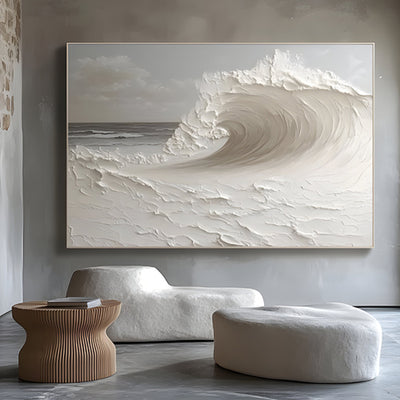
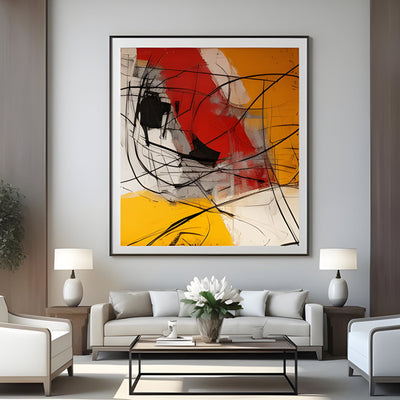
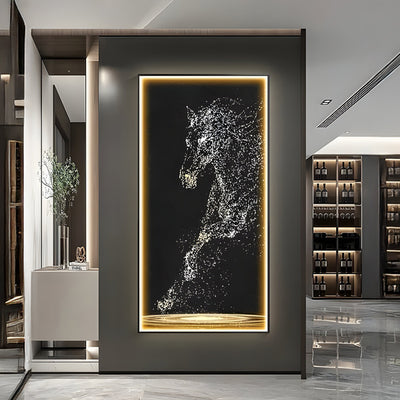
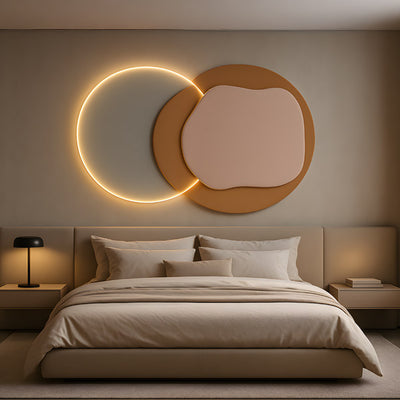









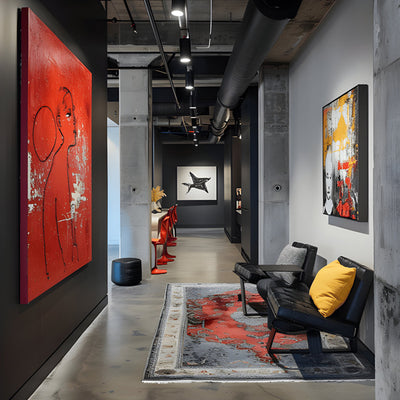


Most people choose hallway art while standing squarely in front of it. That is the one position nobody will view it from again. In an abstract wall art hallway, every piece is read at a slant, on the move and often in half-light, so what succeeds there is chosen for that oblique view. Here is how we advise clients to buy for the corridor they actually have.
Looking for the full range in this category? Browse our Wall Art & Wall Decor collection for every available finish, size, and configuration.

Quick Answer
Buy for the side view. Relief and texture read better at a raking angle than a flat print does.
Let width set depth. In a narrow corridor, keep the piece shallow enough that shoulders and bags clear it.
Favor one large piece on the end wall over a row of small ones along the long wall.
Space a series to walking pace, not to the tape measure alone.
Check the downlights before you commit to a textured surface.
The Raking View: How an Abstract Wall Art Hallway Is Really Seen
In a typical 4-foot (1.2 m) corridor you are rarely more than a couple of feet from the wall and almost never facing it. A flat canvas seen that way foreshortens into a thin trapezoid and loses most of its color field. Relief behaves differently. The low angle throws shadows off every ridge, so a surface that looks modest head-on can look far deeper from the side.
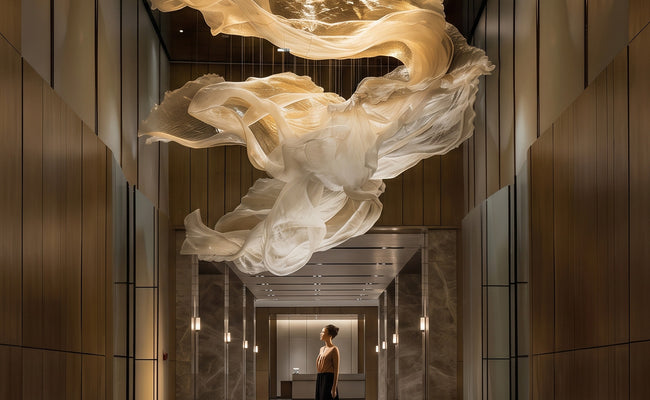
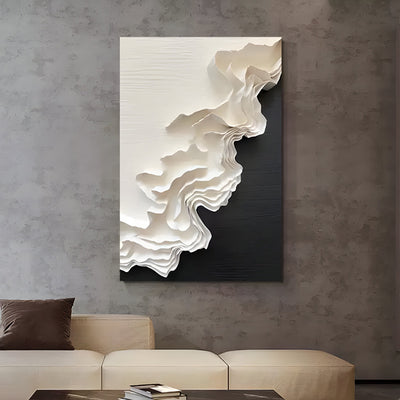
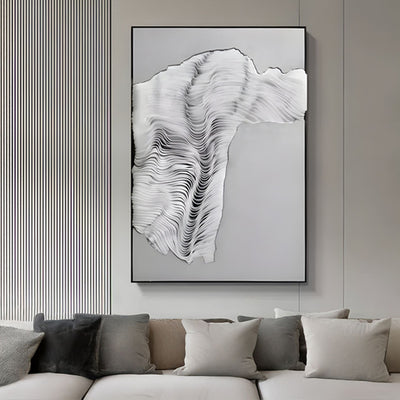
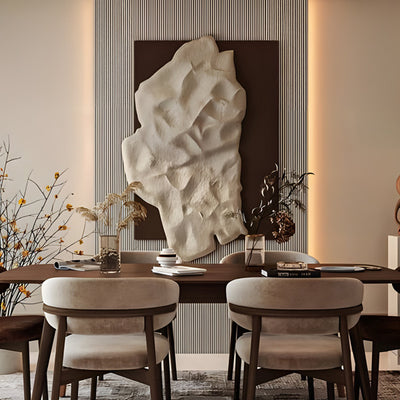
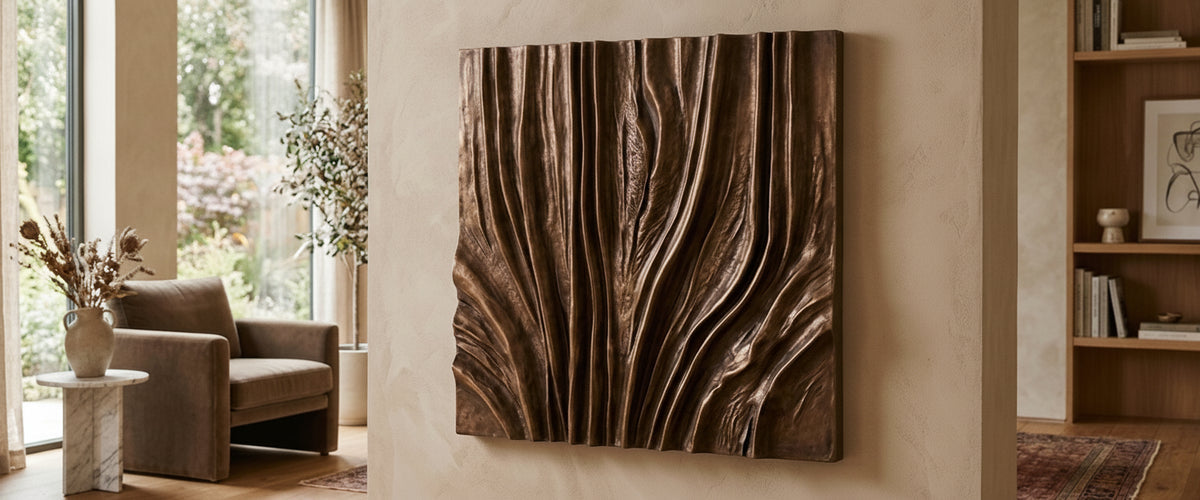
From a few steps away, each fold casts its own shadow line: the view that matters in an abstract wall art hallway.
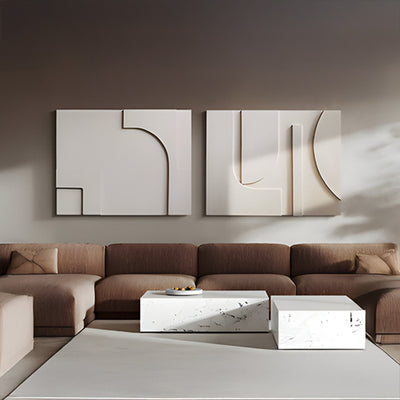
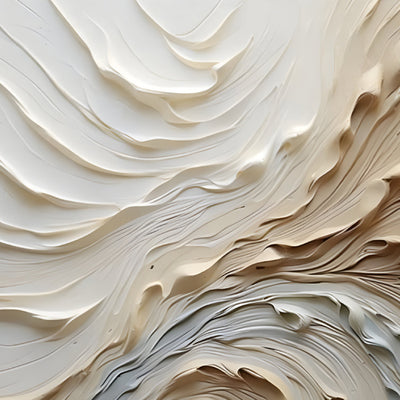
That is why we judge wall pieces in the studio by walking past them, not by standing in front of them. For a wall that will mostly be seen at a slant, a pleated relief such as Pleat Brown Abstract Wall Art - 70cm, at 70 cm (about 28 inches), is closer to the right idea than a flat canvas: from the front the folds read as gentle ridges, and from a few steps down the corridor each fold carries its own shadow line. If you are shortlisting abstract wall art for a hallway, view the product images taken at an angle first, then the straight-on shot.

Corridor Width Caps Relief Depth
Anything that projects from the wall will eventually meet a shoulder, a laundry basket or a vacuum cleaner. The US accessibility standard for public circulation routes limits wall-mounted objects between 27 and 80 inches above the floor to 4 inches (100 mm) of projection (ADA Standards, section 307). Private homes are not bound by it, but it is a sensible ceiling for any hall where two people pass each other.
A common case: a client wants deep, dramatic folded steel on the long wall of a prewar apartment hall barely wider than a doorway. The better answer is to keep the drama in the surface, bring the projection well under that 4-inch line, and move the deeper relief to the end wall, where nobody brushes past it. Wider halls, the kind found in many ranch houses and farmhouses, can take more depth. Measure clear width first and choose second.
Why One Large Abstract on the End Wall Outworks a Row of Small Ones
The end wall is the only head-on view a corridor offers, and you see it for the full length of your approach. A large piece there gets 20 or 30 feet of build-up. A row of small frames on the long wall, by contrast, tends to blur into a single strip of visual noise at walking speed.
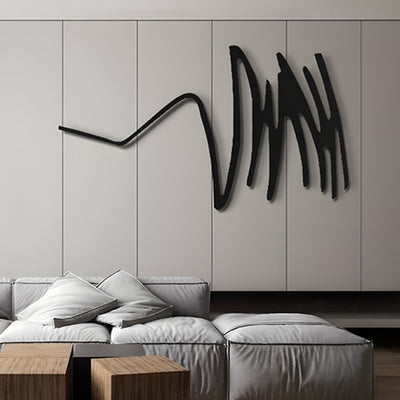
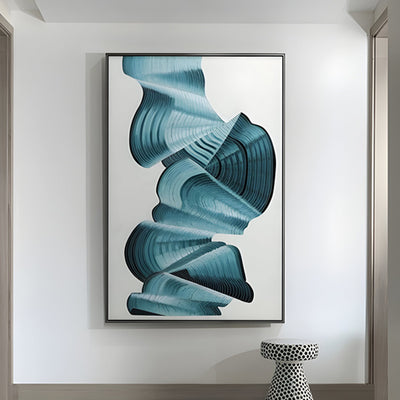
If the end wall is generous, a long horizontal piece such as Peach & Teal Comet Trail Wall Art - 220cm, at 220 cm (roughly 7 feet), can carry the whole hallway on its own. As a working guide, let the piece fill a clear majority of the wall's width so it reads as intended rather than leftover. For more options at that scale, our wall sculptures collection is the place to compare.
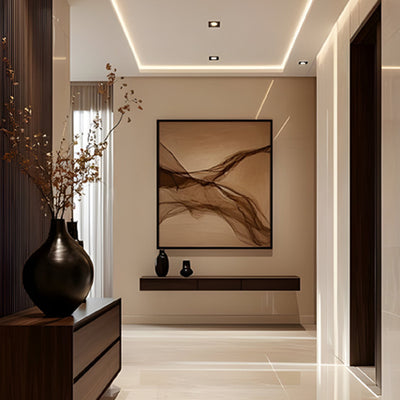
A single wide piece on the end wall gives an abstract wall art hallway the full length of the approach to build up.

Spacing a Series to the Stride
Sometimes the long wall has to carry the art: a windowless gallery hall, say, or a corridor with no true end wall. Treat it as a sequence. An adult stride is about 2.5 feet (75 cm), and a series works best when each piece arrives in view just as the last one slips out of peripheral vision. Keep the gaps identical and hang everything on a shared centerline, usually around 57 to 60 inches (145 to 152 cm) from the floor.
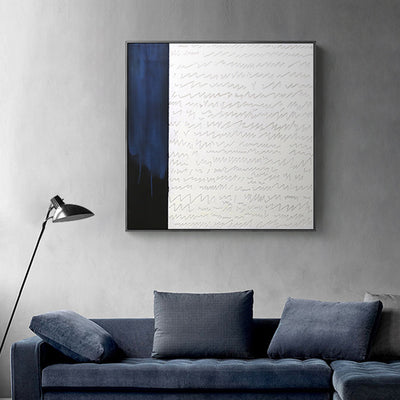
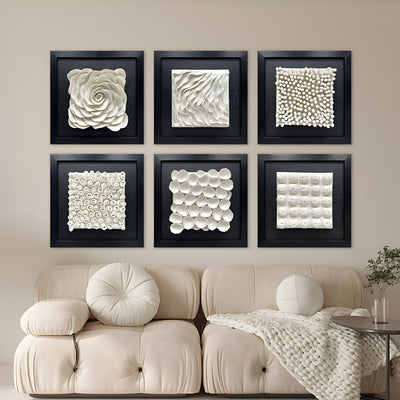
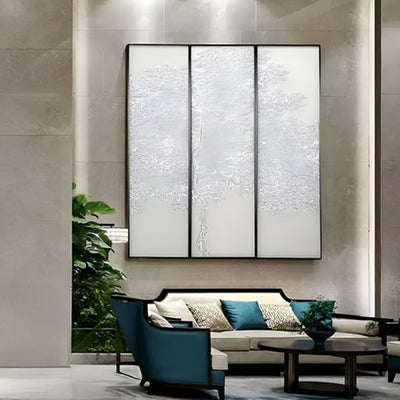
A triptych solves much of this for you. On a long wall with no end view, a set of matched panels such as Riverine Flow Pearl White Textured Triptych Wall Art keeps the spacing and centerline consistent, so the eye travels with you rather than stopping at each frame.
Downlights Can Flatten or Carve a Textured Surface
Recessed downlights cast scallops of light down the wall. When a fixture sits close to the wall, light grazes the surface and carves every ridge into relief. When it sits farther back, it washes the piece evenly and flattens it. Material matters too: polished stainless steel throws hotspots, while a patinated bronze or brushed finish diffuses light and holds detail. Before buying, photograph the wall at night with only the hallway lights on. That photo will tell you more than any showroom. Our metal wall art range covers both reflective and matte finishes if you want to compare.
Abstract Forms That Hold at a Glance and Reward a Closer Look
The best abstract wall art for a hallway works at two speeds. It needs a clear silhouette or color field that registers in half a second as you pass, plus surface incident (tool marks, folds, layered patina) for the guest who stops. Fussy detail with no strong overall shape turns to static in a corridor, and an abstract wall art hallway full of it feels busy rather than considered. Browse our abstract art with that two-speed test in mind.

An Abstract Wall Art Hallway Buyer Checklist
Clear width: measure wall to wall and set a maximum projection.
Light position: note how far each downlight sits from the wall.
Sightline: is there a true end wall, and how long is the approach?
Wall build: confirm studs, masonry or drywall before choosing a heavy metal piece.
Touch zone: polished finishes at shoulder height will show fingerprints.
Obstructions: check door swings, switches and thermostats.
When the Corridor Should Set the Brief
Ready-made pieces suit a standard abstract wall art hallway. A commission earns its place when the corridor is unusual: a curved wall, an extra-long gallery hall in a mountain chalet, a tight depth limit, or a window whose light you want the piece to answer. At Giant Sculptures we work from measured drawings and photographs, scale the design to the wall, engineer the fixings, and choose between bronze, stainless steel, Corten or stone to suit the light and the traffic. Budget depends on material, scale, complexity, engineering, installation and finishing, so the honest route is a tailored quote. Start with our hallway art collection, then talk to us about the hall you have.
For wider placement ideas, Abstract Acrylic Wall Art: Painted Canvas or Cast Glass Panel? is useful companion reading before finalising the setting and sightlines.