





























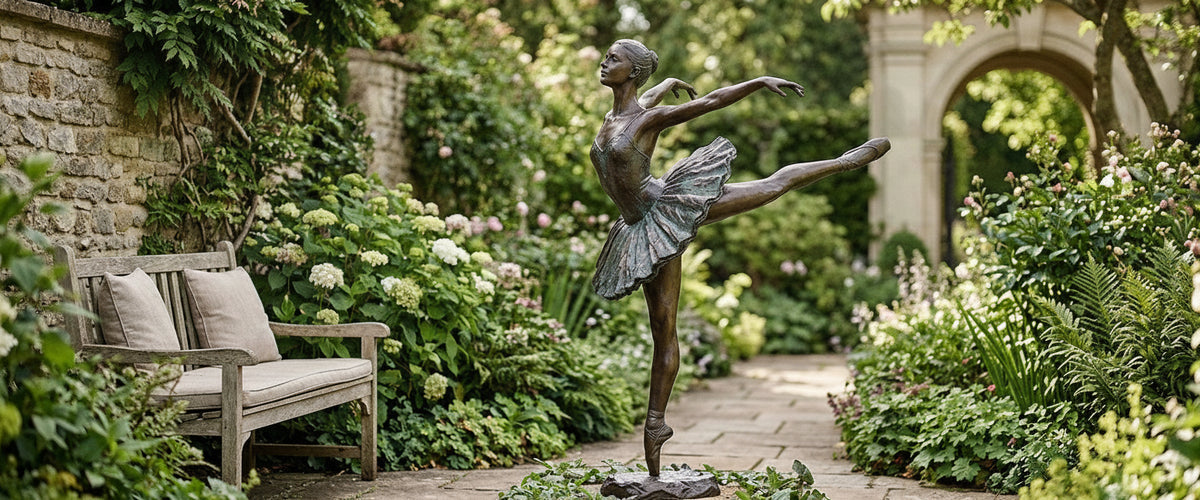

Most ballerina sculptures fail at the ankle. Not the face, not the hands, the ankle. A bronze ballerina sculpture puts an entire figure's weight through a wedge of metal roughly the width of two fingers, and everything a buyer responds to (lift, poise, the sense that the dancer arrived at this position rather than posed for it) depends on how honestly that transition is modeled and how well it is engineered underneath. Get it right and the piece breathes. Get it wrong and you have a very heavy ornament on a stick.

Key Takeaways Before You Shortlist
Pose first. Read the silhouette from ten paces away. If it does not tell you what the dancer is doing, detail will not rescue it.
Anchoring is structural, not cosmetic. Raised-leg poses need internal steel and a plinth designed around the load path.
Patina should answer the wall behind it, not a swatch on a screen.
Half life-size and life-size are different objects, not the same object at two settings.
"Famous" usually means famous composition, not a famous original. Ask about the edition and the foundry marks.
Why the Degas Silhouette Became the Reference Point
Every buyer measures a bronze ballerina sculpture against one mental image: a young dancer in fourth position, chin lifted, arms held low behind her back. That image comes largely from Degas. His wax figures were cast in bronze after his death, and the National Gallery of Art holds one of the largest groups of them anywhere, which is why a Degas ballerina bronze sculpture has become shorthand for the whole subject. The original Little Dancer Aged Fourteen was modeled in wax and dressed in a real fabric tutu and hair ribbon, a detail that still shapes what collectors expect from surface and texture today.
That inheritance is useful and slightly limiting. Classical compositions sell because they are legible; anyone recognizes them instantly. But a famous bronze ballerina sculpture composition also arrives pre-loaded with comparison. If you want the piece to feel like yours rather than a quotation, contemporary treatments earn their keep. Where a room calls for the dancer at rest rather than mid-performance, something like the Life-Size Contemporary Seated Ballerina Bronze Sculpture - 160cm reads better, and it sidesteps the balance problem entirely by keeping both feet down and the weight low.

Arrested Motion Versus Frozen Awkwardness
There is a narrow window in dance where a position looks resolved. A half-second earlier or later and the same body reads as unstable, or worse, as a mannequin. Sculptors who understand dance model the moment of arrival: the supporting hip stacked, the ribcage lifted away from the pelvis, the trailing arm still carrying a trace of the movement that brought it there.
Test it by squinting. Step back until the detail dissolves and only the outline remains. Strong pieces still read: you can name the position from the shape alone. Weak pieces collapse into a vertical smudge with limbs attached. We use the same squint test on maquettes in the studio before anything is scaled up, because a composition that only works at close range will disappoint the moment it goes on a landing or into an open garden.
The Arabesque Problem
A raised leg needs far more anchoring than it looks like it does. In an arabesque, the mass of the extended leg sits well outside the footprint, so the bronze is fighting a permanent cantilever. Bronze has excellent compressive strength and casts beautifully in thin section, but the load still has to travel through the supporting ankle into whatever you have bolted it to.
The cantilever of an extended leg is resolved below the plinth, not in the modeling.
Our answer on dynamic poses is a stainless steel armature carried through the supporting leg and out into a hidden base plate, with the fixing designed around the plinth material at the same time as the sculpture. A client in the Hamptons once had a limestone plinth cut before commissioning the figure, and we ended up re-detailing the base plate to suit a block that was never engineered for an off-center load. Order the sculpture first, then the plinth. It saves a stonemason's second invoice.
Outdoors, add wind. A tall figure with an extended limb behaves like a small sail in a winter gale or on an exposed hillside. Any bronze ballerina sculpture destined for open ground should be specified with the fixing detail, not just the finish.
Patina: Dark Chocolate on Pale Plaster, Warm Mid-Brown Against Oak
Patina is chemistry, not paint. It is developed on hot metal with applied solutions and then sealed with wax, which is why two pieces from the same mold can look meaningfully different. Tate's definition of patina is a good primer on why the surface keeps shifting over time rather than staying fixed.
Practically: a dark chocolate patina cuts cleanly against pale plaster, white-painted brick or a limewashed hallway, and it flatters an on-pointe silhouette because the outline stays crisp. Against oak paneling, walnut or a warm-toned interior, that same dark finish goes muddy; a warmer mid-brown with lighter highlights on the raised surfaces keeps the figure from sinking into the wall. Green and verdigris patinas belong outdoors, where foliage supports them. Ask for a sample plaque and look at it in the actual room at the actual time of day you will use it. Screens lie about bronze.
Half Life-Size on a Console, Life-Size on a Landing
Scale changes the relationship, not just the shipping cost. A half life-size dancer is an object you look down at; it belongs on a console table, a library shelf or a hall chest, and it rewards fine surface detail because viewers get within arm's reach. A figure around 5 ft 3 in (160 cm) meets you at eye level and starts behaving like a presence in the room, which is why stair landings, double-height entrances and gallery walls suit it.
At eye level, patina choice decides whether the figure lifts off the wall or sinks into it.
Go monumental and the rules change again. At roughly 9 ft 10 in (300 cm), a piece such as the Monumental Contemporary Ballerina Dancer Bronze Sculpture - 300cm needs distance and sky, and it is read mostly as silhouette, so surface detail matters less than the strength of the outline. Water adds another layer: a figure conceived as a fountain, like the Life-Size Classical Ballerina Bronze Fountain, combines dancer and movement, but it also brings a pump, a reservoir and a service route into the conversation, so plan the plumbing before the pedestal. The wider range of life size bronze statues is worth walking through if you want to see how the same subject shifts character across sizes.

Editions, Foundry Marks and What "Famous" Really Means
Buyers often assume a famous bronze ballerina sculpture means a famous original. Nearly always it means a famous composition, cast in bronze by a foundry working from an approved model. That is normal practice and has been for centuries. What matters is transparency: who cast it, whether the work is part of a numbered edition, whether foundry marks are present, and whether the surface was chased and patinated by hand or left rough from the shell.
Ask these questions before you commit:
Is this a stock composition, a limited edition, or a one-off commission?
Lost-wax ceramic shell casting, or sand cast? Wall thickness in the extended limbs?
What is the internal armature material, and where does it terminate?
How is the piece fixed down, and who supplies the base plate?
Which patina recipe was used, and what is the recommended re-waxing interval?
Indoor or outdoor sealing specification?
Crating, rigging and access: can it physically reach the room?
Budget follows those answers. Material volume, scale, pose complexity, engineering, finishing and installation all move the number, so a tailored quote is the only honest figure. If you want a specific dancer, a specific costume or a portrait likeness, that is commission territory, and it starts with a maquette. Giant Sculptures works this way as standard, and the same process applies whether the piece ends up in a hotel lobby, a walled courtyard or among the bronze garden statues on a private estate. For subjects beyond the human figure, the bronze figures and statues range shows how far a modeled surface can be pushed. And if you want wit rather than reverence, the pose survives a change of dancer: a hippopotamus in a tutu still reads, unmistakably, as a ballerina.
For wider placement ideas, Bronze Framed Wall Art: How to Buy a Piece That Earns Its Wall is useful companion reading before finalising the setting and sightlines.