





































































































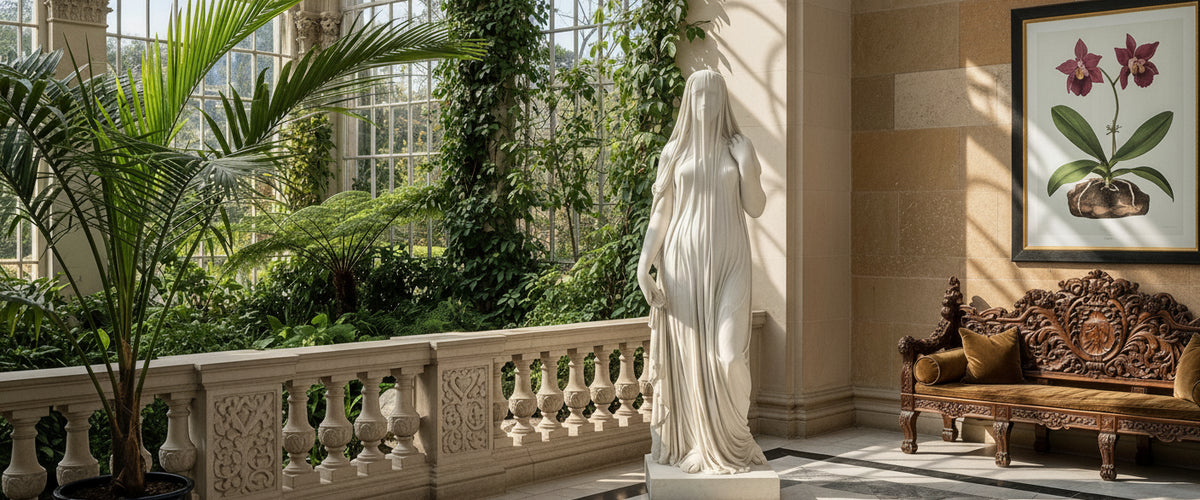

Stand in front of a well-carved marble figure and the room reorganizes itself around it. That is the quiet power buyers are really asking about when they type what is a figurative marble sculpture into a search bar. The short answer to what is a figurative marble sculpture: it is a sculpture carved from natural marble that depicts a recognizable human or animal form, from a portrait bust to a full standing figure. The longer answer, the one that actually helps you buy well, is about stone choice, scale, pose, placement and the maker behind the chisel.
At Giant Sculptures we commission and ship large figurative marble sculptures to private homes, hospitality projects and estate gardens across the US and Europe. The questions below are the ones serious buyers ask before they sign off on a piece they intend to keep for thirty years or more.

Key Takeaways
Definition: A figurative marble sculpture renders the human or animal form in carved natural marble, ranging from busts to monumental standing figures.
Stone matters: Statuario, Carrara, Bianco P, and colored marbles each carry different price, translucency, and weather behavior.
Scale changes everything: A 70 cm (28 in) cherub reads as a detail; a 180 cm (5 ft 11 in) veiled figure becomes the anchor of a room or garden.
Outdoor use is possible but depends on climate, sealing, and base engineering.
Bespoke commissions typically run several months from sketch to crate; plan around that, not against it.

What a Figurative Marble Sculpture Actually Is
Figurative simply means representational. A figurative marble sculpture depicts something we recognize: a goddess, a saint, a dancer, a horse, a cherub holding flowers. That separates it from abstract or geometric stone work, where the subject is form itself. Combine that with marble, a metamorphic limestone prized for its fine grain and slight translucency, and you have the art form that produced famous marble sculptures like the Venus de Milo, Michelangelo's David, and Bernini's Apollo and Daphne.
The category covers a wide range. If you ask what is a marble bust sculpture, it is a head-and-shoulders portrait, the format the Romans used to honor emperors and that Renaissance patrons revived for themselves. A full figurative marble sculpture can be life-size or monumental. A relief is carved on a single plane, like a panel. The Pieta marble sculpture by Michelangelo in St. Peter's Basilica is a master class in figurative carving: two figures, drapery, anatomy, and emotion held in one block of Carrara.
So when someone asks what is marble sculpture in general, the answer is broader. The figurative marble sculpture is one branch. Abstract, architectural and decorative carving are the others. This guide stays inside the figurative branch, because that is where most serious residential and garden commissions live.

Materials and Finishes: Choosing the Right Marble
Not all marble behaves the same way under a chisel or under weather. The stone you specify for a figurative marble sculpture changes how the finished figure looks across a decade.
Common Marbles for Figurative Work
Bianco Carrara: The classic white-gray marble from Tuscany, used since Roman times. Even tone, fine grain, slight blue veining. A safe, beautiful default.
Statuario: Whiter and more translucent than Carrara, with dramatic veining. The stone Michelangelo preferred. Reads almost luminous in raking sunlight.
Bianco P / Han White: A dense, pure white marble often used for outdoor figures in Asia and increasingly in Western gardens. Excellent for crisp drapery detail.
Colored and regional marbles: Black, gray and green marbles read as contemporary. A black-marble angel reads completely differently from the same form in white. There is also a market reference some buyers come across, the marble sculpture Quyang Blue Ville Landscaping Sculpture Co, which points to a Chinese regional carving cluster around Quyang known for high-volume figurative work. Quality varies widely; provenance and the carver matter more than the brand of yard.
Finish
Polished marble reflects light and shows veining at full saturation. Honed or matte finishes feel softer and hide micro-scratches better outdoors. A marble sculpture veil, the technique that makes a figurative marble sculpture appear to be covered in transparent fabric, almost always uses a polished or semi-polished finish to play with light through the surface. Antonio Corradini's eighteenth-century veiled figures are the historical reference; modern carvers still chase that effect. A piece like the Veiled Woman at 180 cm shows why scale and finish are inseparable in this technique: the carved veil only reads convincingly because polish on the high points contrasts with the matte recesses underneath, and at half the height the illusion would collapse.

Scale: The Decision Most Buyers Underestimate
Scale is where a figurative marble sculpture commission succeeds or quietly disappoints. A figure that looked imposing in a studio photograph can vanish in a double-height entrance hall. A piece that read as elegant on a plinth in our workshop can dominate a small courtyard.
Some working rules from projects we have shipped:
Tabletop or pedestal busts (40 to 70 cm / 16 to 28 in): Best for libraries, console tables, niches. For a low garden wall or fountain edge, a small piece such as the Cherub Angel Marble Outdoor Sculpture - 70cm sits at the right register, reading as a detail rather than a focal point.
Half-life-size (90 to 130 cm / 3 to 4 ft): Works in entry halls, on landings, and in courtyard plantings. Big enough to anchor, small enough to move with two people and a trolley.
Life-size and above (150 to 200 cm / 5 to 6.5 ft): The serious end of any figurative marble sculpture project. These are the pieces that define a garden axis or the center of a room. At the end of a lawn, a figure in the range of the Famous Cupid Art Angel Marble Outdoor Sculpture - 160cm becomes a focal point you design the rest of the planting toward.
Monumental (over 200 cm): Estate, hospitality and civic territory. Engineering of the base becomes as important as the carving above it.
One client in Napa asked us for a single figurative marble sculpture to terminate a long gravel walk through olive trees. We mocked up cardboard silhouettes at 140 cm, 170 cm and 200 cm on site before we cut stone. They chose 180 cm. At 140 the figure was being eaten by the trees. Lesson: test the silhouette before you specify the height.
Placement: Where Figurative Marble Actually Works
For wider placement ideas, Outdoor Sculptures Unveiled: Essential FAQs for Stunning Garden Décor is useful companion reading before finalising the setting and sightlines.
A figurative marble sculpture likes considered placement. A few principles we use:
Give it a backdrop. White marble against a pale stucco wall disappears. Against clipped yew, dark brick, or a planted hedge, it reads sharply.
Think about sightlines. A figure at the end of a corridor, axis or pool draws the eye. A figure tucked into a corner becomes decoration.
Watch the sun. Polished marble in full Texas or Arizona sun can glare. East- or north-facing positions are kinder to the carving and the viewer.
Indoors, mind the light. Statuario in a Manhattan apartment with floor-to-ceiling glass will shift in tone all day. That is a feature, not a flaw, if you set it up to be seen.
Garden bases: A figurative marble piece on grass alone looks unfinished. A stone or bronze plinth raises it, protects the foot from strimmer damage, and lets you adjust final height.
For larger gardens in the Hamptons or Aspen, figurative marble sculpture pairs work well. Where the brief is framing, a gateway, pool steps, or the entrance to a parterre, a matched set like the Angel Pair Angel Marble Outdoor Sculpture - 180cm does the symmetry work for you; you do not need to overthink the planting around them.
Outdoor Use, Weather and Long-Term Care
For general conservation principles, V&A sculpture techniques is a useful external reference, though the final care routine should always follow the material and finish specified for the individual commission.
Marble is durable, but it is not inert. It is a carbonate stone, and acidic rain, deicing salts and aggressive cleaners all etch it over time. A properly sourced and sealed figurative marble sculpture lives happily outdoors for generations. The Getty Conservation Institute and major museum conservation departments have published clear guidance on stone outdoors; the principles translate to private clients.
How to Clean Marble Sculpture
Dust dry first with a soft natural-bristle brush.
Wash with clean water and a few drops of pH-neutral soap; never use vinegar, lemon, or general-purpose bathroom cleaners.
Rinse and blot with a soft cotton cloth.
For outdoor pieces, an annual inspection for hairline cracks, biological growth, and base movement is worth more than aggressive cleaning.
Re-seal with a breathable stone sealer every two to three years in exposed climates.
Anything beyond surface dirt, iron staining, deep biological colonization or structural cracking, should go to a stone conservator. Power washers, wire brushes and household chemicals cause more damage to a marble sculpture than weather ever does.
How Marble Is Carved (Briefly)
Clients often ask how to sculpture marble, usually out of curiosity rather than an intention to pick up a chisel. The traditional sequence for a figurative marble sculpture has not changed much in five centuries.
Sketches and a small clay or plaster maquette establish the composition.
The block is selected from a quarry; the carver checks for veining and faults.
Rough material is removed with point chisels and pneumatic tools, often guided by a pointing machine that transfers measurements from the maquette.
Tooth and flat chisels refine the form. Rifflers shape detail.
Abrasives take the surface through progressively finer grits; polishing, where required, can take as long as the carving.
A life-size figurative marble sculpture commission is typically three to six months of carving once stone is selected, on top of design and approval time. Shipping, crating and on-site installation add weeks, not days. Build that into your project schedule from the start.
Budget and Commissioning: What Actually Drives Cost
We do not quote ranges in articles because every figurative marble sculpture commission is genuinely different. The honest list of cost drivers is:
Stone grade and origin: Statuario from a specific quarry costs multiples of a standard Bianco P block.
Block size and yield: A 200 cm figure needs a much larger block than the finished height suggests, because the carver removes material in every direction.
Complexity of pose: Drapery, multiple figures, undercuts and veils take far longer than a standing figure with arms close to the body.
Finish: Full polish across detailed drapery is labor-heavy.
Engineering: Bases, internal armatures for outdoor installation, and seismic anchoring in California all add cost.
Logistics: Crating, freight, customs and white-glove installation for a piece that may weigh several hundred pounds (over 150 kg).
For a tailored figurative marble sculpture, the right approach is a brief: subject, mood, approximate height, indoor or outdoor, site photos, and any references you love or hate. We work back from that to a stone recommendation, a maquette, and a written quote.
How Giant Sculptures Approaches Bespoke Marble
We work with carving workshops we have visited in person, in the same regional traditions that have produced figurative marble sculpture for centuries. For collectors comparing scale, finish and subject before committing to a commission, the marble sculptures collection and the broader figurative sculptures catalog are useful research ground. Most serious clients use stock pieces as a conversation starter and then commission a figurative marble sculpture tuned to their site.
Some of the most rewarding projects have started with a client sending us a single image, a sketch on hotel stationery, a museum postcard, an old photograph, and asking what is possible for their figurative marble sculpture. The answer, almost always, is more than they think, and on a longer timeline than they hope. Plan early, and the piece arrives at the right moment in your build or renovation.