





































































Put three figures in a ring, link their arms, and you have solved the oldest problem in fountain design: there is no back. A single nymph over a basin always shows someone her shoulder blades. A three graces statue turns in the round, so the water reads well from any path you walk. That is why the group, known since Roman copies of a Hellenistic original, has been a favorite fountain subject for centuries, and why it is one of the classical subjects we are asked about most for American gardens.
Running water changes the rules, though. Spray, minerals, frost and wind all act on three faces at once. Here is how we plan these pieces at Giant Sculptures.

At a Glance
Size the basin to the height the water falls from, not only to the height of the figures.
Release water above the heads or below the feet. Never across the faces.
Bronze handles running water best. Marble needs soft or filtered water and gentle cleaning.
In frost zones, drain the system down before the first hard freeze, every year.
Place the basin so the house hears it before it sees it.
Why Linked Arms Make a Better Water Centerpiece
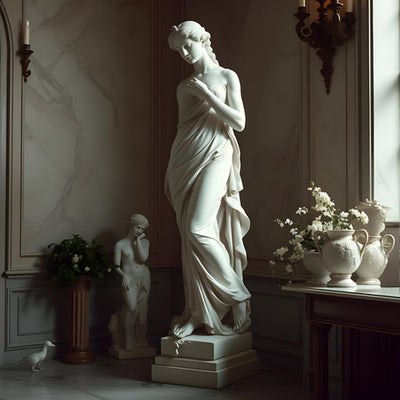
The Graces were carved to be walked around. The second of Canova's two versions, now held by the V&A and the National Galleries of Scotland, presses the three bodies so close that the composition becomes one closed silhouette. Over water, that closed form gives a three graces statue real practical work to do. The core of the group hides a feed pipe, the three bodies frame the falling water from every side, and the eye never lands on an unfinished angle.
Scale decides how much of that you can use. Once a three graces statue reaches roughly 7 feet (210 to 230 cm), the core and plinth are large enough for a concealed feed to be planned during commissioning, rather than bolted on afterward. Below that height, a low spill at the feet is usually the cleaner solution.
Basin Diameter Versus Three Graces Statue Height
Our working rule is simple. The horizontal distance from the point where water leaves the sculpture to the basin rim should at least match the height it falls. Then add margin for wind. A three-figure group raises the stakes, because any drift lands on a face somewhere, and faces are where mineral tracks show first.
We learned this on a commission shipped to Napa. The basin was correct on paper. After the first summer the client sent photos of faint white tracks running from the eyes of the figure facing the afternoon breeze. We lowered the outlet, and the tracks stopped. Now we ask every client which way the prevailing wind blows before we sign off a basin.
Taller groups need the most room. With a 7.5-foot (230 cm) carving such as The Three Graces Marble Sculpture - 230cm, water released from a raised urn has a long fall and a wide scatter, so a generous basin is the cheapest insurance you can buy.

Where the Water Should Leave the Group
Three outlets cover nearly every project, and each suits a different garden.
Urn held aloft: the classical choice, with the most sound and the most splash. Best in bronze, in a wide basin, out of the wind.
Shell at the feet: a low, quiet spill that keeps the figures almost dry. Suits courtyards and terraces close to seating.
Hidden jets at the plinth: water rises around the group rather than from it. The most marble-friendly option, and the most contemporary in feel.
Marble, Bronze or Cast Stone Under Running Water
Marble is calcium carbonate, and hard water leaves limescale on a marble three graces statue within months. Acidic cleaners then etch the surface you were trying to rescue. The National Park Service advises using the gentlest cleaning method that works on stone, and that applies doubly to a carved face. Soft or filtered water and a regular rinse do more than any chemical.
Green streaks are a separate problem. On marble they are usually algae where water sheets slowly. On bronze, copper runoff can stain a pale stone basin green, so we often pair bronze groups with a darker granite basin or advise clients to treat the staining as part of the patina. If you want the full urn-held-aloft effect with water running over the figures, a cast group like the Large Classical Three Graces Bronze Sculpture is the more forgiving choice, since its 220 cm height leaves room to route the feed through the plinth.
Rust bleed almost always comes from hidden steel: ferrous fixings, or an iron armature inside cast stone. We specify stainless steel or bronze fixings throughout.
Winterizing a Three Graces Garden Statue
Water expands as it freezes, in marble pores and in copper pipe alike. A split fitting inside a bronze three graces statue is a far bigger repair than a cracked basin. In Aspen or upstate New York, make drain-down a fixed habit: pump off, lines drained and blown through, basin emptied, and a breathable cover over the group rather than tight plastic, which traps condensation.
Coastal California and southern Texas can often run year-round, but a single hard night still splits unprotected pipework. Fit a drain valve at the lowest point of the system when you install, not after the first leak.

Sightline and Splash: Placing the Basin
The best Three Graces fountains are heard first. Set the basin slightly off the main axis from the front door or terrace, so guests catch the sound, turn, and find the group. On a Hamptons lawn that might mean a clearing at the end of a path; in a Texas courtyard, a corner where the walls carry the sound back to the house.
Courtyards reward a smaller three graces statue. Close to seating, a 3-foot 3-inch (100 cm) carving such as The Three Graces Marble Sculpture over a shell spill keeps the marble largely out of the flow and the sound at conversation level.
Keep paving out of the splash zone. Wet stone underfoot is a slip risk, and mineral rings on limestone pavers are harder to remove than marks on the sculpture itself.
Buyer Checklist Before You Commission
Test your water hardness before choosing marble.
Confirm your frost zone and who will handle drain-down.
Choose the outlet (urn, shell or plinth jets) before sizing the basin.
Walk the main viewing points and note wind direction.
Plan power, pump access and a drain valve at the lowest point.
Check delivery access for crane or lifting equipment.
Budget depends on material, scale, carving complexity, plumbing engineering, installation and finishing, so we quote each fountain individually. Giant Sculptures can adapt a Three Graces group in bronze or marble for water, and we test the plumbing in the studio before crating. Send us your site photos and wind direction, and we will tell you honestly which version suits your garden.
For wider placement ideas, How to Place a Three Graces Marble Sculpture so All Three Figures Read is useful companion reading before finalising the setting and sightlines.