





































































































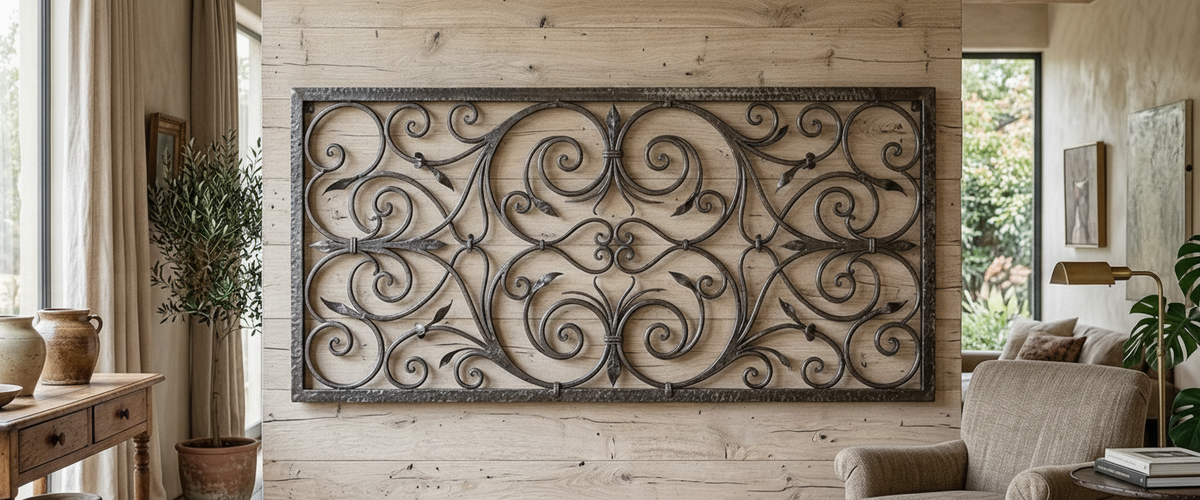

Put a piece of wrought iron wall art under low afternoon light and it confesses immediately. Real forged work throws shadow in a hundred small places: the dimpled skin left by the hammer, the way a bar swells at a bend and thins at a tip, the slight asymmetry of two scrolls that were turned by the same hand on different mornings. Laser-cut sheet steel painted black stays flat and even under the same light, because nothing about it ever moved while hot. Both get sold under the same search term, often at similar prices. Only one of them was ever shaped by heat and hand.
Hammer texture and a tapering end: the two fastest tells in hand-forged work.

At a Glance: What Separates Forged from Fabricated
Two panels of wrought iron wall art can look identical in a thumbnail and still be separated by twenty hours of labor at the anvil. Here is where the difference shows up in person.
Surface: forged iron carries hammer texture and scale; cut sheet is uniform and machine-smooth.
Ends: hand-drawn tapers and leaf ends show tool marks; punched sheet ends are identical across every element.
Joins: collars, rivets and forge welds signal craft; ground-flat tack welds usually signal speed.
Depth: forged panels sit in three dimensions and cast shadow; flat cut-outs read as silhouette only.
Weight: a serious panel can run 40 to 80 pounds (18 to 36 kg) or more, which changes how you fix it.
Finish: wax, lacquer, paint or galvanizing each suit different climates, and the wrong one fails fast outdoors.
Hammer Marks and Tapered Ends: The Tells in Wrought Iron Wall Art
True wrought iron in the historic sense is a low-carbon, slag-streaked material that is now rare; most contemporary forged work uses mild steel worked hot at the anvil, which the trade still calls wrought ironwork. The Artist-Blacksmith's Association of North America is a useful place to see what hot-worked steel looks like when it is done properly. What matters to a buyer is process, not vocabulary. Heat changes the metal's shape from the inside, so a forged bar tapers with a subtle spiral, thickens where it was upset, and keeps the faceted memory of the hammer face.
Run your thumb along the back of a piece. Hand-forged elements are rarely perfectly flat on both faces. Cut-and-weld pieces are, because they started as a sheet on a bed. Neither approach is dishonest, and good fabricated metalwork has its place, but pricing should follow labor. If a large panel is described as hand-forged and every leaf is a clone of every other leaf, you are looking at a die or a laser, not a blacksmith.

Why Hand-Turned Scrolls Still Read at Ten Feet
Scale is the honest test. Stand back ten feet (3 m), which is roughly how most people see a wall piece in a great room or a hotel lobby, and machine bends go flat. A press brake makes a constant-radius curve, and the eye registers it as a diagram. A scroll turned on a bick tightens as it winds, so the curve accelerates. That acceleration is what your peripheral vision picks up before you consciously read the shape. Large wrought iron wall art has to survive that viewing distance, and only hand-turned curves reliably do.
This is why we advise clients to mock up a footprint in painter's tape before committing to size. On a Napa wine-country commission, the architect wanted a forged panel 5 feet (1.5 m) wide over a fireplace; taped out, the chimney breast swallowed it. We went to 8 feet (2.4 m) and the room finally settled. Big walls eat detail, and delicate scrollwork sized for a hallway looks apologetic on a double-height stone chimney. Browse a broad range in our iron art and wrought iron wall decor collection to calibrate what a given span really covers.
Not every wall wants forged mass at that scale. In a narrow corridor or a shallow alcove where the sightline is three feet rather than ten, applied relief carries the shadow work that heavy scrollwork would otherwise provide, and something like Blossomkin Bird 3D Floral Wall Art is closer to the right design language than a scaled-down iron panel pretending to be a big one.
Collars and Rivets Versus Tack Welds
Joins tell you who made the thing. A collar is a wrapped band of hot steel that clamps two bars together, and it leaves a visible, slightly rumpled ring. Rivets show a domed head. Forge welds leave a faint seam and a thickened junction. All three are slower than reaching for a MIG gun, which is exactly the point: they are declarations of method.
Tack welds are not automatically bad. Structural connections behind the visible face of large wrought iron wall art often need modern welding to be safe, and we specify it deliberately on pieces over 6 feet (1.8 m). What should worry you is a decorative front face held together by welds that have been ground smooth and painted over, because grinding removes the metal's history and paint hides the repair. Ask for photographs of the reverse before you buy. Any serious maker has them.
Rust as a Finish, Rust as Failure
Interior wrought iron wall art is easy: a hot-waxed finish over black scale, refreshed once a year with a soft cloth, holds up indefinitely in a climate-controlled home. Lacquer gives a glossier, harder skin, but when it eventually chips it traps moisture underneath and rust blooms in a ring. We have replaced lacquered panels from a Hamptons pool house for exactly that reason; salt air found the pinholes within two seasons.
Outdoors, choose deliberately. Hot-dip galvanizing gives sacrificial zinc protection and is the least glamorous but most reliable route for coastal or freeze-thaw sites; the American Galvanizers Association publishes service-life data by environment. Painted-over-galvanized work reads closest to traditional ironwork. A controlled rust patina can be handsome on a garden screen, but understand that it is active corrosion, it will stain limestone and stucco below, and thin sections will eventually lose material. For permanently weathering exteriors we usually steer clients toward Corten or stainless instead, which you can compare in our metal wall art range.

Wrought Iron and Wood Wall Art Without the Craft-Fair Look
Iron and timber is a proven pairing, and it goes wrong in predictable ways. Thin iron on thick wood looks like hardware. Orange-toned varnished pine drags the whole composition toward a roadside gift shop. What works is contrast in mass and restraint in color: heavy forged bar against pale quarter-sawn white oak, or a dark waxed panel floated an inch clear of reclaimed barn timber so shadow does the framing. Keep the wood matte and low-chroma.
A dark waxed forged panel held an inch off quarter-sawn oak, so shadow does the framing.
Wrought iron and wood wall art also benefits from breathing room. Timber moves with humidity, so fixings through wood should be slotted rather than pinned rigid. If you are grouping pieces, a quieter framed set such as Kansora Woodland & Floral Nature 2-Set Framed Wall Art can flank a forged centerpiece without competing for attention, and our wood wall art selection is a useful place to test tone against your iron finish before you commit.
What 66 Pounds of Forged Panel Needs Behind the Plaster
Weight is where most disappointments start. A 30 kg (66 lb) piece of wrought iron wall art is not going on drywall anchors, whatever the packaging says. Locate studs and bolt into them, or fit a hardwood or steel batten spanning at least two studs and hang the panel from that. On masonry, use resin-anchored fixings rather than plastic plugs. For anything cantilevering forward, remember the load is not purely vertical; the lever arm multiplies pull-out force at the top fixings.
Weight also rules some rooms out entirely. Above a cot or a low bed, forged edges and 30 kg of steel are the wrong answer regardless of how good the fixings are, and a soft-fronted display piece such as Cuddiloft Panda Plush Display 3D Wall Art solves that placement without asking the wall to carry structural load.
Quick Buying Checklist
Ask for close-up photos of a tapered end, a join, and the reverse face.
Confirm shipped weight and the number of fixing points supplied.
Tape out the full footprint on the wall and view it from your usual seat.
Match finish to environment: wax inside, galvanized or coated outside, patina only where staining is acceptable.
Check whether depth is real relief or printed shadow, especially with 3D wall art styles.
Ask what maintenance the maker expects in year one, year five, year twenty.

Commissioning a Bespoke Piece
Most of the large wrought iron wall art we make at Giant Sculptures starts as a wall dimension and a mood, not a catalog number. We work from elevation drawings, agree a scaled maquette or full-size paper template, then forge to that. Budget depends on material, span, complexity of the forging, engineering for the fixings, finishing system and installation, so the sensible next step is a tailored quote rather than a guess. Tell us the wall, the climate and the sightline, and we will tell you what the metal can honestly do.
For wider placement ideas, Bronze Metal Wall Art: How Placement Changes What You See is useful companion reading before finalising the setting and sightlines.