





































































































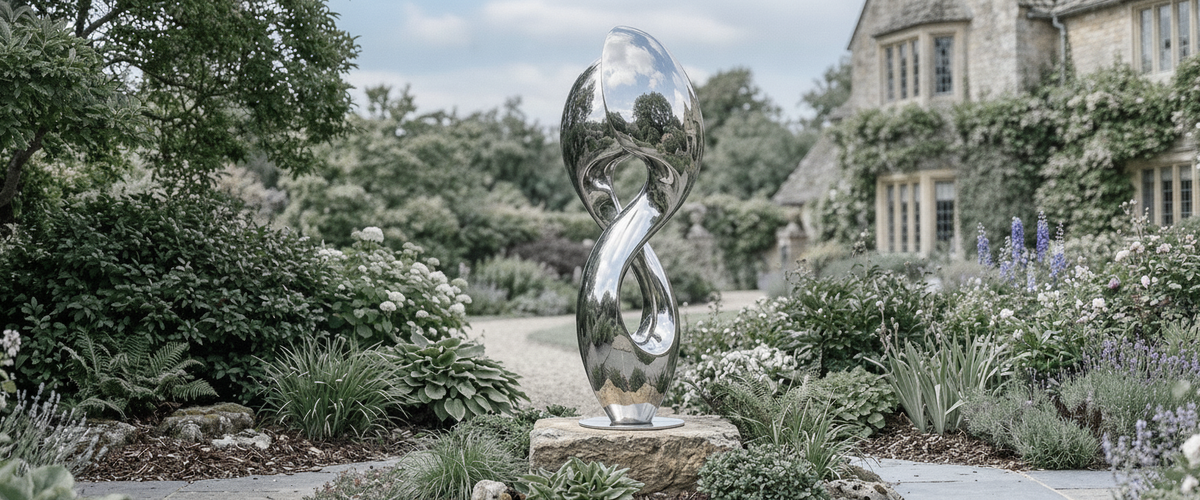

The piece you approve in June is not the piece you live with in January. That single fact catches out more buyers of stainless steel garden sculptures than budget, lead time or shipping ever does. A mirror-polished form reading as liquid light against a hedge in full leaf can flatten into a cold blank once the foliage drops and the sky turns gray. Choose the finish, grade and backdrop deliberately and the opposite happens: one form quietly becomes four sculptures across the year.
Looking for the full range in this category? Browse our Stainless Steel Sculptures collection for every available finish, size, and configuration.
A reflective form borrows its color from whatever sits behind it, which is why the backdrop is part of the specification.

Key Takeaways Before You Choose
The short version, before the detail: the best stainless steel garden sculptures are chosen for their site, not only for their shape.
Finish drives mood. Mirror amplifies whatever surrounds it. Satin and brushed hold their own tone in flat winter light.
Grade follows geography. 304 suits most inland gardens; 316 is the sensible call within reach of salt air or pool chemistry.
Backdrop is part of the purchase. Evergreen structure behind a reflective piece keeps it legible in January.
Weight is not stability. Hollow fabricated forms need engineered ballast and a foundation sized for wind load.
Care is technique, not effort. Wiping in the wrong direction lays scratch patterns into polish that no amount of cleaning removes.
One Form, Four Seasons
Reflective metal has no fixed color. It borrows, and that is what sets stainless steel garden sculptures apart from stone or bronze. In April a polished surface picks up new growth and reads green-tinged and soft; by August it deepens with canopy shadow; in October it flares with copper and rust tones from the planting around it; in February it takes the sky, which across much of the northern US is a low, even gray. Judge a piece from a summer photograph and you have seen roughly a quarter of what it does.
Curved, organic forms handle this shift better than flat planes, because a curve gathers several sources of light at once and always keeps a bright edge somewhere. A twisting form of around 96cm (roughly 3 ft 2 in) works on a terrace or plinth precisely because its surface never presents one dead face to the viewer. Flat-panel geometry is sharper and more architectural, but it demands a backdrop with real contrast or it disappears against a pale wall in winter.

Brushed, Satin or Mirror: What Each Finish Hides
Most stainless steel garden sculptures are offered in three finish families, and each one hides something different. Mirror polish flatters form and exaggerates everything else. Every fingerprint, water spot and pollen film shows. It also exaggerates the setting, which is a gift in a garden with structure and a problem in a bare one.
Satin and brushed finishes carry a directional grain that scatters light rather than throwing it back. They hide water marks, tolerate a busier planting scheme, and keep a consistent silvery tone regardless of what the sky is doing. For gardens that are only visited at weekends, or commercial courtyards without daily maintenance, brushed is usually the more forgiving specification. Gold-toned and colored PVD coatings sit somewhere in between, adding a warmth in winter that plain silver lacks. Where the piece also has to register after dusk rather than only in daylight, a lit gold-finished form such as Luminous Stag at 212cm (roughly 7 ft) carries a garden through the dark half of the year in a way untreated polish cannot.
304 versus 316: The Grade a Coastal Garden Picks for You
Both grades resist corrosion through a self-repairing chromium oxide film. The difference is molybdenum, which 316 adds and which sharply improves resistance to chlorides. Salt spray, de-icing runoff and pool splash all count as chlorides. Industry guidance from worldstainless is consistent on this point: exposure environment, not appearance, should drive the grade decision for stainless steel garden sculptures.
One Hamptons client came to us after installing a 304 piece roughly 200 yards from open water. Within two summers it developed the brown speckling installers call tea staining. Cosmetic, not structural, but it needed professional refinishing. Anything within a mile or so of surf, or beside a saltwater pool, should be 316. Slender bird and animal forms are the least forgiving of all, so for a piece like Crane sited at a pool edge or pond margin we will usually specify the higher grade with a fine-polished finish, simply because thin legs and narrow sections have less material to spare.
Within salt spray range, 316 with a brushed finish is the safer specification.

Why Mirror Finish Needs Planting Behind It
Reflective stainless steel garden sculptures only work if there is something worth reflecting. Set a polished piece against an open lawn or a light rendered wall and by December it becomes a pale smudge in a pale scene. Set the same piece against yew, holly, a dark stained fence or a mass of ornamental grasses left standing through winter and it stays sharp all year.
Scale changes the calculation too. Where the planting cannot supply that contrast, height can: at 226cm (about 7 ft 5 in), Molecular rises clear of a mature hedge and reads as a silhouette against open sky, which holds up even on flat gray days. Smaller pieces have no such luxury and depend entirely on what sits immediately behind them. Decide the backdrop before you decide the sculpture.
Ballast, Wind Load and the Plinth Nobody Sees
Large stainless steel garden sculptures are usually fabricated hollow. That keeps them shippable and, on a windy Texas ridge or an exposed Aspen slope, turns them into sails. Stability comes from the base detail: a steel plate cast into a reinforced concrete pad, chemical anchors sized for the overturning moment, and a plinth that carries the load into ground below the frost line.
Practical things to settle before the crate leaves us:
Site exposure and prevailing wind direction, plus any funneling between buildings.
Ground conditions: made ground, clay and shallow bedrock all change the foundation design.
Fixing method, whether bolt-down, cast-in, or a pinned stone plinth.
Access route for craning or hand-carrying, including gate widths and overhead cables.
Whether the piece needs to be removable for winter storage or refinishing.
A Cleaning Routine That Keeps Polish Sharp
Well-made stainless steel garden sculptures ask very little, but what they ask is specific. Most damage to polished steel comes from cleaning it badly, not from weather.
Rinse first. Flush grit off with clean water before any cloth touches the surface. Dragging dust across mirror polish is how fine scratch patterns start.
Wash with mild detergent and warm water, using a soft microfiber cloth. Follow the grain on brushed finishes; use straight, overlapping passes on mirror.
Never use steel wool, wire brushes or chloride-based cleaners. Free iron particles embed in the surface and rust. ASSDA publishes clear guidance on cleaning methods and tea stain prevention.
Dry with a clean cloth to stop mineral spotting from hard water.
Rinse more often near the coast. Quarterly is fine inland; monthly freshwater rinsing is realistic within salt spray range.
Book professional repolishing every few years if the piece is mirror-finished and heavily handled.

How to Brief a Bespoke Commission
Most of the stainless steel garden sculptures we make to order start with a photograph of the site rather than a sketch. Send the view you actually look at, the season it was taken in, and the sightline that matters most. From there we work through grade, finish, wall thickness, internal armature, base detail and installation sequence. Browsing the stainless steel garden sculptures for sale across our wider metal sculptures collection first is a useful way to identify the language you respond to before a bespoke conversation.
On budget, there is no honest shortcut: material grade, height, complexity of the fabrication, engineering for wind load, finishing hours and installation all move the number. Send us the site details and we will quote it properly rather than guess.
For wider placement ideas, Large Abstract Garden Sculptures: A Buyer's Guide to Scale, Metal, and Placement is useful companion reading before finalising the setting and sightlines.