





































































































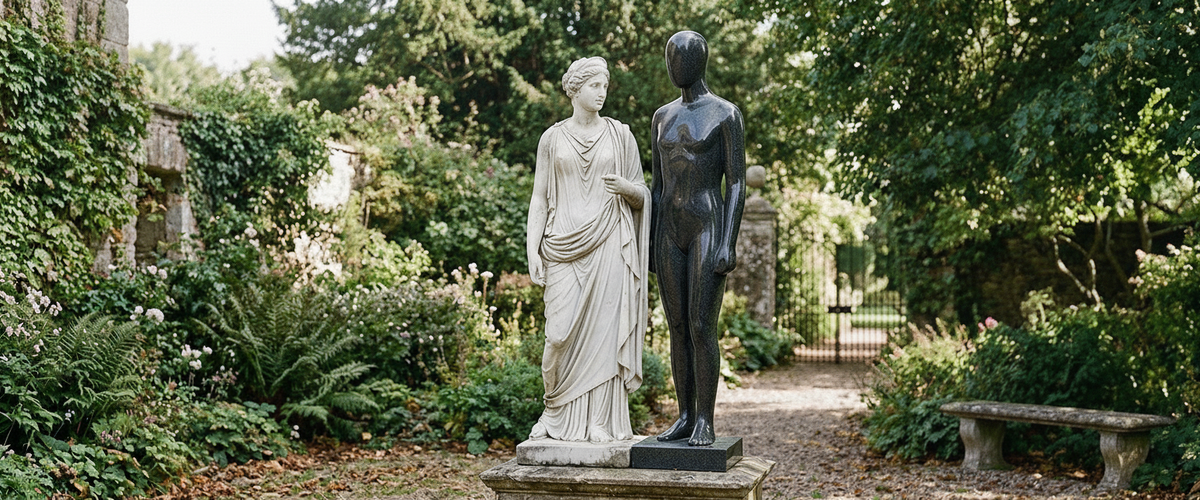

Two figures, one garden, twenty winters of the same weather. The granite one still holds a crisp edge along the collar. The marble one has gone faintly sugary across the shoulders, and eyes that once read from thirty feet now need you at ten. Here is the short answer most buyers are after: among marble granite statues, granite wins outdoors wherever frost and acid rain do the judging, while marble wins wherever someone stands close enough to read an eyelid. Same site, same rain, different rock. The deciding factor is crystal size and how each stone handles water, and that choice outlives everyone who argues about it at the planning stage.

Quick Answer: Marble or Granite
Marble carves finer. Fingernails, eyelids, tendons, drapery folds. It is the stone for portrait busts and anything you will stand close to.
Granite lasts harder. It resists frost damage, acid rain and abrasion far better, but its coarse crystals fight small detail.
Freeze-thaw climates (Aspen, New England, the Hudson Valley, northern Britain) punish outdoor marble faster than mild coastal sites, which is why we specify marble granite statues by climate before subject.
Weight and access matter earlier than most buyers expect with marble and granite statues. Granite runs roughly 165 lb per cubic foot (about 2,650 kg per cubic meter).
Cleaning is stone-specific. A routine that keeps granite bright will slowly erode marble.
Crystal Size Explained: The Detail Marble Holds and Granite Blunts
Marble is recrystallized limestone, made of interlocking calcite grains that are usually small and even. A carver can cut across them in almost any direction and the stone holds an edge, which is why classical portraiture, drapery and anatomy belong to marble. Granite is an igneous rock built from visibly separate crystals of quartz, feldspar and mica. Those crystals are hard, unevenly sized and unevenly colored, so a fine line carved across a feldspar crystal disappears the moment it crosses into quartz. Crystal size, more than price or fashion, sorts marble granite statues into the jobs each rock is actually good at.
The same jawline carved in each stone: marble keeps the line, granite breaks it up between crystals.
The practical rule from our studio for marble and granite statues: the closer a viewer will stand, the stronger the case for marble. A bust on a hallway plinth in a Manhattan apartment lives at conversation distance and needs marble's precision. A granite figure reads best at fifteen feet or more, where mass and silhouette do the work. Browse our marble busts and torsos and you can see how much information the stone carries in a jawline; try to reproduce the same passage in granite and you lose about half of it.
Frost, Acid Rain and Sugaring: How Marble Granite Statues Age Outdoors
Marble is calcium carbonate, and calcium carbonate dissolves in mildly acidic rain. Rainwater picks up atmospheric carbon dioxide and sulfur compounds, and over decades it etches exposed surfaces, rounding off crisp carving and eventually loosening grains at the surface. Conservators call the resulting granular crumble sugaring, and the US Geological Survey's work on acid rain documents the same chemistry on marble headstones and monuments. It is the single biggest reason marble and granite statues age at such different speeds on the same lawn.
Frost does the mechanical half of the damage. Water enters micro-porosity, freezes, expands and pops grains off the surface. Repeat that a hundred times a winter on a north-facing shoulder that never dries, and you get the soft, blurred look people mistake for age when it is actually decay. Granite's low porosity and hard crystal structure make it dramatically more resistant, which is exactly why granite headstones outlast marble headstones in the same cemetery by generations. Plenty of marble granite statues do survive hard winters, but only where the site does half the work. If you want a marble figure outdoors in a hard-frost climate, plan for a covered position, a sheltered niche, or a winter cover as part of the purchase, not as an afterthought.

Busts, Fountains and Gazebos: Matching the Stone to the Job
Different objects put different demands on stone. Marble and granite statues busts fountains gazeebos and sculptures (yes, that is how a good share of our inquiry emails spell gazebos) are not interchangeable commissions, and the material decision should follow function.
Portrait busts: marble, almost always. Interior or covered exterior placement.
Fountains and water features: granite for basins, spouts and anything with constant wet-dry cycling; marble only for the sculptural centerpiece, and preferably above the splash line. Constant water on marble accelerates etching and encourages biological staining.
Gazebos, colonnades and pavilion columns: granite for load-bearing elements, marble for capitals and decorative panels under cover.
Animal and abstract garden pieces: either, depending on how much of the design lives in fine surface detail. Most of the marble granite statues we ship for private gardens sit in this group.
That last category is where the material argument for marble and granite statues gets more forgiving. A dark, dense marble copes with outdoor life far better than a soft white statuary marble, and a form such as the Gacko Black Marble Triple Bear Sculpture, 200cm survives weather precisely because mass and silhouette carry it; there is very little incised detail for frost and rain to blur. Scale the same design down for a courtyard and the logic still holds, provided the viewing distance comes down with it.
What a Granite Figure Asks of Your Paving, Base and Access Route
Stone punishes optimistic logistics. Marble granite statues arrive crated, heavy and completely unforgiving of a gate that measures short. We shipped a granite group to a Napa hillside garden where the client had a beautiful gravel path and a gate exactly four inches too narrow for the crate. The crane had to reach over a wall, and the reach determined the crane class, which determined a third of the installation cost. Sort the route first.
Most stone installs sit on a poured pad or spread footing sized to the piece, not on sand-laid paving.
Three questions to answer before you sign off on marble and granite statues: what does the finished piece weigh with its plinth, what will the ground under it do in wet weather, and how does it get from truck to final position. Solid stone concentrates enormous point loads. A slab patio laid on sand will settle unevenly under a granite figure and tilt it within two seasons, so most of our stone installs sit on a poured concrete pad or spread footing sized to the piece. Ask your supplier for crate weight and base dimensions in writing and hand them to your landscape contractor early. Where the terrace is already built and a crane day is out of the question, a small carved piece such as the Snail Marble Sculpture, 60cm can be set by two people on existing paving with no groundwork at all, which is often the difference between a project that happens this season and one that waits a year.

Polished, Honed and Flamed Finishes Under Flat Light
Finish changes a stone's personality more than most buyers realize, and it is usually the last big decision on marble granite statues. Polished granite goes almost black when wet and mirrors the sky, which looks superb in bright Texas sun and can look like a dark hole under gray overcast. Honed surfaces read matte and even, holding their color in flat northern light where polish just glares. Flamed granite, thermally textured until the surface spalls into a rough grip, gives sculptural mass a tactile skin and hides rain-streaking well.
Marble runs from polished to honed to a fine tooled finish, and this is where marble and granite statues part company fastest outdoors. Polished marble outdoors is a short-lived pleasure; the shine etches away within a few years of acid rain. Honed or lightly tooled marble ages more gracefully because there is no gloss to lose. Indoors the calculation reverses, and high polish against metal becomes the point: where a lobby or stair hall wants reflection rather than classical weight, the Gold Mirror Molten Drip Marble Pedestal Sculpture, 110cm is closer to the right design language, and it lives somewhere no acid rain will ever reach it.
When Bonded Marble or Cast Stone Is the Honest Answer
Sometimes solid stone is the wrong specification, and saying so is part of the job. Roof terraces and cantilevered decks have structural load limits. Some interiors have no crane access. Certain forms, especially thin outstretched limbs or wide sweeping curves, are structurally fragile in natural marble but reliable in a cast material. Bonded marble and cast stone use crushed stone in a binder, giving genuine stone content with better tensile behavior and a fraction of the weight. The US National Park Service's guidance on cast stone in historic buildings is a useful primer on how convincingly the material has performed for over a century.
Cast materials also weather differently, so match them to the setting rather than treating them as a straight stand-in for solid marble granite statues at close viewing range.
Cleaning Routines That Suit One Stone and Ruin the Other
Marble: rinse with clean water and a soft natural bristle brush. Use a pH-neutral stone cleaner only when needed. No vinegar, no lemon, no acidic patio wash, ever.
Granite: tolerates firmer brushing and mild detergent. Still avoid strong acids on polished surfaces, which can dull the shine.
Both: keep pressure washers away from marble granite statues. High pressure drives water into micro-cracks and strips weathered surface grain irreversibly.
Biological growth: treat algae and lichen with a proprietary biocide made for stone, applied in dry weather, then rinse gently. Scraping takes the stone with the lichen.
Seasonal: in hard-frost regions, clear standing water from horizontal surfaces and drain fountain basins before the first freeze.
Annual check: look at the base joint, the fixings and the plinth level. Most stone failures start at the bottom.

Commissioning Stone That Suits Your Site
For wider placement ideas on marble and granite statues, Marble Garden Statues: What Winter Really Does to White Stone is useful companion reading before finalizing the setting and sightlines.
At Giant Sculptures we specify marble granite statues around the site before the subject, because a superb carving in the wrong rock becomes a maintenance problem within a decade. Bespoke work starts with your climate, sightlines, viewing distance, access and base conditions, then moves to material, scale and finish. Budget follows the same logic: stone type, block size, carving complexity, engineering, transport and installation all move the number, so we quote each commission individually rather than publishing bands that mean nothing. Send us a site photo and a rough scale, and browse the marble sculptures and statues collection to sharpen what you actually want to look at for the next fifty years.