






































































































Type clip art hallway into a search bar and you get exactly what you would expect: flat vector corridors, cartoon doors, dashed runner rugs and a stack of free printables. As a planning tool it earns its place. Designers sketch corridors this way because it strips a hallway down to proportion and rhythm before anything gets bought. The problem starts when the clip art hallway mood board becomes the purchase, and a 24-foot (7.3 m) passage ends up with three small posters floating in the middle of a big blank wall.

Key Takeaways
A clip art hallway layout is a proportion study. Use it to test spacing and sightlines, then buy real work sized to the wall, not to the sketch.
Corridors punish thin, small, low-contrast pieces. Scale and relief depth matter more here than in any other room.
Depth is your constraint: in a passage under about 42 inches (107 cm) wide, keep projection tight so shoulders and luggage clear the wall.
Framed graphic works, bronze low relief, cast stone panels and polished stainless steel all read differently under corridor lighting than they do in a clip art hallway drawing. Sample before committing.
Budget depends on material, scale, engineering, finishing and installation. Ask for a tailored quote rather than guessing from a clip art hallway mood board.
Clip art hallway illustrations are useful for testing spacing and sightlines before anything is bought.
What a Clip Art Hallway Actually Means, and Who It Suits
Two groups search for clip art hallway ideas. The first group is planning: homeowners, interior designers and facilities managers who want a quick visual of how art for hallways could sit along a run of wall. Flat illustration is perfect at that stage because it forces you to think in blocks and gaps instead of falling for one picture you like. The second group wants downloadable graphics to print and frame cheaply, which is a fair choice for a rental corridor or a temporary office fit-out.
Where that approach falls apart is longevity. Inkjet prints on light paper fade, cockle in humidity and look tired within a few years, and hallways are often the most abused space in a building: door swings, wheeled bags, vacuum cleaners, contractors carrying boxes. The Library of Congress is blunt about how quickly light and poor materials degrade paper-based works, which is why its preservation guidance pushes stable mounts, glazing and controlled exposure. If a corridor is on a five-year plan, printing straight from a clip art hallway file is fine. If it is the spine of a house you intend to keep, buy once.
Materials, Finishes and Scale Decisions for Hallway Art
Corridors are viewed at an angle and at speed. You rarely stand square to a hallway wall, so surface behavior does more work than fine detail, and surface behavior is the one thing a clip art hallway graphic cannot show you. Three material families earn their place.
Framed Graphic and Architectural Works
Strong geometry survives being seen from the side, which is why the tall blocks of color in a clip art hallway sketch translate reasonably well into real work. Where a passage needs a graphic anchor rather than sculptural mass, a tall hard-edged composition such as Ecliptica Abstract Architectural Column Gold Frame Wall Art is the more workable format, because the vertical run carries the eye upward and the frame edge catches raking light from a wall washer. Vertical pieces also flatter tall corridors and stop the eye dropping to floor level. If you are hanging a series, keep frame profiles identical and vary only the image.

Relief and Metalwork
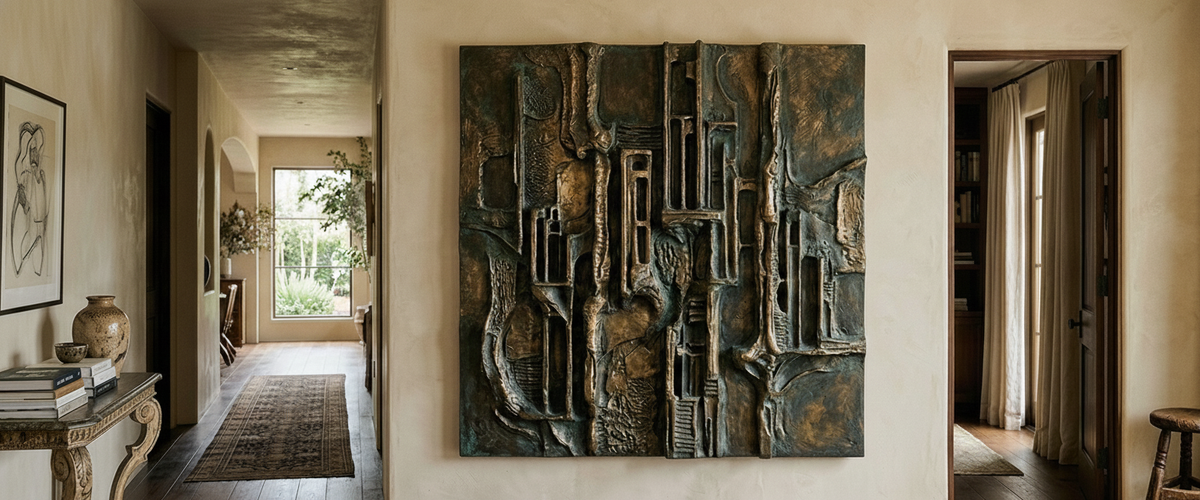
Bronze and cast stone low relief hold a corridor better than anything flat, because shadow does the talking as you walk past. Polished or brushed stainless steel behaves differently again: it picks up moving reflections, which can be beautiful in a wide gallery-style hallway and busy in a narrow one. No clip art hallway render will warn you about that. Brushed finishes calm it down. For a Dallas penthouse corridor we worked on, a brushed stainless relief panel replaced a mirror, and the client kept the reflective quality without giving every guest a full-length self-portrait on the way to dinner.
Scale Rules That Hold Up
Proportion is the one thing a clip art hallway layout gets right, so use it here. Aim for a piece or grouping that fills roughly two thirds to three quarters of the usable wall width between door casings and switch plates. Hang centers at about 57 to 60 inches (145 to 152 cm) from the floor, and lower rather than higher if the corridor has a low ceiling. In passages under 42 inches (107 cm) wide, keep total projection modest and choose rounded frame edges or a shallow relief over a deep box frame. Anything heavier than around 50 pounds (23 kg) needs a fixing into masonry or blocking, not drywall anchors, and a French cleat spreads that load far better than two hooks.
Where to Place Hallway Art for the Strongest Visual Impact
For wider placement ideas, Hallway Art That Actually Works: A Placement Guide for Narrow Spaces is useful companion reading before finalizing the setting and sightlines.
Test the layout in the space before you commit. Painter's tape on the wall in the exact outline of each piece takes ten minutes and saves an expensive mistake, and it is the honest version of the clip art hallway mockup. Walk the corridor at normal pace. If your eye skips past the tape, the piece is too small.
Angled light across a bronze relief on the terminal wall does the work no flat print can.
Four placements consistently work:
The terminal wall. The wall you face at the end of a hallway is the single most valuable spot in the house. Give it your largest and most sculptural piece; this is where a bronze or stone relief pays for itself.
Single long run. Hang one oversized work rather than five small ones. A rhythm of matched frames is the alternative, spaced 3 to 6 inches (7.5 to 15 cm) apart with consistent centers.
Stair landings and turns. A change of direction naturally slows people down, which rewards detail and texture.
Opposite a door or window. Pieces here get borrowed daylight, so avoid unglazed paper works and watch fading on any tinted finish.
Lighting is the quiet variable, and no clip art hallway diagram accounts for it. Ceiling downlights aimed straight down will graze a frame and skip the artwork entirely. Aim for a beam hitting the wall at roughly 30 degrees from vertical, which lights the surface and, on relief work, throws the shadow that makes the carving legible. The Smithsonian's Museum Conservation Institute publishes guidance on light exposure that is worth reading before you install anything bright and permanent over a sensitive surface.
Budget, Commissioning and Delivery Considerations
Buyers arriving from a clip art hallway search often expect corridor art to be the cheapest line in a project. Sometimes it is. But once you move to cast bronze, carved stone or engineered metalwork, cost is driven by material choice, finished size, pattern and mold work, surface finishing, the fixing system, crating and installation. Rather than working from a guessed figure, send us the wall dimensions and a photo. That takes minutes and stops the design running ahead of the budget.
Access is the thing buyers forget. Hallways are usually reached through other rooms, and a wide relief panel that fits the wall perfectly may not turn the corner at the top of a stair. We ask for door widths, stair turns and elevator dimensions early, and we have split large panels into two or three sections with a concealed joint precisely to solve that. A New York apartment corridor commission went in as three vertical modules for exactly that reason, and reads as one work on the wall.
Commissioning a bespoke piece follows a predictable path: brief and site measurements, scaled drawings or a maquette, material and finish samples for approval, fabrication, then crated delivery with installation guidance or a fitting team. Lead time depends on process, since casting and hand-finishing take longer than fabricated metalwork. Build that into the project schedule rather than the last two weeks of it.

Hallway Art Checklist Before You Buy
Measure usable wall width between casings, switches, thermostats and art lighting.
Record corridor width, ceiling height and door swing clearance.
Tape out the footprint from your clip art hallway layout and live with it for a few days.
Confirm wall build-up: drywall, plaster on masonry, or concrete, and locate blocking.
Check the fixing rating against the finished weight, including frame and glazing.
Assess natural light hours and any direct sun on the wall.
Plan lighting angle and beam spread before finishes are signed off.
Verify the delivery route from the front door to the wall.
Ask about cleaning: microfiber and pH-neutral products for metal and stone, never abrasive pads.
Get the fixing detail and care sheet in writing for long-term ownership.
How Giant Sculptures Helps With Bespoke Hallway Projects
Most of our work is large-scale, which changes how we look at a corridor. We treat a hallway as an architectural surface rather than the leftover strip a clip art hallway sketch tends to imply, and that usually means fewer pieces at greater size, in materials that will still look right in thirty years. Our hallway art collection is a good place to calibrate scale, and if nothing there fits your wall, that is what the bespoke route is for: existing designs resized, finishes matched to your hardware, or an entirely new relief developed from your brief.
Bronze, stainless steel, marble and cast stone all sit within what we make and specify, and we will tell you when a material is wrong for the space. Highly polished steel in a narrow, low-lit passage is one example; a deep-projection panel beside a swinging door is another. Send dimensions, photos and any drawings you have, and we will come back with options, finish recommendations and a quote built around the actual project rather than a clip art hallway template.
A clip art hallway plan is a good first hour of work. The next step is choosing something with weight, surface and a fixing detail that will hold up to decades of daily traffic, and that is a conversation worth having before the walls get painted.