





































































































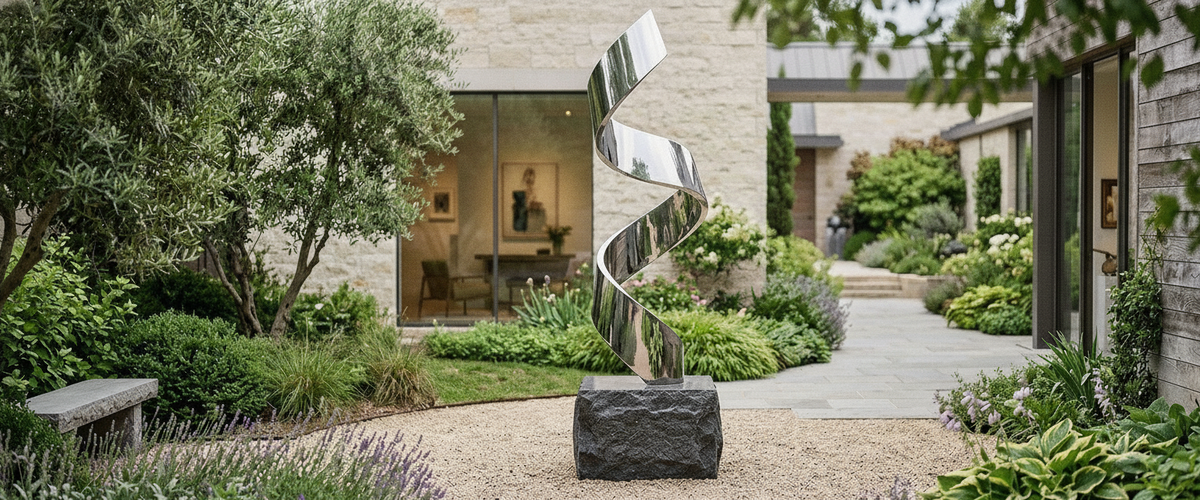

A visitor decides how they feel about your company before they reach the sign-in screen. Seconds, not minutes, from door to desk. The best sculptures for office spaces do their work inside that window and then keep working for the next fifteen years of foot traffic, cleaning carts and lanyard buckles swinging at hip height. Most corporate art gets picked for a photograph. It should be picked for a walk.

Quick Answer: What Works Where
Placement decides half the outcome, so the best sculptures for office spaces are chosen zone by zone rather than catalog page by catalog page.
Reception: one confident piece read from 20 to 30 feet (6 to 9 m), with a silhouette that survives backlighting from the glazing.
Atrium: buy height, not width. Vertical and suspended forms hold a multi-story void; wide horizontal pieces flatten out from the mezzanine.
Elevator lobby: viewed from four feet away, twice a day, forever. Weld quality and finish consistency matter more than size.
Breakout zones: assume the piece will be touched, leaned on and photographed. Specify solid material and a designed touch point.
Circulation routes: plinth footprint and protrusion clearance first, aesthetics second.
Boardroom: usually needs less sculpture than the corridor outside it.
The Reception Read Happens in Seconds
Reception is a glance, not a viewing. What registers is silhouette, material honesty and whether the piece looks like it cost something to make. Thin fabricated shells give themselves away at close range; the light bends wrong across the panel joints and the eye picks it up even when the brain does not. Solid bronze, forged stainless and carved stone read as substantial from any angle because they are.
Position matters as much as the object. Set the piece off the axis of the desk so visitors approach it obliquely and see it turn as they move. A sculpture parked dead center behind reception becomes wallpaper by week three. Something from our abstract sculpture range with a strong vertical twist works hard here because the profile changes every few steps.
Set off the desk axis, the profile changes with every step a visitor takes.

Atrium Voids Reward Height, and Most Buyers Get That Backwards
Clients walk into a three-story atrium, see acres of floor, and ask for something wide. Then the piece arrives and reads as a squat footnote from the second-floor walkway. Volume in an atrium is vertical. The best sculptures for office spaces built around a void are almost always tall: a rising column, a ribbon form or a piece suspended in the middle of the void does more with a fraction of the footprint, and it gives every floor a different view of the same object.
Mirror-polished stainless is the workhorse for these spaces because it picks up glazing, sky and the movement of people below. We specify our stainless steel sculptures for exactly that reason in lobbies where the light changes across the day. If the atrium opens onto an external courtyard, carry the idea outside with weathering steel; a Corten sculpture holds its own against planting and gray winter light in a way that painted steel rarely does.
Elevator Lobbies Are Seen from Four Feet Away
This is the most unforgiving location in any building. Staff stand in front of the piece twice a day, every day, with nothing else to look at. Grind marks, inconsistent patina and a sloppy plinth junction will be noticed, resented, and eventually mentioned in a facilities email. Specify a hand-finished surface, ask to see the weld treatment on a sample, and check the base detail where the sculpture meets the floor.
Scale down and refine up. Some of the best sculptures for office spaces at this viewing range are also the smallest: a modest cast bronze on a well-proportioned plinth outperforms an oversized piece crammed into a six-foot-deep lobby. Our bronze sculptures suit these close-viewing positions because the patina rewards attention rather than punishing it.
Breakout Zones: The Piece People Lean On
Anything within arm's reach of a sofa will be touched. Accept it and design for it. The best sculptures for office spaces built for sitting and talking are solid all the way through. Bronze polishes bright at contact points over years, which looks intentional when the form invites a hand and looks like damage when it does not. Solid stone and marble take the same treatment without complaint. What fails in breakout areas is anything hollow, anything with a delicate projecting element at shoulder height, and anything with a painted finish that chips into a bright white scar.
Assume photography too. If the piece sits where people take team shots, check what sits behind it in frame. A fire extinguisher cabinet in every LinkedIn post is a slow, quiet own goal.

Where a Beautiful Sculpture Becomes a Hazard Notice
Corridors and stair landings tempt buyers because they are empty. They are empty for a reason. Under the 2010 ADA Standards for Accessible Design, objects with leading edges between 27 and 80 inches (685 to 2030 mm) above the floor cannot project more than 4 inches (100 mm) into a circulation path. Wall-mounted reliefs and cantilevered forms get caught by this constantly. Floor-standing work needs a cane-detectable base and a footprint that keeps the required clear width intact.
Get the facilities manager and the building's access consultant into the conversation before you fall in love with a location. It is a ten-minute check that saves a piece from being relocated to a stairwell after the first inspection.
Fingerprints, Lanyards and the Cleaning Cart
Finish selection is where the best sculptures for office spaces are won or lost. A developer once pushed hard for a full mirror polish in a south-facing lobby with floor-to-ceiling glass. We specified a satin-brushed finish instead, and it still looks deliberate years later; the mirror version would have needed wiping twice a day. Brushed and satin surfaces hide handling. High polish demands a maintenance routine someone has actually agreed to.
Satin and brushed surfaces forgive fingerprints; mirror polish asks for a cloth twice a day.
For stainless, routine cleaning is mild detergent and warm water with a soft cloth worked along the grain, never abrasive pads or chloride-based products. The Nickel Institute publishes clear technical guidance on cleaning and maintaining architectural stainless if your facilities team wants it in writing. Bronze needs a wax cycle rather than polish. Corten needs a drainage margin: on one campus courtyard we specified a gravel bed and a sealed paving edge, because early runoff will stain pale concrete and nobody wants that conversation.
Why the Boardroom Needs Less Sculpture Than the Corridor Outside
Boardrooms are working rooms. People sit with their backs to the walls, the screen dominates one end, and a large sculpture competes with the only thing anyone is meant to be looking at. This is the one room where the best sculptures for office spaces are the quiet ones: a single small, excellent piece on a credenza is plenty. Spend the real budget on the corridor, the lobby outside and the client-facing route in, where the sculpture is seen in motion by everyone rather than statically by twelve people once a month.
Checklist: Specifying the Best Sculptures for Office Spaces
Walk the approach and note the viewing distance and the first angle of sight.
Confirm floor loading with the structural engineer, especially on suspended slabs and above parking levels.
Check delivery access: door widths, elevator car dimensions and turning clearance, or plan a crane lift.
Agree the anchoring method, whether resin-fixed, bolted or ballasted on a hidden plate.
Ask who cleans it, how often, and with what product. Get it into the building's maintenance schedule.
Request a finish sample and a weld detail before sign-off.
Book installation out of hours and confirm protection for finished floors.

Commissioning Something That Fits the Building
Catalog pieces solve plenty of briefs. Awkward atria, double-height voids and brand-specific forms usually need a commission, and the best sculptures for office spaces of that kind are the ones drawn around the building rather than dropped into it. At Giant Sculptures we work from site photographs, floor plans and sightline notes, then develop scale models and material samples before anything is fabricated. Budget depends on material, scale, structural complexity, engineering, finishing and installation access, so the sensible route is a tailored quote against your actual drawings rather than a guess against a category.
Choose for the walk, specify for the cleaning cart, and the piece will still look right long after the office furniture has been replaced twice.
For wider placement ideas, Metal Wall Art for the Office: Buy for the Room and the Camera is useful companion reading before finalising the setting and sightlines.