





































































































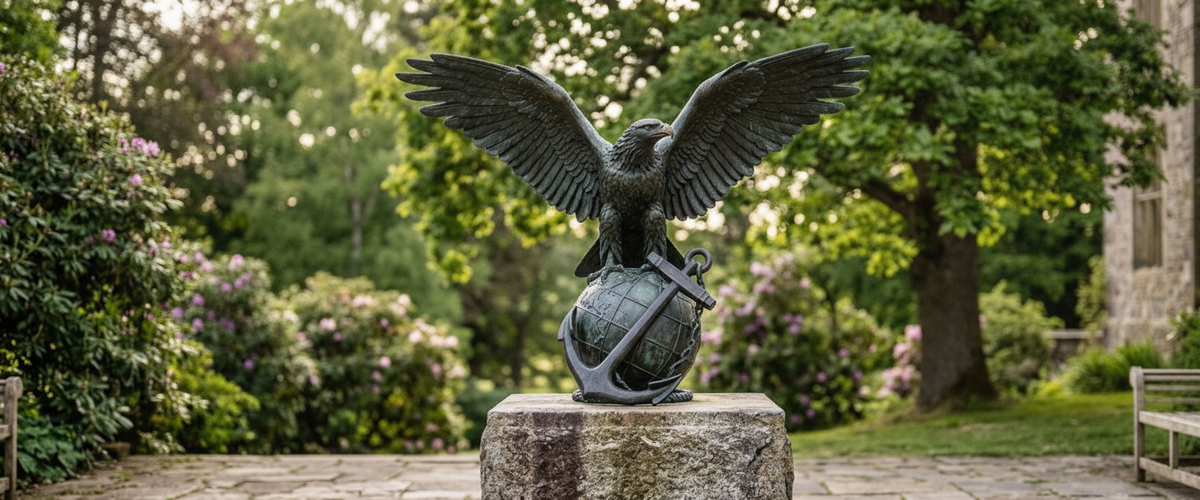

The sculpture that ends up on its side was rarely knocked down by a storm. More often a guest leaned in for a photo, or frost lifted one corner of a shallow pad a fraction of an inch each winter until the piece tilted. If you want to anchor outdoor sculpture properly, rank the forces honestly first. Then match the fixing to the material and the footing to the ground. At Giant Sculptures we ship large bronze, stone and steel pieces worldwide, and we settle the fixing detail in the studio long before the crate is built.
At a glance:
On most pieces under about 8 feet (2.4 m), people leaning and climbing are the load that decides the design. Wind takes over on tall, broad or sail-like forms.
Bronze is fixed through threaded studs cast or welded into its base, never glued.
Stone sits on a stainless steel pin and a mortar bed that can drain.
Stainless steel and Corten bolt through base plates into concrete, with rebar once size or wind area grows.
Lawn, gravel, decking and roof terraces each need a different footing.
Ask for drawings showing how the maker will anchor the outdoor sculpture at quote stage, not after delivery.

Wind, Frost Heave and a Visitor's Shoulder: Ranking the Loads
Wind is the load everyone worries about, and it matters most when a piece has a large flat face. Wind pressure climbs steeply as speed rises, so a broad Corten panel or a figure with outstretched wings works like a sail. A compact seated bronze of the same weight barely registers. When you anchor outdoor sculpture against wind, total weight matters less than how much surface faces the gusts and how high that surface sits above the base.
Frost heave is the slow, quiet one. Water collects under a pad, freezes, expands and lifts it, then lets it settle back slightly out of level. Repeat that for a few seasons and a plinth tilts. Any plan to anchor outdoor sculpture in a cold climate starts with a footing that reaches below the local frost line, which varies sharply between Napa and Aspen; the International Residential Code and your local building department set the depth for your county.
Why People Leaning and Climbing Outweigh Most Gusts
A person bracing against a figure pushes sideways at shoulder height, roughly 4 to 5 feet (1.2 to 1.5 m) off the ground. That long lever turns a modest push into a serious overturning force at the base. Wind spreads its load across the whole surface; a shoulder concentrates it in one spot, and often a narrow one: an arm, a horn, the rim of a bowl.
We test-rock freestanding pieces in the studio before they are crated. A figure that feels immovable standing upright can start to walk when someone hangs off one limb. Weight alone does not hold a piece in place: we have seen a heavy bronze set loose on gravel shuffled visibly out of square within weeks by guests perching on its plinth, and the only cure was to go back and bolt it down. Before you anchor outdoor sculpture in a garden, courtyard or hotel, assume it will be touched, sat on and climbed.
Bronze on Threaded Studs: The Fixings Are Cast In, Never Glued On
Our bronzes leave the foundry with stainless threaded studs fixed into the base, either cast into the metal or welded to internal bosses during fabrication. On site, those studs drop into holes drilled in the plinth and are set with a structural resin anchor or bolted through to a plate below. The resin grips the stone or concrete; the bronze itself is never glued to anything. Adhesive between metal and plinth degrades in sunlight, and it makes the piece almost impossible to lift and move later. Studs are simply the most reliable way to anchor outdoor sculptures cast in bronze.
Studs are fixed into the bronze at the foundry, then resin-set or bolted into the plinth on site.
Monumental scale changes the engineering. Once spread wings are carried high above the base, as on a 400 cm (about 13 foot) Eagle, Globe and Anchor bronze, the piece behaves less like a garden statue and more like a small structure: it needs multiple studs, a calculated plinth and a properly sized footing. Use stainless or silicon bronze hardware throughout. Plain carbon steel against bronze invites galvanic corrosion and rust streaks down the patina.

Stone on a Stainless Pin and Mortar Bed: The Frost-Safe Detail
Stone is heavy enough to resist sliding but brittle enough to crack if it is fixed rigidly. The detail we learned through British winters works just as well in Vermont or Colorado: a marine-grade stainless dowel set into matching sockets drilled in the base of the stone and the top of the plinth, with the stone bedded on mortar. The pin stops it walking; the mortar spreads the load evenly. Never use mild steel pins. They rust, expand and split stone from the inside, a failure well known to masons and covered in trade guidance from bodies such as the Stone Federation Great Britain.
A stainless pin stops the stone walking; the mortar bed spreads its weight and lets water drain.
Leave a drainage path at the joint so water cannot sit and freeze. When you anchor outdoor sculpture carved in stone, trapped water does more damage over time than any gust. A breathable lime-based mortar suits softer stones; marble and granite tolerate a stronger bed.
Stainless and Corten on Base Plates: When the Concrete Pad Needs Rebar
Fabricated steel sculpture is welded to a base plate, which bolts to concrete through cast-in or resin-set anchor bolts. A small pad of unreinforced concrete is fine for a low, compact piece. To anchor outdoor sculpture in steel that is tall, slender or carries a big wind face, the pad needs rebar and a depth set by an engineer, because the bolts are only as strong as the concrete holding them. With Corten, plan for runoff: early weathering stains pale paving, so set a gravel apron or dark border around the plate.
Lawn, Gravel, Decking or Roof Terrace: Each Ground Asks for a Different Footing
The ground under the plinth matters as much as the fixing, so the way you anchor outdoor sculpture on a lawn is very different from a roof terrace.
Lawn: a concrete footing below frost depth, finished flush or just below the turf, with a mowing strip so blades never strike the plinth.
Gravel: a hidden pad beneath the gravel. Loose stone is never a foundation.
Decking: do not fix to the boards. Bolt through to joists over a steel spreader, or bring an independent footing up through the deck.
Roof terrace: a structural engineer checks load capacity first. Drilling through a waterproof membrane is a last resort, which is why ballasted bases on spreader plates are common on New York roof terraces.

How to Anchor Outdoor Sculpture: A Buyer's Checklist
Confirm the finished weight and height, and ask where the center of gravity sits.
Identify the ground: soil, gravel, deck, slab or roof.
Check local frost depth and any permit rules for permanent structures.
Ask which fixings come built into the piece and what the installer supplies.
Request a fixing drawing for your contractor or landscape designer.
Plan for removal: bolted fixings let you take the work with you if you move.
Bespoke commissions make it easiest to anchor outdoor sculpture well, because we design the studs, pins or plates around your actual site from the first sketch. Budget depends on material, scale, complexity, engineering, installation and finishing, so ask us for a tailored quote that includes the fixing detail. Fix a piece with the same care that went into making it, and it stays put, level and safe for decades.
Once you know how you will anchor the outdoor sculpture on your site, Eagle Statue for a Memorial Garden: Wings, Gaze and Where You Sit is useful companion reading for wider placement ideas before finalizing the setting and sightlines.