





































































































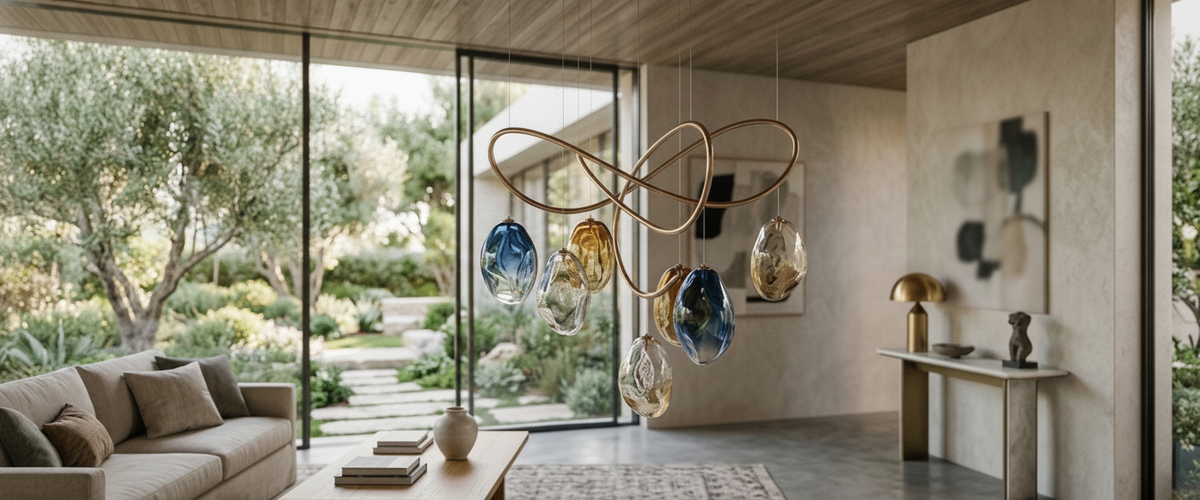

The lobby is the only room in a hotel that every guest walks through, usually while dragging a bag and scanning for the check-in desk. That is the real problem behind a hotel lobby metal sculpture. It has to register in about three seconds for someone who is not looking for it, survive a night cleaning crew with a damp cloth, and still photograph well at 6pm when the bar fills up and the lighting drops. Most specification documents cover height and budget. Almost none cover the parts that actually decide whether the piece works.

Quick Answer: What a Lobby Piece Really Has to Do
Before anyone draws a form, a hotel lobby metal sculpture has to clear five practical hurdles:
Read from three positions: the entrance, the check-in desk, and the elevator lobby. If it only works from one, it is a wall of blank metal for the other two.
Match the volume, not the floor plan: a double-height atrium punishes anything under roughly 8 ft (2.4 m).
Choose a finish that forgives hands: satin and hand-brushed stainless hide fingerprints; mirror polish records every one of them.
Solve the load path early: slab capacity, fixing points and anchor detail are the building manager's first three questions.
Design for the install window: most lobby pieces go in during a single overnight shift, which changes how the work is built and sectioned.

Hotel Lobby Metal Sculpture Design Starts With Three Sightlines
Walk the room before you draw anything. The first sightline is from the revolving door or main entrance, where guests see the piece at a distance and at an angle, often against backlight from the glazing. Silhouette does all the work here. The second is from the check-in desk, where people stand still for four or five minutes with nothing to look at. That is where surface detail, weld texture and finish quality earn their keep, because guests are close enough to study them.
The third sightline is the elevator lobby, and it is the one clients forget. Guests approach it from behind or from the side, often several times a day. A piece with a strong front and a dead back becomes a chore by day two of a stay. Every hotel lobby metal sculpture we build is tested against all three viewpoints, which is why we push abstract and semi-abstract forms with genuine 360-degree resolution, and why work with a clear reverse profile tends to outperform relief-style panels. Browsing our metal sculptures with those three positions in mind narrows the field faster than any mood board.
Suspended or Floor-Standing in a Double-Height Atrium
A double-height atrium is generous vertically and stingy horizontally, because the floor belongs to circulation, luggage carts and seating clusters. A suspended hotel lobby metal sculpture solves that. A hanging form draws the eye up, fills the volume that architects paid a fortune to create, and keeps the floor clear for the operations team. The trade-off is engineering: you need confirmed steel above the ceiling, a structural engineer's sign-off, and access for future inspection.
Floor-standing pieces give you presence at human scale and a much simpler approval path. They also give guests something to orient around, which is worth more in a busy lobby than most designers admit. For a hotel with a strong regional identity, a figurative anchor can carry the story better than abstraction. We have shipped bronze and steel work from our bull statues collection into corporate and hospitality lobbies where the animal reads instantly as a symbol of the city's trading history. The trick is plinth height: raise a floor piece too far and it blocks the sightline to reception; sit it too low and the queue at check-in hides it.

Stainless, Brass and Mild Steel in a Space Guests Touch Daily
Lobby metal gets handled. Children touch it, guests lean on it, wheeled cases clip it. Material choice for a hotel lobby metal sculpture should start from that fact rather than from a swatch.
Stainless steel is the workhorse. Grade 316 handles humid coastal cities and heavy cleaning chemicals better than 304, and it takes finishes from hand-brushed to mirror. The stainless steel sculptures we build for commercial interiors are usually specified in a satin or linished finish for exactly this reason. Published guidance on architectural stainless makes the same point: finish selection drives long-term appearance far more than grade alone.
Brass and bronze bring warmth that stainless cannot, and they age. Unlacquered brass will develop a patina from hand contact within weeks, which some operators love and others hate. If your housekeeping team expects a uniform look, lacquer it and plan for re-lacquering, or accept living patina as part of the design. The Copper Development Association publishes useful background on how copper alloys behave over time indoors.
Mild steel, painted or powder-coated, is the value option for large sculptural volumes and works well in high-ceiling atriums where the piece is out of reach. Down at hand height it scratches, and touch-up in a live lobby is awkward. We tend to reserve it for suspended or elevated work.
Fingerprints and Night Cleaning Crews
A hotel lobby metal sculpture is cleaned by people working at 2am, at speed, with whatever cloth is on the cart. Design for that reality.
Avoid full mirror polish below 6 ft (1.8 m). A mirror-finished mock-up in our studio reflected the cable tray and a stack of pallets straight back at us. In a lobby that is the luggage rack and the printer behind reception, so we moved the lower third to a hand-brushed finish.
Specify directional grain so wipe marks follow the brush line instead of crossing it.
Ban abrasive pads in the handover pack. Write it down. Hand it to the housekeeping manager, not just the designer.
Keep hollows drainable. Cupped forms collect cleaning fluid and dust in equal measure.
Leave a rescue route. Ask your maker how a scratch gets blended out in situ, without scaffolding, before you sign off.
Load Paths, Fixings and the Building Manager's Questions
Sign-off rarely fails on aesthetics. It fails on paperwork. Expect the building manager to ask for the finished weight, the point loads at each fixing, the anchor type and embedment depth, and whether the slab has post-tension cables or underfloor services in the drill zone. Suspended work adds questions about the primary steel, connection detail and the deflection allowance in the ceiling grid.
Two answers save weeks. First, get a base plate designed with more fixing points than the minimum, so the anchor pattern can shift on site if a scan finds a conduit. Second, ask for a stamped structural calculation as part of the commission rather than as an afterthought. Any serious hotel lobby metal sculpture project should include that from the outset.

Why the Overnight Install Window Changes the Design
Hotels do not close. Installation happens between roughly 1am and 5am, and the practical working window is often shorter once you account for floor protection and the goods elevator. That constraint should shape a hotel lobby metal sculpture from the first sketch, not the last week.
It means sectioning the work so every module fits the service elevator; on one commission the goods lift interior was under 7 ft (2.1 m) tall, so a tall vertical form was split into three flanged sections with concealed joints. It means dry-fitting the whole assembly in the studio and numbering every part. It means bolted connections rather than site welding, because hot work permits and fume in an occupied lobby are a fight you will lose. And the crating has to break down quietly and leave before breakfast service starts.
Commissioning Checklist Before You Approve
Photograph the lobby from the entrance, the desk and the elevators at morning and evening light levels.
Confirm ceiling height, structural capacity above, and slab type below.
Measure the goods elevator, door widths and any threshold steps on the delivery route.
Agree the finish at hand height separately from the finish above 6 ft (1.8 m).
Ask for a scaled maquette or full-height mock-up before fabrication begins.
Get the cleaning protocol, touch-up method and inspection interval in writing.
Set the install window and confirm access, protection and permit requirements with the operations team.
Budget depends on material, scale, structural complexity, finishing method and install conditions, so the honest answer is a tailored quote rather than a headline figure. Giant Sculptures builds bespoke work for hotel groups, designers and architects: a hotel lobby metal sculpture that survives a decade of hands, cleaning carts and camera phones without looking tired. Send us the lobby drawings and the three sightline photographs, and the conversation starts from something real.
For wider placement ideas, Bronze Metal Wall Art: How Placement Changes What You See is useful companion reading before finalising the setting and sightlines.