






























































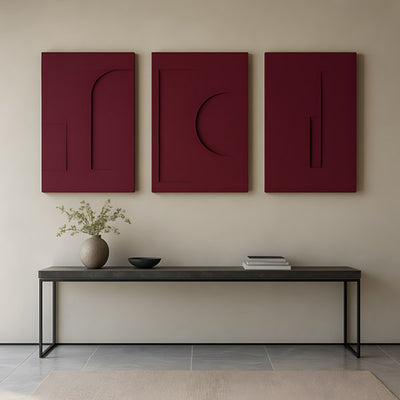

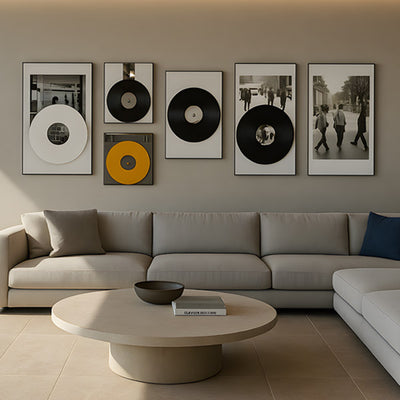
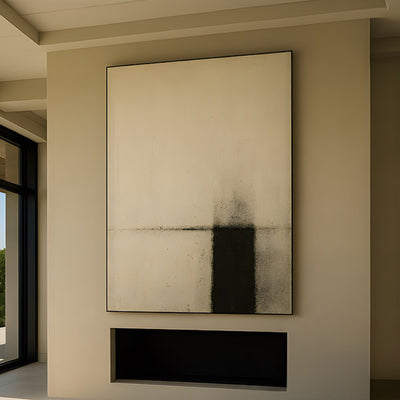
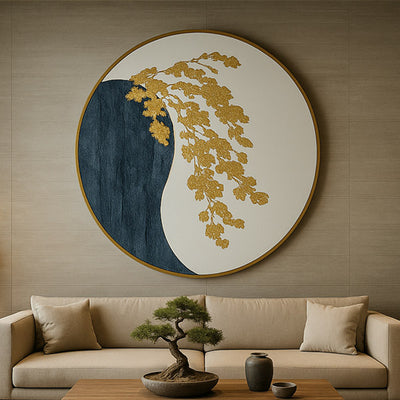






























Stand in your dining room and the art looks correct. Sit down at the table and it floats away from you, marooned somewhere near the ceiling line. That single miscalculation ruins more dining room wall art than bad taste ever has, and it happens because the person hanging the piece is standing on a step ladder while everyone who will actually look at it is sitting in a chair.

Key Takeaways Before You Drill
Hang lower than instinct tells you. Seated eye level runs roughly 16 inches (400 mm) below standing eye level.
Scale dining room wall art to the table, not to the wall. Two thirds to three quarters of table length is the sweet spot.
One substantial work reads better across a meal than a grid of small frames.
Candle soot, steam and airborne cooking film settle on dining walls faster than in most rooms. Choose finishes accordingly.
Light relief work close to the wall face so shadow falls across the surface rather than into your guests' eyes.
The Seated Eye Line Changes Everything
A standing adult's eye sits somewhere around 63 inches (1.6 m) off the floor. Sit that same person in a dining chair and their eye drops to roughly 45 to 48 inches (1.15 to 1.22 m). The gallery convention of centering a work at 57 to 60 inches was built for people walking past. Dining rooms are the opposite: everyone parks for two hours and stares.
We generally center dining room wall art between 50 and 56 inches (1.27 and 1.42 m) from the floor, biased lower when the piece is deep or heavily modeled. Test it before committing. Cut a paper template, tape it up, then sit in the chair furthest from the wall and look. If your neck tilts back, drop it.
Above a sideboard or credenza the rule shifts again. Leave roughly 6 to 10 inches (150 to 250 mm) of breathing room above the furniture so the piece belongs to the wall rather than sitting on the cabinet like a photo frame.

One Big Piece or a Gallery Grid?
Gallery walls fragment a dining room. Every small frame is a separate thing to read, and across a long dinner the eye keeps hopping instead of settling. A single strong sculpture does the opposite: it anchors the table, gives the room a subject, and survives candlelight when detail collapses into silhouette.
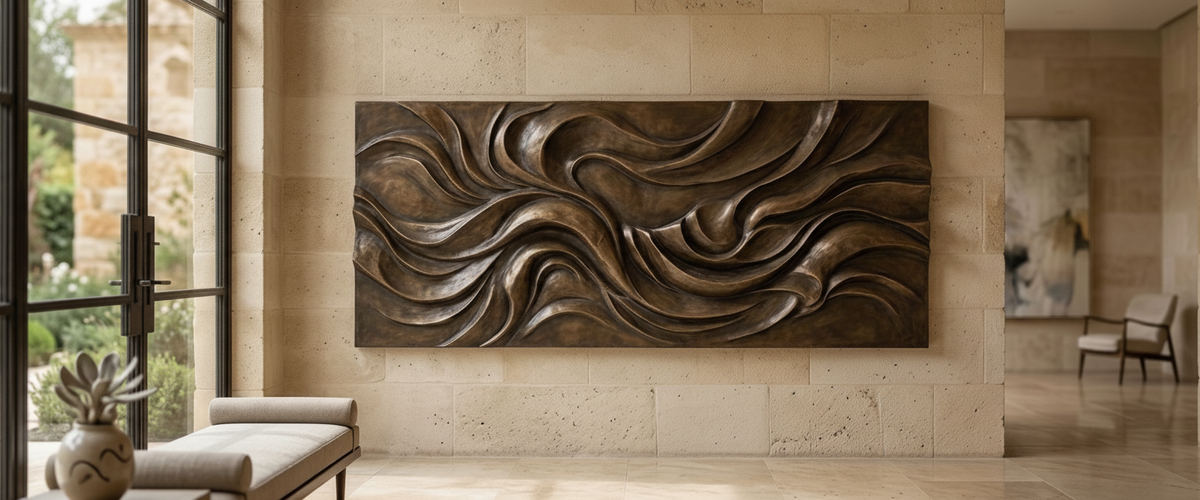
If you want more than one element, work in a considered pair flanking a doorway or mirror rather than a scatter of nine. Wall-mounted sculpture handles this better than framed art because the third dimension keeps the piece alive at low light. A 90cm cast bronze form like the Classical Figural Torso Wall Sconce Bronze Sculpture - 90cm can be run as a matched pair either side of a serving wall, where a flat print would simply disappear once the overheads dim.
A matched pair holds a serving wall better than a scatter of small frames.
Sizing Dining Room Wall Art to the Table, Not the Wall
Here is the proportion we work to in the studio: the visual width of the piece should land between two thirds and three quarters of the table length. A 96-inch (2.4 m) table wants something in the region of 64 to 72 inches (1.6 to 1.8 m) wide. Size to the wall instead and you end up with a piece that dwarfs the meal.
We took a commission for a Napa dining room with a 12-foot (3.6 m) walnut table where the client's first instinct was a single narrow vertical panel. On paper it suited the wall. Against the table it looked like a bookmark. We rebalanced to a horizontal forged steel relief that ran with the table's axis, and the room finally read as one composition.
Width follows the table axis; height stays low enough for seated sightlines.
Height matters less than width here, because seated sightlines compress vertical drama. Depth of relief, on the other hand, earns its keep every evening the room is used.

What a Dining Wall Quietly Does to a Finish
Dining rooms are chemically busy. Candle soot carries fine carbon particles that cling to textured surfaces. Steam from serving dishes carries fats that settle as a soft film, and over a few years that film hardens and grays out a matte patina. Conservators count pollutants and airborne dust among the agents of deterioration for interior surfaces, and dining walls collect both faster than most rooms (Canadian Conservation Institute).
Practical consequences: specify dining room wall art in materials that tolerate that atmosphere, and avoid raw plaster or unsealed wood directly above a candle line. Sealed bronze, stainless steel and lacquered or waxed metalwork wipe clean and forgive. Handle patinated bronze with clean dry hands only, since skin oils mark waxed surfaces (see the Smithsonian Museum Conservation Institute on surface care). Ask your supplier which wax or lacquer system was used at the finishing stage; you want that answer written down before delivery, not two years later when the piece needs attention.
Lighting Relief So It Throws Shadow, Not Glare
Flat downlight kills relief work. Aim a narrow beam at 25 to 35 degrees off the wall plane and the modeling comes forward, casting shadow across the surface instead of bouncing light back at seated guests. Warm color temperature around 2700K keeps bronze and Corten reading correctly next to candlelight.
Where the wall has no usable ceiling track, the alternative is to let the sculpture carry its own light. A sconce-format bronze such as the Classical Figural Torso Wall Sconce puts a warm glow at roughly seated eye level and lights the modeling from within the piece, which suits older rooms where you cannot cut into the ceiling.
Put the fitting on its own dimmer circuit, separate from the pendant over the table. Dining room wall art wants to sit dimmed low while dinner runs and come back up full for drinks beforehand.
Awkward Rooms: Low Ceilings, Radiators and Serving Hatches
Low ceilings favor horizontal pieces; a wide, shallow relief makes an 8-foot ceiling feel deliberate rather than cramped. Radiators are the real problem, because rising heat draws dust straight up the wall face and cycles it daily. Keep at least 12 inches (300 mm) of clearance and prefer sealed metal over textured stone in that zone.
Serving hatches, returns and awkward chimney breasts usually mean the best wall for dining room wall art is not the obvious one. In a Dallas project we moved the commission to the short wall facing the kitchen doorway, so the piece greeted people arriving with plates rather than hiding behind the host's chair. Browse dining room art and the wider wall art and wall decor range with your seated sightlines in mind, not your floor plan.

Commissioning a Bespoke Dining Piece
If nothing off the shelf fits your table proportion, commissioning solves it properly. At Giant Sculptures we start with the table dimensions, ceiling height, chair positions and the lighting you already own, then work up scale drawings before fabrication. Material choice follows the room: forged and welded work from our metal wall art range for hard-edged interiors, carved and laminated wood wall art where you want warmth against stone floors.
Budget depends on material, scale, depth of modeling, engineering for the fixing, finishing and installation, so the honest answer is a tailored quote rather than a headline figure. What we will tell you upfront is the fixing spec. Substantial dining room wall art needs a structural fixing into studs, masonry or a plated backing board, and that decision belongs at the drawing stage.
Checklist Before You Commit
Measure table length and calculate your target piece width at two thirds to three quarters.
Sit in the furthest chair and mark seated eye level on the wall in pencil.
Tape a full-size paper template and live with it for two days.
Confirm wall construction and whether a backing plate is needed.
Check candle and radiator positions against the proposed finish.
Specify a dedicated dimmable light on its own circuit.
Get the maker's written care and re-waxing guidance at handover.
Get the height and the proportion right and dining room wall art stops being decoration on a wall. It becomes the thing people talk about between courses.
For wider placement ideas, Bronze Metal Wall Art: How Placement Changes What You See is useful companion reading before finalising the setting and sightlines.