





































































































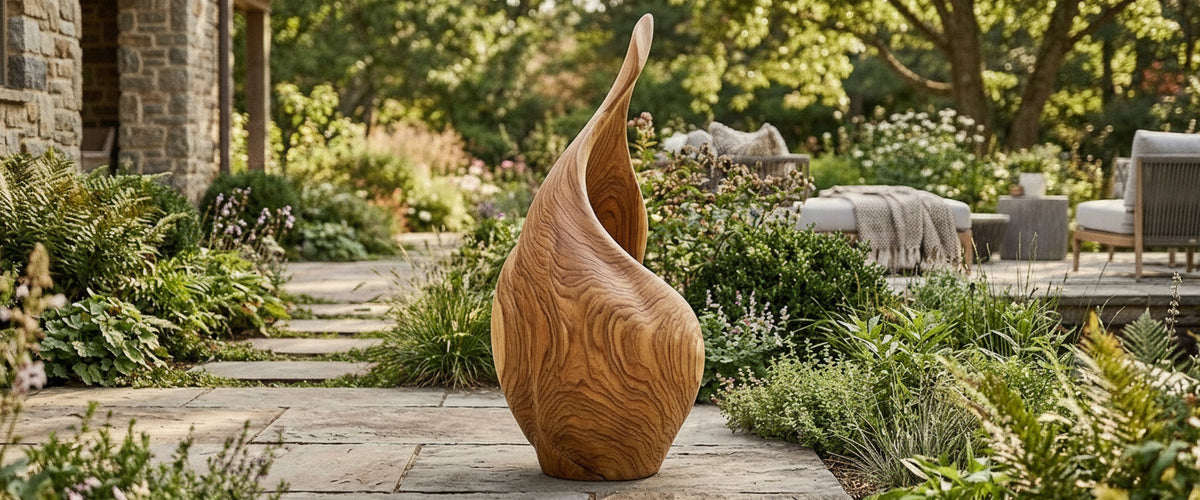

A curved wooden form can hold a whole room together or vanish against a busy wall, and the difference is almost never the carving itself. It is placement. Abstract organic wood sculptures live and die by sightlines, scale, and the light that falls across their grain. Get those right and a single piece will pull the eye from the front door across the room. Get them wrong and you have spent real money on something people walk past.
The organic side of this genre matters. These are not geometric slabs; they borrow from bone, seed pods, river-worn stone, the twist of a growing branch. That softness reads differently depending on where you stand and what sits behind it, which is exactly why abstract organic wood sculptures deserve more placement thought than most buyers give them.

Abstract Organic Wood Sculptures at a Glance
- Best rooms: entrance halls, stair landings, double-height living spaces, and any spot with a long approach.
- Scale rule of thumb: the piece should read from the main viewing distance, not just up close.
- Pedestal height: aim to put the visual center of the sculpture near eye level, roughly 55 to 63 inches (140 to 160 cm) from the floor.
- Light: raking side light reveals grain and curve; flat front light kills depth.
- Outdoors: true wood needs shelter or sealing; for exposed gardens, consider bronze or stainless steel forms that echo the same organic language as abstract organic wood sculptures.

What Abstract Organic Wood Sculptures Look Like in Real Rooms and Gardens
Indoors, an organic abstract sculpture behaves like a full stop at the end of a sightline. Set a carved, twisting column at the far end of a hallway and it gives the eye somewhere to land. In a great room with tall glass and pale plaster walls, a single warm-toned wooden form breaks up all that flat surface and adds a note of handmade texture that stone or steel cannot quite match. If plaster is your palette, an organic abstract plaster sculpture can echo the same soft, biomorphic language in a lighter tone.
The hanging pieces work differently again. Where a room needs a floating object rather than a grounded one, a carved wood and clear resin form such as the Hanging Carved Wood & Clear Resin Column - 45cm catches light through the resin and throws soft shadows on the wall behind it. Suspended over a stairwell or a dining table, it changes as you move around it, which is the whole point of abstract organic sculptural art: no single fixed view.
Scale up and the effect grows. At a full 120cm drop, the Hanging Carved Wood & Clear Resin Wave Crown Column - 120cm becomes an architectural gesture rather than a tabletop object. In a double-height entrance or a hospitality lobby, that vertical drop does work no wall art can do, and it shows how abstract organic wood sculptures scale from intimate to monumental.

Scale, Sightlines, and Pedestal Height
Most disappointing installations of abstract organic wood sculptures come down to one error: the piece is too small for the space or sitting at the wrong height. A sculpture that looks generous in a studio can shrink the moment it enters a 20-foot (6 m) room.
Start from the main viewing point. Where will people usually stand or sit when they see this piece? Measure that distance. A form meant to be read from across a large living room needs more mass and a bolder silhouette than one tucked into a reading nook. As a rough guide, a sculpture viewed from 15 feet (4.5 m) or more wants a presence you can register instantly; fine detail is wasted at that range.
Pedestal height is the lever people forget. The sculpture's visual center, not its base, should sit near eye level for a standing viewer. Too low and guests look down on it like a coffee-table trinket. Too high and it feels aloof and hard to read. For a seated setting such as a lounge, drop the whole arrangement a few inches so it works for people on sofas rather than people standing at a party.
Give an organic form room to breathe. These curves need negative space around them to register as three-dimensional. Crowd a biomorphic shape against furniture and the eye cannot separate object from clutter, which undoes the appeal of abstract organic wood sculptures fast.

Indoor Versus Outdoor: When Each Wins
Wood is a living material, and that is both its charm and its limit. Indoors, in stable humidity, well-finished abstract organic wood sculptures can last for generations with light care. Outdoors, unprotected wood moves, checks, and grays as it weathers, which some clients love and others do not expect. The American Institute for Conservation notes that wood's response to swings in relative humidity is the main driver of cracking and warping, so a sheltered position matters as much as any sealant (culturalheritage.org).
For a covered loggia, a shaded courtyard, or a sheltered porch, a sealed and maintained wood sculpture can hold up beautifully. For open lawns, pool surrounds, and coastal exposure, we usually steer clients toward a material that carries the same organic vocabulary without the upkeep. A cast bronze form gives you those flowing curves with far greater tolerance for weather. Where the setting is exposed but the silhouette still needs to feel body-derived and soft, the Large Contemporary Abstract Female Torso Bronze Sculpture, 140cm is closer to the right material language than carved wood on a lawn.
When a client wants pure abstract organic sculpture art outdoors, a monumental biomorphic piece such as the Monumental Modern Abstract Biomorphic Bronze Sculpture, 340cm delivers the seed-pod, growing-form language of abstract organic wood sculptures at a scale and durability wood simply cannot reach in a hot, open garden.
Light, Backdrop, and Contrast
Light is what turns a carved surface into something worth looking at. Side light, raking across the grain, throws the ridges and hollows into relief and makes the organic form read as sculpture. Flat, head-on light flattens everything and the piece looks like a photograph of itself. Position an indoor piece where daylight arrives from an angle, or add a directional spot set off to one side rather than straight on.
Backdrop decides contrast. A pale, warm wood form disappears against pale oak paneling and sings against a charcoal or deep green wall. This is where abstract organic wood sculptures reward planning, since a darker walnut or blackened piece wants the opposite. Before committing to a spot, hold a large sheet of card in the sculpture's tone behind the intended position and check whether it stands out or merges. It is a two-minute test that saves an expensive mistake.
Reflections matter for the resin-and-wood hybrids. Clear resin picks up window light and glows; set it where it can catch a beam and it earns its keep. Bury it in a dim corner and half the material's appeal is lost.
Common Placement Mistakes We See in Commissions
For wider placement ideas, Modern Abstract Wood Sculpture: How to Place It so the Form Actually Reads is useful companion reading before finalizing the setting and sightlines.
These come up again and again when clients send us photos of a space before a bespoke build of abstract organic wood sculptures:
- Buying for the studio, not the room. A piece that looks bold on a plain plinth can be swallowed by a patterned rug and a full gallery wall. Judge scale against the actual setting.
- Pushing it flat to the wall. Organic forms need to be seen in the round. Pull the piece forward so light and eye can travel around it.
- Ignoring the approach. The first view is usually from a doorway or the top of the stairs, not from the seat right beside it. Design placement for the walk-in.
- Under-lighting. A sculpture worth commissioning is worth one properly aimed light.
- Wrong material for the weather. Assuming carved wood will survive an open, exposed garden. Match material to exposure from the start.
One commission taught us this the hard way. A client in a coastal home wanted a carved organic column for a terrace facing the water. We flagged the salt-laden air and moving humidity, and together we switched the piece to a stainless steel form with the same flowing profile. Two years on it still looks the way it did the day it was installed, and the client thanks us for the redirect. That is the kind of conversation worth having before anything is carved.
Commissioning a Piece That Fits
Because abstract organic wood sculptures are so placement-sensitive, a bespoke route often beats buying blind. At Giant Sculptures we build to the room: we ask for the viewing distance, the wall color, the light direction, and the ceiling height before we recommend scale or material. If you are drawn to the organic vocabulary but the setting is exposed, we will show you how a bronze or steel version reads in the same space rather than sell you a material that will fight the climate.
Browse the organic sculptures collection to see the range of flowing, nature-derived forms, or the wider abstract sculptures if you want to compare geometric and organic approaches side by side. Whatever the material, abstract organic wood sculptures earn their keep when placement is planned first. Budget depends on material, scale, complexity, engineering, installation, and finishing, so the honest answer on cost is to send us the space and ask for a tailored quote.