






































































































A wall panel that looks perfect on your screen can disappoint the moment it hangs. The relief is too shallow to catch light, the pattern repeats in a way you never noticed at thumbnail size, or the piece that felt bold in the render vanishes across a double-height room. Good 3D wall panel art solves problems most buyers never see coming, and the decisions that matter get made long before anyone picks up a tool.
We field a lot of questions from designers and homeowners who have found a look they like but are not sure how it translates to a real wall, a real material, and a real budget. So here is how sculptors actually think through a piece of 3D wall panel art on commission, and what you should be asking before you sign anything.
Raking light turns a faceted relief into a shadow machine.

Key Takeaways
Depth and light matter more than the pattern. A relief lives or dies by how it throws shadow across the day.
Viewing distance drives the design. A piece tuned for 10 feet often needs more depth and bolder forms to work at 30.
Material sets the ceiling. Cast bronze, carved wood, and molded panels age and read very differently.
Bespoke 3D wall panel art follows a sequence: maquette, sample, fabrication, install. Skipping steps is where projects go wrong.
Budget depends on material, scale, complexity, engineering, and installation. Ask for a tailored quote rather than trusting a flat price.

What Sculptors Weigh up Before Taking a 3d Wall Panel Art Commission
The first thing we look at is not the design. It is the wall. How tall is it, what is it made of, how far back will people stand, and where does the light come from during the hours the room is actually used. A relief panel is a shadow machine; the carved surface only comes alive when raking light rolls across it. Put a low-relief piece on a wall that only ever sees flat overhead light and you have bought a very expensive flat texture.
Then we think about the room's job. A hospitality lobby that people move through quickly wants bold, legible forms. A private study where someone sits with a book for an hour rewards fine detail and quieter modeling. Those are different pieces of 3D wall panel art even if the client describes them with the same three adjectives.
We also ask what the panel is competing with. Against a plain plaster wall, subtle depth reads. Against busy stone or timber cladding, the sculpted surface needs stronger relief and cleaner silhouettes to hold its own. Getting this wrong is the most common reason a beautiful sample looks weak once installed.

Craft Decisions That Change the Result (and the Price)
Material is the biggest fork in the road. Where the wall calls for crisp facets and a uniform surface doing the heavy lifting, a geometric composition such as the Prisma White Geometric Panel lets the shadows between planes carry the whole effect. That is a very different craft problem from a figurative bronze relief, where the modeling of a muscle or a jaw is what the eye locks onto.
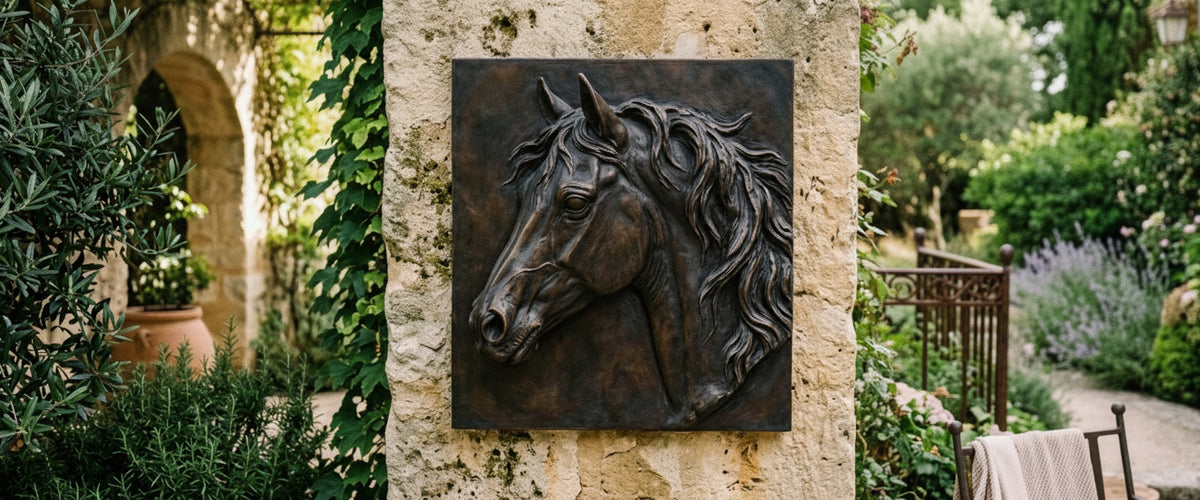
For durable, collectible 3D wall panel art, we lean toward cast bronze, carved hardwood, and engineered metalwork. At 80cm, a piece like the Traditional Horse Head Bronze Relief - 80cm is a good measure of what depth buys you: the projection of the muzzle and the undercut of the mane create real shadow, so the animal reads as sculpture rather than decoration. Bronze also patinates and lasts for generations outdoors or in, which matters if the panel is meant to be a permanent feature rather than a season's trend.
Deep projection and undercuts let a bronze relief read as sculpture, not decor.
Relief depth is its own decision. Bas-relief (shallow) is elegant and space-saving but demands good light and a smart viewing distance. High relief projects further, casts stronger shadow, and holds up in bigger rooms, but it costs more to fabricate and weighs more to hang. Every extra inch of projection on your 3D wall panel art is more material, more modeling time, and more engineering on the fixing.
Finish is the last big lever. A polished bronze face bounces light and reads bright; a dark patina absorbs it and pushes the form into relief. On molded and PVC-style panels, the paint finish changes everything, which is why buyers so often ask how to paint them (more on that in the FAQs). None of these choices is right or wrong in the abstract; they are right or wrong for your wall.

Why Some Panels Read Right at 10 Feet and Wrong at 30
Scale is where taste meets physics. The eye resolves less detail as you move back, so fine modeling that sings up close simply disappears at distance. A piece of 3D wall panel art designed for a hallway where you pass within a few feet can carry delicate texture. The same panel on a 20-foot atrium wall becomes a gray smudge.
When a piece needs to work at 30 feet (around 9 meters), we push three things: overall size, relief depth, and the boldness of the forms. Big, clean shapes with deep shadow lines read across a room. Repeating modules, like a grid of geometric tiles, need enough individual scale that the pattern stays crisp rather than turning into visual noise. We have seen clients order a beautiful tile at sample size, then tile a huge wall, only to find the repeat now reads as wallpaper. The fix is designing the composition at full scale from the start, not scaling up a small idea.
This is also why we build 3D wall panel art to order for large walls. A stock panel sized for a living room will not carry a commercial staircase. If you are covering a serious span, the honest answer is usually a bespoke layout engineered for that exact wall and that exact viewing line.
Our Studio Process: Maquette, Sample, Fabrication, Install
Every considered 3D wall panel art commission runs through the same sequence, and each step exists to catch a specific problem.
Maquette. A small-scale model or detailed 3D visual lets you judge composition, depth, and proportion before committing material. This is where most design changes should happen, because they are cheap here and expensive later.
Sample. A physical section in the real material and finish. You see how the surface catches light in your actual conditions. Take it to the wall if you can; a sample by a window tells you more than any render.
Fabrication. Casting, carving, or forming the panels, then finishing. Timelines depend on material and scale; bronze casting is slower than machined or molded work.
Install. Mounting, alignment, and any on-site finishing. For heavy panels this means proper fixings into structure, not plasterboard alone, and often a specialist fit rather than a DIY afternoon.
Skipping the sample stage is the single biggest regret we see. A finish that looks warm on screen can look flat in your north-facing hallway. Ten minutes with a physical sample saves you from a wall-sized mistake.
Honest Red Flags to Ask About Before You Commit
A trustworthy maker will welcome these questions. If they dodge them, that tells you something.
"Can I see a sample in the real material and finish?" No sample, no confidence. Renders flatter everything.
"What does this weigh, and how does it fix to my wall?" Weight drives the mounting system. A heavy bronze relief needs structural fixing and sometimes a mounting rail, not adhesive.
"How will the finish age?" Bronze patina develops over years; painted composite can chip or fade. Ask what maintenance looks like a decade from now.
"Is the composition designed for my viewing distance?" If the answer is generic, the 3D wall panel art was not planned for your room.
"What is included in the quote?" Design, fabrication, finishing, crating, freight, and install are separate costs. Budget depends on material, scale, complexity, engineering, and installation, so insist on a tailored quote that lists what is in and what is not.
"Can you engineer it for outdoors if I want it there later?" Interior finishes rarely survive weather. Corten, marine-grade stainless, and cast bronze do; many decorative panels do not.
Where to Buy 3d Wall Panel Art You Can Live With
For off-the-shelf decorative panels, plenty of suppliers stock lightweight modular tiles, and they suit fast, low-commitment refreshes. For 3D wall panel art meant to last and hold a room, look for a maker who works at scale in durable materials and offers bespoke commissioning. Our 3D Wall Art collection spans geometric panels through to figurative relief, and the Bronze Wall Art range shows what cast metal brings to a wall in longevity and presence. If you want something built for a specific span, Giant Sculptures takes 3D wall panel art commissions from maquette through install.
The Victoria and Albert Museum's guidance on caring for metalwork is a useful reality check on how surfaces behave over time, worth reading before you assume any finish is maintenance-free. The short version: material choices you make at the maquette stage decide how your 3D wall panel art looks in twenty years, not just next week.
For wider placement ideas, 3D Wall Art Panels: How to Choose, Place, and Commission Them is useful companion reading before finalizing the setting and sightlines.