

























































































A seven-foot fiberglass figure can read as perfect from thirty feet and be structurally finished at arm's length. That gap between how a piece looks and how it is actually holding up is what makes fiberglass statue repair so easy to get wrong. Owners patch the crack they can see, repaint the panel, and stand back happy. Nine months later the same line reopens in the same place, slightly wider, because the crack was never the problem. It was the symptom.
We get these calls at Giant Sculptures fairly often, usually from a venue manager or a homeowner who inherited a resin piece with the property. The question behind almost every fiberglass statue repair inquiry is the same: can this be saved, and should it be? Both halves matter.

Key Takeaways Before You Touch a Sander
Crazing is cosmetic. Laminate cracking is structural. Fine spiderweb lines in the gelcoat are a surface issue. A crack you can feel with a fingernail, or one that has gone dull white along its length, has reached the glass.
Tap before you sand. Delamination hides under intact paint. A coin and thirty seconds will find it.
Most failures start with UV. Chalking, color drift and gloss loss almost always arrive before any structural problem, and at that stage a fiberglass statue repair is really a refinishing job.
Check the armature and the mount. Rust bleed through white gelcoat is a warning about the steel inside, not a stain to bleach out.
Repair has a ceiling. Once you are into large-area color matching plus laminate rebuilding plus a new base, a recast in bronze, stainless or stone can be the better long-term buy.
Gelcoat Crazing Versus Structural Laminate Cracks
Fiberglass is a sandwich: a thin pigmented gelcoat on the outside, glass mat and resin behind it, sometimes a foam or steel core inside that. The failure modes are different at each layer, and so is the right fiberglass statue repair.
Crazing looks like fine cracked glaze on old pottery. It clusters around tight radii, casting seams, and anywhere the gelcoat was sprayed too thick. It stays in the top layer. Run a fingernail across it and you feel nothing. This is a resurfacing job: cut back, refill, refinish, recoat.
Laminate cracking is a different animal. Look for a single defined line rather than a web, a whitened halo along the crack (that is stressed resin separating from the glass fibers), and flex when you press either side of it. If daylight shows through from behind, it is through the shell. That is a structural fiberglass resin statue repair, and it needs the laminate ground back to a feathered scarf joint and rebuilt with fresh mat and resin, not filler and paint.
The honest test is the fingernail and the flex. Anything you can catch a nail in, or anything that moves independently under hand pressure, is structural until a restorer proves otherwise. ASTM D2563, the visual defect classification practice for glass-reinforced plastic parts, draws the same line between surface defects and laminate defects for good reason.

The Tap Test: Finding Delamination Before You Sand Anything
This is the single most useful thing an owner can do without tools, and it should happen before any fiberglass statue repair is quoted. Take a coin or the back of a screwdriver handle and tap steadily across the surface in a grid, listening rather than looking. Sound laminate gives a bright, tight click. Delaminated or voided areas give a dull, hollow, slightly flat knock, like tapping a hollow door.
Mark the dull zones with low-tack tape as you go. What you usually find is that the visible crack is a small feature at the edge of a much larger delaminated patch, which explains why a previous fiberglass statue repair failed: the filler was bonded to a layer that was already lifting. On a life-size animal piece, the dull zones cluster at load points: shoulders, haunches, the underside of an outstretched limb, and anywhere a mold seam runs.
Tap in the morning if the piece lives outdoors. Sun-warmed resin reads differently, and a warm shell can mask a soft spot.
UV Chalking and Color Drift: Why the Surface Dies First
Outdoor fiberglass rarely fails structurally in its first decade. It fails visually. Ultraviolet light breaks down the resin binder at the surface, releasing loose pigment as a fine powder. Wipe a dark piece with a damp cloth and look at the cloth: if it comes away with chalky color, the gelcoat is oxidizing.
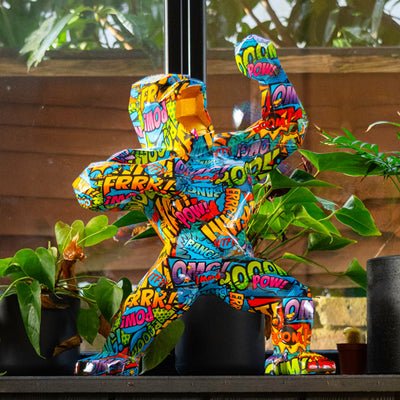
Color drift follows. Reds and deep blues shift first, blacks go gray-brown, and metallic effect coatings lose their depth entirely. We saw this on a set of oversized fruit pieces installed at a retail plaza in Arizona, where the south-facing units drifted noticeably within a couple of seasons while the shaded units held their finish. Same batch, same coating, different sun exposure.
Chalking can often be cut and polished back once or twice, then it needs a full recoat. Conservation guidance on plastics and composite objects is consistent on this point: light exposure is the driver, and controlling it does more than any product you can apply afterward. The Canadian Conservation Institute's notes on modern materials are a good grounding read before you commit to a treatment plan.
Practical version: if the piece has already been recoated twice, a third refinish is money spent on an aging shell. That is the moment to price a replacement alongside further fiberglass statue repair.

Armature Rust and Mounting Failures That Reappear Six Months Later
Here is the repair nobody quotes for properly. Many older fiberglass statues are built over mild steel armatures or bolted to steel plates set into the base. Water finds its way in through a hairline crack, a drilled fixing hole, or an unsealed underside, and the steel starts working. Rust expands to several times the volume of the original metal, and it pushes outward against the shell.
The symptoms are specific: orange bleed lines running down from a fixing point, a raised blister that feels hard rather than hollow, cracks radiating from a single spot like a star. A Dallas client sent us photos of a white fiberglass stag with rust weeping from the rear hoof mount. The shell repair had been done twice. Nobody had opened the base.
If the armature is compromised, cosmetic fiberglass resin statue repair is a countdown, not a fix. Any competent restorer will want to open the piece, cut back the corroded steel, treat or replace it with stainless, and reseal. If a quote does not mention the internal structure at all, it is a quote for paint rather than a fiberglass statue repair.
The same goes for mounting. Ask how the piece will be re-fixed, what fasteners are being used, and whether the base is being isolated from ground moisture. Reinstalling a repaired statue onto the original failing plate guarantees a repeat visit.
When Fiberglass Statue Repair Costs More Than a Recast
Run the math honestly. Restoration is labor-heavy and hard to scope until the piece is opened, so the true cost of a fiberglass statue repair often lands well above the first quote. Cast bronze or fabricated stainless carries a higher entry cost but a far longer service life and lower ongoing spend.
We tell buyers to price a rebuild rather than a repair when three or more of these are true:
Delamination covers a broad area rather than one localized patch.
The armature or mounting steel is corroding.
The piece has already been refinished more than once.
The original color was a custom match with no recorded formula.
The sculpture is a permanent public or commercial installation with a real safety duty.
It is large enough that crating, freight and crane time will be paid twice, once to the restorer and once back again.
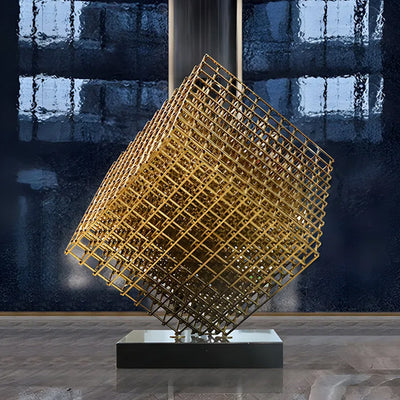
Scale is what usually tips it. Moving a ten-foot (3 m) figure weighing a few hundred pounds to a workshop and back can approach the cost of the repair itself. At that point, commissioning a new piece in a material that will outlast you starts to look like the cheaper decision over twenty years. Our bronze sculptures and stainless steel sculptures exist largely because clients reached that conclusion after their second resin repair.
None of this makes fiberglass a bad choice. It is the right material for lightweight, oversized and seasonal work, and for rooftop and interior settings where weight limits rule out metal. Our fiberglass sculptures get specified for exactly those reasons. The mistake is expecting a resin shell to behave like cast bronze through thirty years of full sun or coastal salt air.

Choosing a Restorer: The Questions That Actually Sort Them
Anyone with a spray gun can make a statue look better for a season. Use this checklist before you hand over a piece you care about.
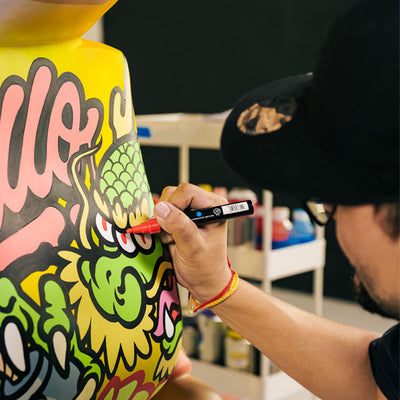
How do you match the color? Listen for spectrophotometer readings, sprayed test cards checked in daylight, and blending into a natural break line rather than a mid-panel edge.
What is the topcoat system? An automotive-grade two-pack polyurethane with a UV-stable clear is a different proposition from a single-pack rattle can. Ask for the product data sheet.
Will you open the structure? Anything mounted outdoors should have the base and fixing points inspected, not just the visible damage.
How are cracks prepared? You want feathered scarf joints and new laminate on structural cracks. Filler alone over a moving crack will telegraph back through.
What is the expected finish life in my location? A restorer who asks about your sun exposure and salt air before answering knows the job.
Can you show similar work at this scale? Repairing a garden gnome and repairing a fourteen-foot (4.3 m) figure are unrelated skills.
What is the reinstallation plan? Fasteners, isolation from ground moisture, drainage, and who lifts it.
How to Repair a Fiberglass Statue: The Short Version
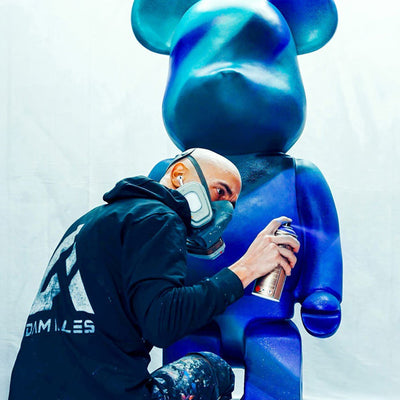
For a small, non-structural chip on an interior piece, a competent owner can handle the fiberglass statue repair alone. Clean with isopropyl alcohol, key the area back with fine abrasive well beyond the damage, fill with a compatible polyester or epoxy filler, cut back flush, then refinish and blend. Take your time on the blend; the repair itself is rarely what gives it away, the halo around it usually is.
Anything structural, anything outdoors, and anything over roughly three feet (0.9 m) belongs with a professional. Grinding cured fiberglass releases glass dust and resin vapor, and it needs proper respiratory protection and extraction. Doing it badly also seals moisture into the laminate, which is how a small crack becomes a delaminated panel.
Thinking Past the Next Repair
When a client asks us about fiberglass statue repair, the useful conversation is usually about what happens next rather than what happened last. If the piece is sentimental, one-off, or lightweight by necessity, repair it properly and manage its sun exposure. If it is a landmark piece carrying a brand, a garden, or a lobby, and it has already been patched once, take the quote for the repair and put it next to a quote for a bespoke recast.
We build commissions from originals all the time, including recreating a resin piece in bronze or fabricated stainless at the same scale and pose. Cost depends on material, size, complexity, engineering, installation and finish, so it is worth asking for a tailored quote rather than guessing. The point is to make the comparison with real numbers on both sides, instead of paying for the same crack three times.
For wider placement ideas, What It Takes to Make Fiberglass Sculpture That Holds a Room is useful companion reading before finalising the setting and sightlines.