





































































































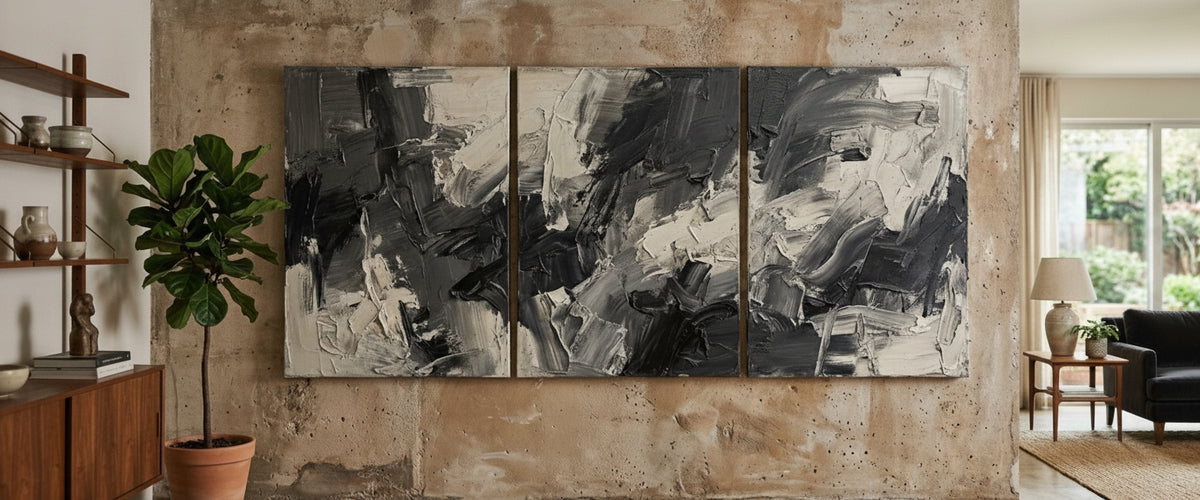

Walk into most large living rooms and the art is a foot too narrow and hung six inches too high. The wall swallows it. That single sizing error costs more design credibility than any choice of subject or palette, and it is the reason so much canvas wall art looks like a placeholder rather than a decision. Get the scale right and a single painted panel can anchor a 20-foot (6 m) great room without a stick of extra furniture.
Giant Sculptures spends most of its time on bronze, stainless steel and stone at architectural scale, so we come at canvas wall art from a slightly unusual angle: we think about sightlines, proportion and long-term ownership before we think about subject matter. That habit transfers well to stretched fabric.

At a Glance: Buying Canvas Wall Art Without Regret
- Size to the wall, not the sofa alone. Aim for artwork spanning roughly two-thirds to three-quarters of the furniture below it.
- Hang the center at eye level, around 57 to 60 inches (145 to 152 cm) from the floor, unless a sofa or console forces you higher.
- Stretcher quality decides longevity. Kiln-dried bars, corner keys and cross-bracing on anything over 5 feet (1.5 m).
- Linen holds tension better than cotton duck over decades and in swinging humidity.
- Multi-panel sets buy you width when a single stretcher would be impossible to move upstairs.
- Bronze or metal relief wins where you need weight, texture and shadow rather than color.
- Budget follows material, scale, hand-finishing and framing. Ask for a quote against your actual wall dimensions.

What Canvas Wall Art Actually Means, and Who It Suits
The term covers a wide spread of quality. At one end sits a digital print bonded to thin cotton over a stapled softwood frame. At the other sits hand-painted oil or acrylic on primed linen, stretched over kiln-dried bars with keyed corners, varnished for UV resistance. Both are sold under the same label. Only one of them still looks right in fifteen years.
Canvas wall art suits buyers who want presence without weight. A 6-foot (1.8 m) painted panel might weigh under 25 pounds (11 kg), which means standard drywall anchors and one pair of hands, not a structural survey. That matters in apartment buildings, in rented offices, and above fireplaces where a stone or bronze piece would need blocking behind the plasterboard. It also suits people who want color as the primary tool. Paint delivers saturated hue in a way patinated metal simply cannot.
It suits some rooms less well. Damp bathrooms, unheated pool houses and covered patios in Texas or Florida will punish stretched fabric, and those are the conditions where canvas wall art fails first. Humidity swings slacken and re-tension the weave repeatedly, and the American Institute for Conservation is blunt about how much damage unstable environments and direct light do to painted surfaces. If the space is exposed, look at metal wall art instead.

How to Compare Canvas Wall Art Options Before Buying
Five things separate a piece worth living with from one you will quietly replace.
1. Surface: printed, embellished, or fully hand-painted
Hand-embellished pieces start as a print and receive real brushwork or impasto on top, which gives raking light something to catch. Fully hand-painted work has depth all the way down. Look at the piece under angled light in the product photography. If the surface is flat under a side light, it is a print.
2. Substrate
Cotton duck is the standard and performs well when properly primed. Linen is stronger, less prone to sagging over decades, and holds a finer tooth for detail work. Weight matters too; a heavier weave resists the ripples that show up on wide unsupported spans.
3. Stretcher construction
Stretcher bars decide whether canvas wall art stays flat for decades, so ask to see the back of the piece before you buy. Good bars are kiln-dried, beveled on the inner edge so the wood does not print through the fabric, and fitted with expansion keys so tension can be corrected years later. Anything over 5 feet (1.5 m) in either direction should carry a cross-brace.
4. Depth of wrap
A 1.5-inch (38 mm) gallery wrap reads as a considered object and can hang unframed. A slim 0.75-inch (19 mm) profile looks thin on a big wall and usually needs a float frame to earn its place.
5. Format flexibility
Multi-panel canvas wall art solves real logistics problems. Where a stairwell turn rules out a single wide stretcher, a three-part set such as Fantoria 3-Set Animal Fantasy Oil Canvas gives you the same horizontal field while each panel stays light enough to carry and easy enough to re-level if the house settles. We have shipped triptychs to clients who could never have got one stretcher of that width through the front door.

Materials, Finishes and Getting the Scale Decision Right
Finish is the quiet variable on any piece of canvas wall art. A matte varnish kills glare and suits rooms with strong window light on the opposite wall, which is why it works so well behind full-height glazing. Satin or gloss deepens dark passages and makes blacks read as black rather than gray, but it will mirror a window if you place it carelessly. Abstract pieces built on tonal contrast rather than color, like the charcoal-and-bone palette of Skull&Stone II, gain the most from a lower-sheen finish, because the eye then reads the texture instead of the reflection.
On scale, use arithmetic rather than instinct. Measure the wall width, subtract any furniture or door casing you must clear, then target 60 to 75 percent of the remaining span. For a 12-foot (3.7 m) feature wall behind a sectional, that means art around 7 to 9 feet (2.1 to 2.7 m) wide, delivered as one panel or as a set with consistent gaps of 2 to 4 inches (5 to 10 cm). Most canvas wall art gets bought a size or two below that number, and buyers then wonder why the room feels unfinished.
Ceiling height changes the answer. In a double-height entry, the artwork needs vertical emphasis; a tall portrait-format panel or a stacked pair reads far better than a wide horizontal marooned in the middle of the plaster.
Placing Canvas Wall Art for Living Room Impact
Canvas wall art for living room walls has one job above all others: it has to work from the seated position. Sit down first. Where does your eye land when you are three feet into the sofa cushions? That is the center point, not the number a tape measure gives you standing up.
Practical rules that hold up in real houses:
- Leave 6 to 10 inches (15 to 25 cm) between the sofa back and the bottom edge of the frame.
- Keep art off the wall that faces your largest window if the finish has any sheen.
- Above a fireplace, stay clear of the heat plume; a mantel shelf that projects 5 inches (13 cm) or more helps deflect it.
- In open-plan spaces, treat each zone separately. One large piece per sightline beats four medium pieces competing.
- Light from the front at roughly 30 degrees. Sharper angles blow out impasto and create hot spots.
One client hit the classic version of this problem: a long loft wall with a radiator below it, so the seated eye line sat unusually high. We ended up recommending canvas wall art as a vertical stack of two square panels rather than the wide horizontal she had planned. Same total area, completely different result from the sofa.
Canvas or Bronze Relief? Knowing When to Switch Material
Canvas wall art gives you color and lightness. Cast metal gives you shadow, mass and permanence. When a room already has plenty of color and needs gravity instead, a relief does more work. Where a hallway is lit from one end and the wall needs something that changes through the day, a cast piece such as Traditional Horse Head Bronze Relief, 80cm is the better call than a painted panel, and bronze holds its patina for generations with almost no attention. That is a different proposition from painted fabric, which the V&A's conservation guidance treats as a sensitive, environment-dependent surface.
Hybrid schemes often work best. Canvas over the sofa, a bronze relief in the hallway where light rakes across the wall, and the two never compete because they operate in different registers. Browse the broader wall art and wall decor range to see how the two sit together.
Budget, Commissioning and Delivery
The cost of canvas wall art tracks four things: surface area, how much of the work is done by hand, substrate and stretcher quality, and framing. A hand-painted linen panel at 8 feet (2.4 m) wide involves materially more studio time than a 3-foot (0.9 m) embellished print, and the framing and crating scale with it. Rather than guess, send us the wall dimensions, ceiling height and a photo, and we will quote against the actual piece.
Two logistics points worth knowing. First, very large canvas wall art can travel rolled in a tube and be stretched on arrival, which cuts freight cost and risk considerably on international shipments. Second, crated stretched panels need a clear path from truck to wall; measure your stairwell turns and elevator diagonal before you commit to a single-panel format.
Pre-Purchase Checklist
- Wall width and height measured, with obstructions noted
- Seated eye level marked in painter's tape on the wall
- Target artwork width calculated at 60 to 75 percent of usable span
- Single panel or set decided, based on access route
- Substrate and stretcher specification confirmed in writing
- Finish sheen chosen against window positions
- Wall construction identified for correct fixings
- Lighting plan agreed before installation, not after
Bespoke Canvas Wall Art and Commissioned Wall Work
Stock sizes rarely match a custom-built wall. Commissioning lets you specify the exact span, orientation, palette and depth of wrap, and it is often the only sensible route above 8 feet (2.4 m). Our studio handles bespoke wall pieces the same way we handle a monumental bronze: dimensioned drawings first, material and finish samples second, then production against an agreed spec. Clients regularly ask us to pull a palette from a rug or a stone slab so the piece sits inside the scheme rather than fighting it.
If you want a starting point, the canvas art collection shows the range of formats and surfaces we work with. Send through your dimensions and we will tell you honestly whether canvas wall art is the right call for that wall, or whether relief or metal will serve you better.
For wider placement ideas, Large Canvas Wall Art: How to Choose a Piece That Actually Holds the Wall is useful companion reading before finalising the setting and sightlines.