





































































































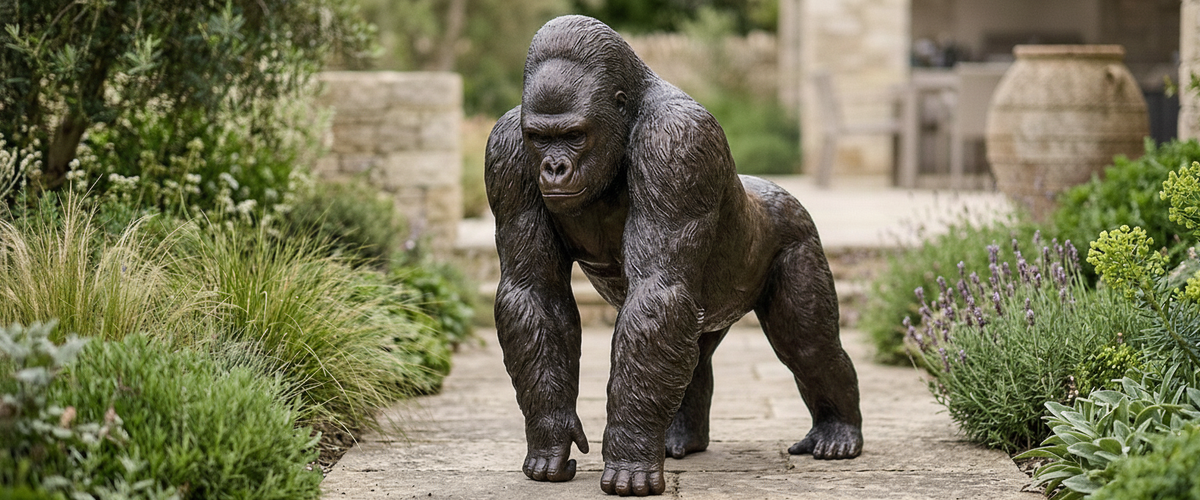

Get a gorilla sculpture wrong and it looks like a zoo gift shop escaped onto the lawn. Get it right and the piece sets the tempo for an entire garden, atrium or lobby, holding attention the way a good portrait does. The difference almost never comes down to price. It comes down to posture, the modeling of the face, the finish you choose, and how high the animal's gaze sits relative to the person walking toward it.

Key Takeaways Before You Buy
Posture is the story. Knuckle-walking reads as movement, seated reads as authority, upright reads as spectacle.
The face is decided in clay. If the brow, jaw and eye sockets are weak in the model, no foundry can rescue them later.
Bronze for permanence, cast resin and fiberglass for weight-limited floors and indoor installs.
Finish changes the genre. Brown patina reads natural history; gloss red reads pop art.
Eye line matters more than height. A gaze above the viewer's head changes the emotional register completely.
Plan anchoring and access early, not on the morning the crate lands.
Knuckle-Walk, Seated or Upright: Three Postures, Three Different Stories
A knuckle-walking silverback is caught mid-decision. The shoulder blades rise, the head drops slightly, and the whole mass moves toward you. Sited at the end of a gravel path or on the turn of a driveway, a piece such as the Life-Size Contemporary Knuckle-Walking Gorilla Bronze Sculpture at 180cm (about 5 ft 11 in) works because you meet it in profile first and head-on second. That sequence is the drama.
Posture carries the story: a knuckle-walking silverback reads as movement toward the viewer.
Seated poses do something else entirely. Weight settles, the arms rest, and the animal becomes a presence rather than an event. A monumental seated gorilla in bronze at 250cm (roughly 8 ft 2 in) reads like a guardian figure at the head of a courtyard or beside a hotel entrance, and it tolerates being viewed from all sides, which matters in a circulation space.
Full upright, chest forward, is the most theatrical option and the least forgiving. It demands distance and a clean backdrop. Put an upright gorilla sculpture in a tight corner and it looks trapped. Give it 30 feet (about 9 m) of open lawn and it becomes the reason people walk to that end of the garden.

Why the Face Is Decided in Clay Long Before Anyone Talks About Bronze
Every serious bronze begins as a clay gorilla sculpture built over an armature, and that is where the argument happens. Our modelers routinely rebuild the sagittal crest and brow ridge two or three times before signing off, because a few millimeters across the eye sockets is the difference between a thinking animal and a costume. Silverbacks carry a heaviness above the eyes and a jaw that is rarely symmetrical, both of which amateur models quietly smooth away, and the field photography published by the Dian Fossey Gorilla Fund is the reference our sculptors keep coming back to.
This is why French-language collectors searching artiste sculpture gorille are asking the right question. They want the hand behind the model, not the catalog number. If you are commissioning, ask to approve clay photographs from three angles before casting begins. Once the wax is invested and the metal poured, the face is permanent. Lost-wax casting has changed remarkably little over the centuries, as the bronzes in the V&A collections make clear, and the discipline is still front-loaded into the model.
Gloss Red Reads Pop Art, Brown Patina Reads Natural History
Neither is wrong, but they are not interchangeable. A big red gorilla sculpture in automotive gloss is a color statement first and an animal second, which is exactly why it works in a white gallery lobby, a Miami courtyard or a design-forward tech campus where the architecture is already loud. Collectors browsing for gorilla art sculpture rather than garden statuary often land here.
Finish decides the genre before scale does: automotive gloss against a traditional waxed patina.
Traditional brown, green-brown or near-black patinas pull the opposite way. They sit into planting, take light softly, and age well. Where the setting calls for observed nature rather than a color statement, a group such as the Life-Size Contemporary Silverback Gorilla and Infant Bronze Sculpture - 180cm in a warm brown patina is closer to the right register for a vineyard garden or a woodland edge. One caution on the gloss route: paint systems are repairable but need recoating on a schedule outdoors, while a waxed patina is maintained rather than replaced.

Bronze, Cast Resin and Fiberglass Judged Honestly
Bronze wins on longevity, repairability and value retention. It also weighs enough that a giant gorilla sculpture needs a hoist, a tracked machine or a small crew with skates and a route plan. Cast resin and fiberglass earn their place where structure limits load, typically upper floors, roof terraces, retail interiors and touring displays. They can be finished convincingly, and a two-person team can often reposition them.
The honest trade-off is impact damage. A knock that dents bronze locally can crack a composite shell. Both are repairable, but only on bronze can the repair be welded, chased and repatinated until it disappears. For anything permanent, outdoors and public-facing, we steer buyers to bronze every time. Comparing postures at the same scale across the gorilla statues and sculptures collection is usually more useful than deciding on material in the abstract.
Eye Line at Two Meters: When the Gaze Lands Above Your Head
Set the eyes at roughly 5 ft (1.5 m) and the piece meets you as an equal; people photograph it and stand next to it. Push the eye line to 6 ft 7 in (2 m) or higher, roughly where a 220cm figure such as the Life-Size Contemporary Silverback Gorilla Bronze Sculpture - 220cm puts it, and the gaze passes over the viewer entirely. The effect is calm authority instead of confrontation, which is why hotels and corporate lobbies usually prefer it.
Decide this before you choose a plinth height, because a plinth lifts the eye line with the figure. We have had two clients specify plinths from a drawing, then discover the sculpture was staring at a mezzanine balustrade rather than into the room.

Lawn Sightlines, Atrium Corners and Floors That Can Carry a Primate
The best siting rule we know: pick the two places people naturally slow down, then choose the one with a clean background. Dark evergreen planting flatters brown patina. Pale render and glass flatter gloss finishes. Some buyers describe what they want as an edge gorilla sculpture, meaning a piece set right at the edge of a terrace or where the ground falls away, and that works beautifully as long as the base is engineered for the slope rather than trimmed to fit.
Indoors, get a structural opinion on point loading before you fall for a specific size. Atrium corners tempt buyers and usually read poorly, because a gorilla sculpture needs one clear approach view to work.
Anchoring and Delivery Day Checklist
Measure gate widths, tight turns, overhead branches and soft ground on the delivery route.
Confirm the lifting method and who supplies it.
Pour or specify the foundation pad before the crate ships, with fixing positions agreed.
Use stainless fixings and an isolation layer between dissimilar metals.
Plan crate disposal and a place to store packing for future moves.
Photograph the piece on arrival, before installation.
A Texas client learned the gate lesson for everyone: a 250cm seated bronze arrived to a driveway with a 7 ft entry and a mature oak overhead. It cost half a day and a smaller machine. Ten minutes of measuring would have saved both.
Commissioning a Bespoke Gorilla Sculpture
If you want a specific posture, scale or finish, a bespoke commission through Giant Sculptures starts with reference images and a site plan, moves to clay for approval, then to casting and finishing. Budget depends on material, scale, complexity of the modeling, engineering, installation and finish, so we quote each project individually rather than publishing bands. Scale is worth discussing early; see how proportions behave across our life-size and large statues before you commit to a height.
For wider placement ideas, Large Life Size Statues: How Scale and Placement Decide Whether a Piece Lands is useful companion reading before finalising the setting and sightlines.