














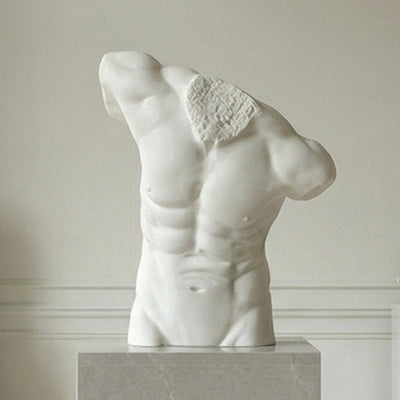


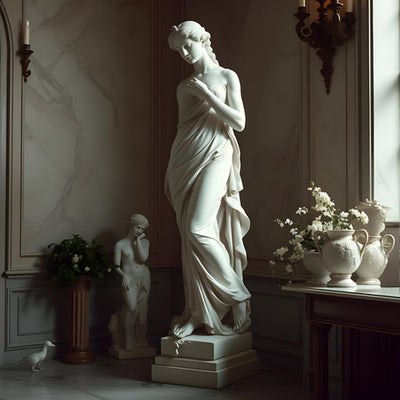






























Put a four-foot Apollo at the far end of a long lawn and he stops being a god. He becomes an ornament. That is the quiet problem with the average Greek Roman statues sale. The originals were made to command a sanctuary, a bath complex or a papal courtyard. The reproductions are often shrunk, softened and cast in whatever ships most easily. At Giant Sculptures we spend a surprising amount of time steering buyers away from the wrong copy and toward one that keeps its presence outdoors. This is how we judge them.

At a Glance
Pose first: open, weight-shifted figures like the Discobolus and Apollo Belvedere read from distance. Compact poses shrink.
Supports are period-correct: a tree stump beside a marble god is Roman engineering. Leave it in place.
Check the extremities: wrists, fingers and loose drapery expose a weak reproduction before anything else does.
Match material to subject: marble suits calm deities. Bronze suits athletes and soldiers in motion.
Scale to the site: outdoors, life size nearly always beats three-quarter, whatever a Greek Roman statues sale is pushing that week.
Why Some Ancient Originals Shrink into Souvenirs
Squint at any statue in a Greek Roman statues sale and look only at the outline. The pieces that survive reproduction have a silhouette you could recognize as a shadow on a wall: an arm thrown wide, a hip pushed out, a head turned hard against the shoulders. A seated philosopher with folded hands reads as a gray lump from 40 feet (12 m). A striding figure reads as a gesture.
The second loss is depth. Weak reproductions among Greek and Roman statues for sale tend to have shallow anatomy, because shallow is faster to carve. Indoors under soft light you might not notice. Under a Texas noon sun, shallow muscle simply flattens, and the figure looks molded rather than sculpted.

Discobolus, Apollo Belvedere and the Farnese Types: Poses Built to Carry
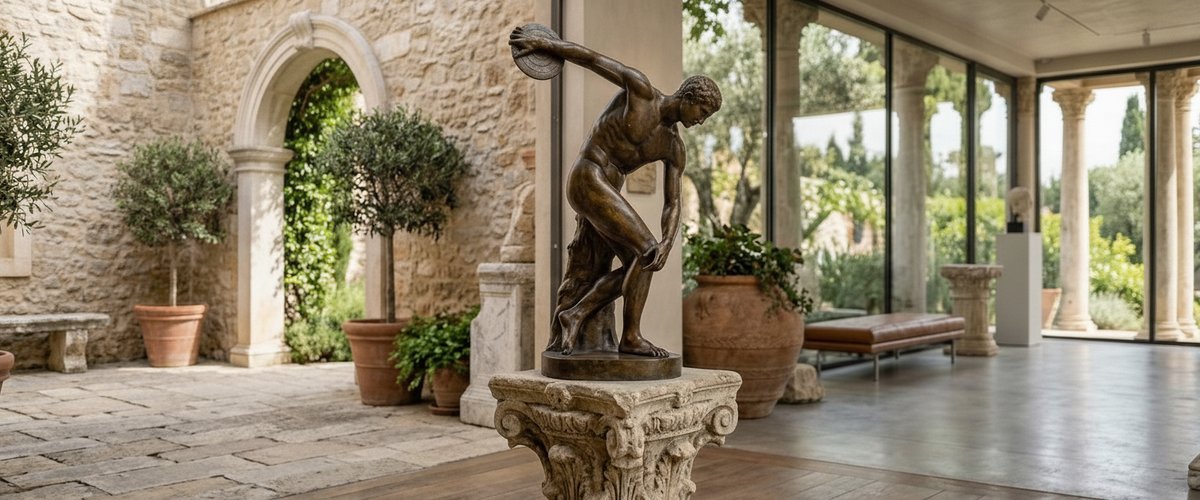
Myron's discus thrower is known to us almost entirely through Roman marble versions, such as the Townley Discobolus at the British Museum. Its coiled torso makes a zigzag you can read across an entire garden. The Apollo Belvedere works the other way. A long stride and an extended arm lead the eye outward, which makes him ideal at the end of an allée. Both poses are worth hunting for in any Greek Roman statues sale.
The Discobolus keeps its zigzag outline even from across a lawn.
The Farnese Hercules carries through mass instead of movement. He leans on his club, exhausted, and the sheer bulk of the torso holds the end of a vista or a courtyard wall. Warrior types with an open, planted stance, a staple of any good Greek Roman statue sale, work on the same principle: the weight sits low and the outline stays wide.
The Tree Stump Is Roman Engineering
Many Greek originals were bronze, and bronze has the tensile strength to balance a whole figure on two slim ankles. Marble does not. Roman copyists solved this with tree trunks, draped columns and small carved struts. That is why the Apollo Belvedere in the Vatican Museums stands beside a trunk. Clients browsing a Greek Roman statues sale sometimes ask us to delete the stump in marble. We decline. In bronze we can often leave it out, because the metal's own strength, backed by an internal steel armature, carries the load instead.
Thin Wrists and Flying Drapery: Where Weak Reproductions Fail First
A collector in Connecticut once asked us to assess a composite Apollo she had bought at a Greek Roman statues sale elsewhere. The base was fine. The crack was at the wrist, where the hand had been cast almost hollow to save material. That is typical. Watch for three warning signs:
Thickened, sausage-like wrists that hide poor modeling.
Fingers fused into mittens.
Drapery that hangs like a rubber sheet.
Good drapery is thin at the edge, deep in the folds, and anchored discreetly to the body at stress points. It is the fastest quality test you can run at any Greek Roman statue sale.

Marble, Marble-Dust Composite or Bronze: Which Gods Each Material Flatters
For wider placement ideas, Greek and Roman Marble Statues: Why the Stone Matters More Than the Myth is useful companion reading before finalizing the setting and sightlines.
Marble flatters stillness: Aphrodite, a resting Apollo, guardian beasts. It weathers gently in dry climates but needs care where freeze-thaw cycles are harsh. On a formal terrace, a guardian beast raised on an architectural base often anchors the elevation better than a slender marble god, which needs its stump and can still read small from the house. A carved figure such as the Winged Lion on a Greek Key Plinth Marble Statue - 220cm gets much of its presence from the plinth itself. The meander band ties the stone to the steps and balustrades around it.
Marble-dust composite is lighter, which helps on rooftops and interiors. It lacks the weight and translucency of stone and can fade under strong UV. It flatters nothing close up, yet it fills the cheaper end of almost every Greek Roman statues sale.
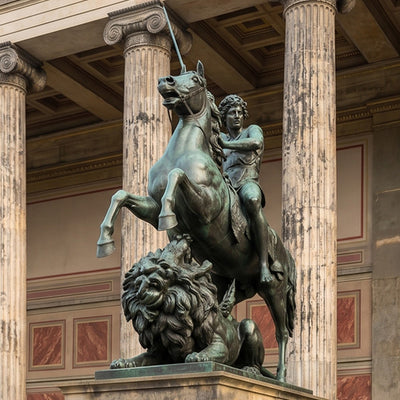
Bronze flatters motion. Athletes, soldiers and commanders gain from its crisp detail and slow-deepening patina. Bronze is also the safer choice wherever winters are hard, so look at it first in any Greek Roman statues sale aimed at a cold-climate garden.
Life Size or Three-Quarter: Let the Original Set the Scale
Most celebrated originals were life size or larger, yet a typical Greek Roman statues sale leans heavily on three-quarter copies. The Farnese Hercules stands over 10 feet (3 m). Reduce him to three-quarter and the heroic bulk turns cute. We learned this in Napa, where a client's three-quarter Venus vanished against a dark yew hedge. The life-size replacement looked as if it had always been there.
Against a dark hedge, the life-size figure holds; the three-quarter one fades.
At the head of a long driveway in Aspen or the Hill Country, a heroic-scale bronze keeps its planted stance legible from the car. A warrior such as the Life-Size Classical Greek Warrior Bronze Statue - 250cm holds that kind of distance, where a three-quarter figure would read as a garden ornament.
Three-quarter figures belong in loggias, entry halls and small walled courtyards. In a library garden or courtyard where visitors stand within arm's reach, a smaller bronze such as the Life-Size Classical Roman Commander Bronze Statue - 150cm suits the space better than anything heroic. Its armor detail rewards close viewing. Before deciding, stake a pole at the proposed height and view it from your main window.
What to Check Before Buying Greek and Roman Statues for Sale
Run through this list before you commit to any Greek Roman statues sale, online or in person:
Measure the real viewing distance, not the distance to the nearest path.
Judge the silhouette against your backdrop: hedge, stucco or sky.
Confirm supports suit the material.
Inspect wrists, fingers and drapery edges in close-up photos.
Ask exactly what the material is, and get the weight in pounds and kilograms.
Plan the plinth, footing and anchoring before delivery day.
Check crane or forklift access to the site.
Budget for any Greek Roman statue sale depends on material, scale, complexity, engineering, installation and finishing. Ask for a tailored quote once you know the site.

When a Studio Commission Is the Better Answer
Ready-made Greek and Roman statues for sale cover the famous types well. They cannot know your site. A Giant Sculptures commission usually beats compromising if you need any of the following:
A matched pair for a gateway.
A specific god the catalog does not carry.
A figure scaled to a two-story facade.
A plinth that echoes your architecture.
Before you settle on a Greek Roman statues sale elsewhere, start with our Greek and Roman statues collection. Then send us photos and measurements. Our studio will tell you honestly whether a stock piece fits or a bespoke figure will serve you better for decades.