





































































































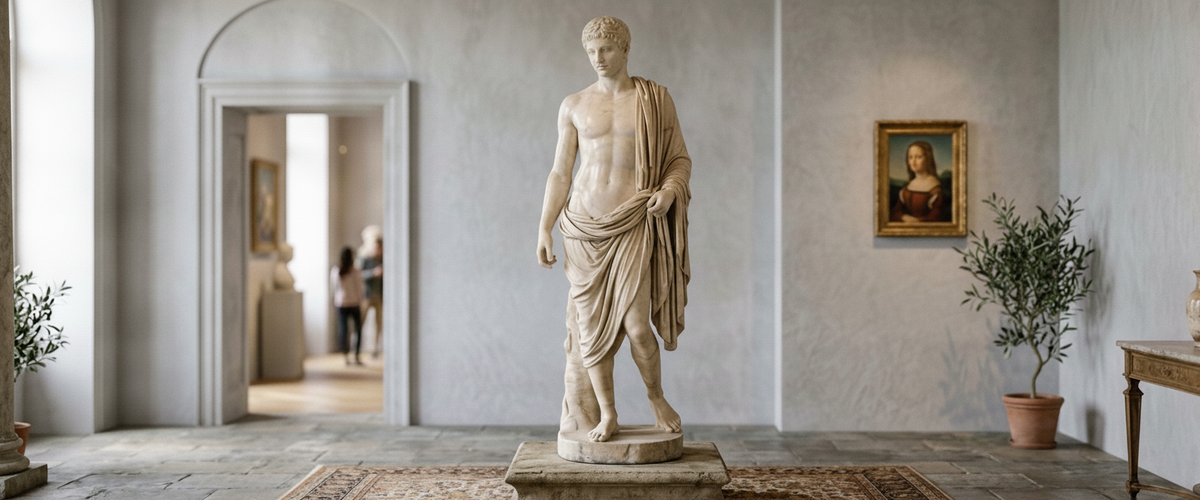

Most classical sculpture fails in the room, not in the workshop. The anatomy can be correct, the drapery convincing, the surface beautifully finished, and the piece still looks like it arrived ten minutes ago and has not decided to stay. What separates a figure that settles into a space from one that looks staged comes down to a short list of decisions: the pose, the material, the height you view it from, and how much of the body you show at all. Get those right and a classical sculpture stops being an object in the room and starts organizing it.

Key Takeaways Before You Shop
Contrapposto is the tell. Weight on one hip is the single device that separates classical sculpture from the stiff figures that came before it.
Most "Greek" figures you know are Roman marbles. The bronze originals were largely melted down, and that history shapes how modern carvings and casts are made.
Material changes the reading. Marble makes a classical sculpture quiet and luminous, bronze makes it dark and graphic, and cast stone weathers fastest into looking settled.
Plinth height is not decoration. Many classical figures were carved to be read from below, and a base that is too low flattens the whole pose.
Bust, torso or full figure is a spatial decision before it is an aesthetic one.
Weight on One Hip: The Device That Makes a Standing Figure Look Alive
Stand a person up straight, arms at their sides, feet parallel, and they look like furniture. Shift their weight onto one leg and everything follows: the hip rises, the shoulder drops to counter it, the spine curves, the free leg relaxes. That is contrapposto, and it is the reason a classical Greek sculpture from the fifth century BC feels like a body rather than a column with features carved into it. Polykleitos built an entire theory around it, and the Doryphoros survives in Roman marble copies precisely because later sculptors kept studying the formula. The Metropolitan Museum's overview of Greek art in the Archaic and Classical periods traces that shift well.
When buyers ask us why one figure feels alive and a similar one feels wooden, the answer is nearly always in the hips and shoulders. Look at the piece from the side, not just head on. If the shoulder line and the hip line are parallel, the classical sculpture will read as static no matter how good the face is. Among the famous classical Greek sculptures worth studying for this, the Riace Bronzes and the Kritios Boy repay a close look at how the weight is carried.
Greek Originals, Roman Copies and What Modern Classical Sculpture Owes Both
The classical sculptures of ancient Greece were mostly cast in bronze, and most of that bronze was recycled into weapons and coinage centuries later. What survived was the Roman marble copy trade: prolific, technically excellent, and responsible for almost everything we picture when we say classical Greek art. A sculpture historian can point at the strut under a marble thigh and tell you it is a translation, because marble cannot hold an unsupported limb the way bronze can.
That matters commercially. A classical sculpture cast in bronze can take poses that marble simply cannot: an extended arm, a rearing horse, a chariot mid-stride. A composition on the scale of the Monumental Classical Chariot with Goddess and Horses Bronze Sculpture - 600cm is only buildable in bronze, because no stone version of that arrangement would stand up without a forest of supports under the horses. If you have fallen for a dynamic pose, you have effectively already chosen your material.
Bronze carries poses stone cannot: a six-meter classical sculpture of a chariot team caught mid-stride.

Marble, Cast Stone or Bronze: How Classical Sculpture Reads
Marble is the material of quiet. Light penetrates the surface slightly before it scatters back out, which is why carved skin looks soft up close and keeps a crisp edge from across a lawn. It suits interiors, sheltered courtyards and mild coastal climates. Outdoors in Aspen or upstate New York, freeze-thaw cycling is the real enemy, and the Smithsonian's conservation guidance on caring for marble is a sober read for anyone assuming stone is maintenance-free.
Bronze goes the other way. It reads as silhouette first, detail second, which is why it holds up against sky, hedging and open water. A patinated figure in a Napa garden will still be legible at dusk when a pale marble has gone to a blur. Bronze also takes moving water without the staining and erosion that punishes stone, which is why so much garden classical sculpture is fountain work. Where a courtyard needs sound and movement from a form that is otherwise entirely still, the Classical Four Cherub Fountain Bronze Fountain - 230cm is closer to the right answer than a standing figure on a plinth. Cast stone sits between the two: it takes moss and weathering quickly, which is an advantage if you want a new piece to look like it has been there thirty years.
Classical Sculpture Carved to Be Seen From Below
Pediment figures and temple statuary were designed for an upward sightline. Faces were tilted, torsos elongated slightly, drapery cut deeper than natural so shadow would read from the ground. Put that same classical sculpture on an 8-inch (20 cm) base in a living room and the proportions turn odd; the head looks small and the pose looks slumped.
Set the figure's own eye line at or just above the viewer's and the pose recovers its intended proportions.
Our working rule is to set the sculpture's own eye line at or slightly above the viewer's. For a life-size standing figure that usually means a plinth of 18 to 30 inches (45 to 75 cm). For a bust, aim to bring the base of the neck close to standing eye level, which is why so many bronze busts and heads look wrong on a low console and right on a tall pedestal. Equestrian and multi-figure groups invert the rule. A piece such as the Life-Size Classical Robed Lady on Horse Bronze Sculpture - 120cm wants a low, broad base and open ground around it, because the composition is read in the round rather than frontally, and lifting it high only pushes the horse's belly into the sightline.
Full Figure, Torso or Bust: What a Hallway Can Actually Take
Entry halls seduce buyers into over-scaling. A full standing figure needs roughly 3 feet (about 1 m) of clear floor on the approach side or people will walk past it sideways, and that assumes the hall is wide enough that the sculpture is not read as an obstacle. We have shipped several torsos to narrow Manhattan and Boston entries for exactly this reason. A torso on a slim pedestal gives you the vocabulary of classical sculpture, the drapery and the anatomy, in a footprint a full figure cannot match.
Busts do something different again. They invite a face-to-face reading, so they work in libraries, studies, dining rooms and stair landings where people pause. Full figures want a destination: the end of an axis, a lawn, a pool terrace, the center of a courtyard.

Where Classical Sculpture Looks Staged, and How to Fix It
Three quick diagnostics. First, if the figure is centered on a wall with nothing else in the composition, it reads as merchandise; give it a companion element such as planting, a bench, a step. Second, if it faces the viewer squarely on approach, turn it 15 to 30 degrees so the pose has to be walked around. Third, if the plinth is a different stone or finish from everything nearby, it will look like a shop display; match it, or contrast it with intent.
A Short Buyer's Checklist
Check the side profile for genuine weight shift, not just a bent knee.
Confirm the material suits the climate: marble under shelter, bronze anywhere.
Measure the approach distance, not only the footprint.
Specify plinth height and material at the same time as the sculpture.
Ask about internal armature, fixing points and lifting arrangements early.
Plan access for delivery: gate widths, ground bearing, crane or gantry needs.
Agree the patina or stone finish against a sample, not a photograph.
Commissioning a Classical Sculpture at Your Own Scale
Catalog pieces solve most briefs. When they do not, a bespoke classical sculpture usually comes down to three variables: scale, pose and finish. We regularly enlarge or reduce a composition, adjust drapery, change a patina to suit a stone terrace, or engineer a base for a windy coastal site. Budget depends on material, size, complexity, engineering, finishing and installation, so the honest answer is always a tailored quote rather than a headline figure.
If you are still deciding on subject and format, browsing the classic sculptures range alongside our bronze figures and statues is the fastest way to work out whether you want a single figure, a group or water in the composition. Giant Sculptures builds most of its work large, in bronze, stone and marble, for clients who expect the piece to outlast the garden it was bought for.
For wider placement ideas, Buying a Classical Marble Sculpture? Check the Fingers First is useful companion reading before finalising the setting and sightlines.