





































































































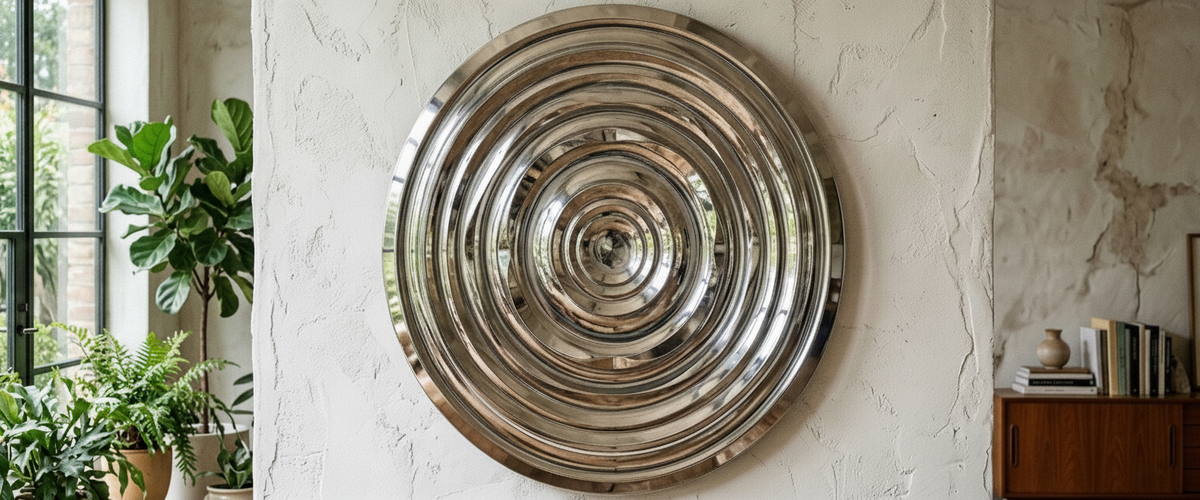

Most mirror art is chosen facing the wrong direction. Buyers study the piece itself, the finish, the frame, the curve of the metal, and never once turn around to look at what the thing will actually be showing them for the next twenty years. A mirrored panel is the only wall piece whose content changes hourly. You are not just buying an object with a reflective face; you are buying a permanent, framed view of the opposite wall.
Get that view right and a mirror wall art piece doubles the light and depth of a room. Get it wrong and you have installed a picture of your ceiling spots, a radiator, and half a doorframe.

Key Takeaways Before You Shop
Photograph the opposite wall first. That photo is the real artwork your mirror art will frame.
Decide how literal you want the reflection. Silvered glass is honest; polished stainless is soft and slightly warped.
Fragmented Art Deco geometry suits tight spaces where a flat mirror would simply double the clutter.
Set height by sightline, seated or standing, not by the mathematical center of the wall.
Humid and south-facing rooms punish silvered glass. Metal-faced pieces hold up better.
Anything above head height needs mechanical fixings into structure, not drywall plugs and optimism.
Start With a Reflection Audit
Stand where the mirror art will hang, hold your phone flat against the wall with the camera facing out into the room, and take a photo. That is roughly what a flat mirrored panel will show. Do it three times: morning, mid-afternoon, and with the lamps on at night. Clients are often surprised. A drawing room that feels calm in person can reflect back a busy bookshelf and a TV screen the size of a door.
A layered panel fragments the room behind you instead of copying it.
If the reflected view is good, buy flat and literal. If it is cluttered, buy geometry. Layered and sculpted mirror art breaks the image into pieces, so you get light and movement without a faithful copy of the mess behind you. Tiered rings and stepped planes catch light at different angles, and the room arrives in fragments rather than as one honest photograph.
Polished Stainless Versus Silvered Glass
Silvered glass gives a true, cool, dimensionally accurate reflection, and it is the most literal mirror art you can hang. It is also the more fragile option. The Corning Museum of Glass has good background on how silvered mirror glass is made; that thin metallic film behind the glass is what fails first when moisture reaches an unsealed edge.
Mirror-polished stainless behaves differently. It reads slightly warmer, gains a gentle convex or concave distortion depending on how the sheet is formed, and shrugs off knocks that would chip glass. That subtle warp is a feature. It softens whatever is behind you, which is exactly what you want in a room with a lot of visual noise. Where the ceiling is full of downlights and a plain reflective sheet would simply glare, a textured steel face such as Rivarenne Black Abstract Texture Steel Mirror 3D Wall Art carries reflection and matte contrast on the same panel, so the surface keeps its depth instead of flattening out.
Bronze and warm-toned mirror art sits between the two. These surfaces reflect less light but flatter skin tones and warm timber, which is why they land well in dining rooms and paneled hallways.

Why Art Deco Geometry Suits Narrow Rooms
An Art Deco mirror rarely presents one continuous surface. Fluting, stepped bevels, sunburst rays and fan segments chop the reflection into slivers, and each sliver catches light at its own angle. In a hallway 40 inches (about 1 m) wide, a flat mirror just reproduces the opposite wall at arm's length and makes the corridor feel busier. Fluted or fanned geometry does the opposite: it reads as light and pattern rather than as a duplicate room.
Fluted segments scatter light down a corridor rather than doubling it.
The same logic applies to stairwells, powder rooms, and the awkward wall between two doors. Buy fragmented mirror art where space is tight and buy flat clarity where you have depth to reflect.
The Things That End Up Inside the Picture
Three culprits ruin more mirrored wall art installations than any design decision does. Ceiling spots aimed straight at the panel produce a hard glare spot that follows you across the room. Radiators reflect as a pale horizontal band at knee height and are almost impossible to unsee. Doorframes cut the reflection with a vertical line that fights the piece's own geometry.
Before you commit, walk the room's main circulation route and watch the mirror art from each end. If a downlight burns a hole in the surface, either move the piece, swap to a narrower beam angle, or choose a sculpted, low-gloss face that scatters the hit.
Hanging Height Is a Sightline Decision
Gallery convention puts the center of a work around 57 to 60 inches (145 to 152 cm) from the floor. That rule assumes a standing viewer and a static image. Mirror art has to answer to seated eye level too. In a living room where people sit, drop the piece slightly so it reflects the room rather than the ceiling void. In an entry hall where everyone is standing and moving, go higher and let the reflection carry down the corridor.
Over a console or fireplace, leave a clear gap above the surface so the mirror art does not appear to grow out of the furniture. Format matters as much as height here: on a low-ceilinged wall, the vertical silhouette of an arched piece such as Arcaluna Blue & Blush Layered Arch Mirror 3D Wall Art pulls the eye upward, where a round of the same width would sit and spread.
Rooms Where Mirror Wall Art Quietly Degrades
Bathrooms, conservatories, pool houses and south-facing sunrooms are the four rooms we get repeat questions about. In humid air, silvered glass develops dark speckling at the edges where the backing lifts. Colored acrylic layers can shift tone under sustained direct UV. Adhesive-bonded assemblies soften in heat.
Metal-faced mirror art is the safer answer in those rooms. Stainless holds its polish in damp air far better than a silvered backing survives it, and the Nickel Institute's guidance on stainless grades and corrosion resistance is a useful primer if you are specifying for a coastal or high-humidity site. We have replaced glass panels in pool pavilions where the original had speckled at the edges within two seasons; the replacement specification was polished stainless on a sealed aluminum backing, and it has stayed clean.
Weight, Substrate and Fixings
Mirror art at architectural scale is heavier than it looks, and the weight sits away from the wall on a lever arm. Anything mounted above head height needs a mechanical fixing into structure. That means locating studs or masonry, not trusting plasterboard anchors.
Identify the substrate before ordering: timber stud, metal stud, plaster on brick, or solid masonry each need different anchors.
Use a French cleat or continuous rail for wide pieces so load is spread rather than hanging from two points.
Add a secondary safety fixing at the base for anything above a seating area, stair, or bathtub.
Check the wall is flat. A bowed wall twists a rigid panel and stresses the joints.
Confirm handling access for stairwells and tight landings before delivery day, not on it.
Ask for the mounting hardware spec in writing so your installer arrives with the right anchors.
Two Search Terms Worth Decoding
People searching mirror art land on two very different things. Mirror clip art is digital graphics, vector illustrations of hand mirrors for design mockups, not physical work for a wall. Mirror motor laser art refers to kinetic laser installations where small motorized mirrors, often galvanometer-driven, steer a beam to draw shapes in space. Those are commissioned as event and venue installations rather than bought off a wall. If you want a permanent, physical, light-reflecting piece, the terms to use are mirror wall art or mirrored wall art.

Commissioning Bespoke Mirror Art
Our studio builds bespoke mirror art and polished metal wall pieces to specific wall dimensions, curvature and finish, which matters when a stock size leaves awkward margins on a feature wall. Going bespoke also lets you control distortion: a shallow convex curve calms a busy reflection; a flat face keeps it sharp. Tone is the other decision worth settling early, and it is easier to settle against something physical: if the room needs warmth in the reflection rather than cool accuracy, a bronze-leaning surface such as Lunestre Bronze Ripple Organic Round Mirror 3D Wall Art is the better starting point for that conversation than a silver-finish sample.
Budget depends on material, scale, complexity, engineering, finishing and installation, so the sensible next step is a tailored quote rather than a guess. Browse the full mirror art collection for format and scale reference, then send us the photo from your reflection audit. That single image tells us more than a mood board.
For wider placement ideas, Clip Art Hallway Ideas: Turning a Mood Board into Wall Art That Lasts is useful companion reading before you finalize the setting and sightlines for your mirror art.