





































































































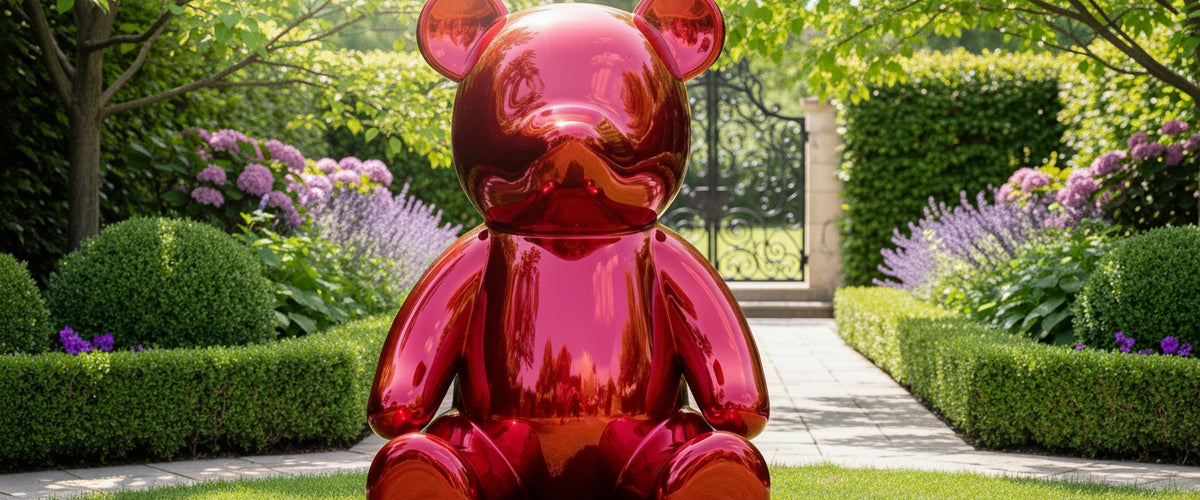

A glossy red balloon dog in a marble foyer or a ten-foot chrome bear at the end of a Napa vineyard driveway tells you something immediately: the owner is not playing it safe. Pop art sculpture is the loudest, most photographed category we ship, and it is also the easiest one to get wrong. Scale slips, the lacquer dulls within a season, the color clashes with the architecture, or the piece ends up looking like merchandise instead of art. This guide is for buyers who want the opposite outcome.

Quick answer: what makes a pop art sculpture work
- Scale needs to be deliberate. Most pop pieces fail because they are too small for the room or driveway.
- Finish matters more than subject. A mirror-polished stainless steel bear and a hand-painted resin bear are different objects entirely.
- Color should fight the architecture a little. Pop art is meant to interrupt, not match the cushions.
- Placement is half the artwork. A single piece, well sited, beats three crowded together.
- Bespoke is normal in this category. Stock sizes rarely fit the actual space.

What is pop art sculpture, and who is it for?
Pop art sculpture takes the visual grammar of consumer culture (cartoons, packaging, toys, fast food, comic book panels) and blows it up into three dimensions, usually with industrial finishes that feel manufactured rather than carved. The movement came out of the 1960s, but the sculptural version really hit its stride later, when artists started using mirror-polished steel and automotive paint to turn cheap-looking imagery into serious objects.
It suits buyers who want the room to react. We see pop art sculpture commissioned most often by collectors with modern architecture, hospitality groups building photogenic lobbies, fashion and tech offices that want a non-corporate centerpiece, and homeowners in places like Miami, Aspen and the Hollywood Hills where the architecture can take a strong color hit. It is a poor fit for soft traditional interiors unless you are deliberately staging a contrast.

Pop art sculpture ideas worth commissioning
The most successful pop art sculpture ideas tend to come from one of four families: animals reimagined as toys (bears, dogs, gorillas, rabbits in glossy lacquer), oversized everyday objects (lipsticks, donuts, ice creams, soda cans), cartoon and comic figures rebuilt at human or super-human scale, and geometric remixes of classical forms in saturated color.
A pop art bear sculpture is the workhorse of the category. It reads instantly, photographs from every angle, and scales beautifully from a 50cm (about 20 inch) tabletop piece up to a life-size driveway statement. Where the brief is a console, plinth or shelf rather than a floor anchor, a tabletop-scale piece such as the Urban Pop Bear Sculpture - 50cm keeps the proportions reading as art rather than as a toy.
Other ideas we are asked about regularly: pop art dragon sculpture in metallic teal or gold leaf for hospitality entrances, pop art dog sculpture in the balloon-dog tradition for collectors who want the visual reference without buying the original artist, and pop art food sculptures (oversized donuts, ice cream cones, burgers) for restaurants and ice cream brands that want a sidewalk magnet. A 3D pop art sculpture mounted on a wall, somewhere between relief and freestanding, is also growing fast as a hotel commission.

Famous pop art sculptures and the artists behind the movement
You cannot talk about pop art sculpture artists without naming Claes Oldenburg, whose monumental clothespins and spoons made oversized everyday objects a serious public art language; Jeff Koons, whose mirror-polished balloon animals defined what most people now picture when they hear the term; Niki de Saint Phalle, whose Nanas brought color and figure into the conversation; and Yayoi Kusama, whose pumpkins sit at the intersection of pop and obsession. Earlier figures like Roy Lichtenstein produced sculptural work too, translating his comic-panel style into painted bronze and steel. The Tate's definition of pop art is a clean primer if you want the movement's origins in one read.
For buyers, the practical point is this: famous pop art sculptures are reference points, not shopping targets. A serious bespoke piece should sit in the same visual family without copying a signature work. Reputable studios will not reproduce another living artist's protected design, and you should not want them to.

Materials and finishes: what actually lasts
Pop art sculpture lives or dies on its surface. The same bear in three different materials is three different price points and three different lifespans.
- Mirror-polished stainless steel is the gold standard for outdoor pop pieces. It holds high-gloss color under automotive-grade lacquer, resists corrosion, and can be engineered for very large scale. Expect serious weight: a life-size stainless bear can run into hundreds of pounds (over 100 kg) before the base.
- Cast bronze with polychrome paint and clear coat is the route for collectors who want pop imagery with traditional permanence. It patinates slowly and behaves predictably outdoors. Heavier and more expensive than steel at the same size.
- Fiberglass and composite with automotive paint is lighter and well suited to interior pieces, retail displays and short-to-medium-term outdoor installations. With proper UV-stable topcoats it can last years outside, but it is not a thirty-year material the way bronze or stainless is.
- Aluminum sits between steel and composite: lighter than stainless, more durable than fiberglass, and a sensible choice for rooftop or balcony placement where weight loading matters.
Finish quality is where studios separate. Look for multi-stage base coats, color coat, and at least two layers of UV-stable clear lacquer. The Getty Conservation Institute publishes useful guidance on outdoor painted sculpture if you want to dig into how these finishes age. For a pop piece destined for full sun in Texas or coastal Florida, ask specifically about UV-stable topcoats and salt-air-rated hardware.

Scale and placement: where pop art sculpture earns its keep
For wider placement ideas, Mirror Art Illusions: 3D Wall Pieces That Play with Light and Space is useful companion reading before finalising the setting and sightlines.
The single most common buyer mistake is going too small. Pop art is loud imagery, and small loud imagery reads as a toy. As a rough rule:
- Tabletop (under 60cm / 24 inches): works as a styling piece on a console, shelf or plinth, ideally in a tight color story with the room.
- Floor piece (1m to 1.5m / roughly 3 to 5 feet): needs about 3 feet of clear breathing room on every side. This is the size that anchors a lobby or a double-height living room.
- Statement scale (1.8m to 3m / 6 to 10 feet): driveway, garden centerpiece, hotel entrance, gallery atrium. Plan delivery access before you commission.
- Monumental (over 3m / 10 feet): requires engineering drawings, foundation work, and often crane access. Budget months, not weeks.
Placement principles worth following: give a pop piece a quiet backdrop (a single-color wall, hedge, or sky), light it from two angles to avoid a flat photograph, and resist the urge to cluster. One ten-foot piece beats four five-foot pieces every time. For interior installations, a 3D pop art sculpture on the wall, like something from our 3D wall art collection, gives you the impact without sacrificing floor space, which is why we see it specified so often for boutique hotels. Where the subject needs a stronger pose and a single saturated color rather than a recognisable toy silhouette, a piece like the Pop Art Gorilla Sculpture - 50cm is closer to the right design language for a desk-height or console placement.

Budget, commissioning and delivery
Pop art sculpture pricing is driven by material, scale, complexity of form, finish quality, engineering, base or plinth, crating and freight. A 50cm interior bear in composite with hand-painted finish is a different commission from a 2.5m mirror-polished stainless gorilla with engineered internal armature and a stone base. Rather than quote ranges that will mislead you, we build a tailored quote against your actual brief: subject, size, finish, location, and timeline.
Commissioning typically runs along these stages:
- Brief and reference. You share the space, the mood, and any visual references. We push back on anything that copies a protected design.
- Concept and quote. Sketches or a digital model, plus a fixed quote covering build, finish, crating and freight.
- Build. Sculpting, casting or fabrication, finishing, and quality check. Lead times for bespoke pop pieces are typically measured in months, not weeks, especially for large stainless steel work.
- Freight and install. We ship worldwide. For US deliveries we coordinate with crating partners and, where needed, white-glove install crews for large floor pieces.
How to make pop art sculptures: a quick reality check
If you are an artist or design student asking how to make pop art sculptures, the short version is: start with a single recognizable form, simplify it aggressively, push the scale beyond comfortable, and treat the finish as part of the artwork. The studios that build pop pieces well are usually hybrid operations: traditional sculptors, metalwork engineers, and automotive painters in one workflow. That hybrid is why bespoke pricing sits where it does, and why a properly finished piece looks nothing like a 3D-printed garden ornament.
Where Giant Sculptures fits in
We specialize in large-scale and bespoke sculpture, and pop art is one of our most-commissioned categories for hospitality, private estates and design-led offices. Recent commissions have included a glossy bear for a Hamptons pool terrace and an oversized animal piece for a hotel atrium in the Southwest. Our pop art sculptures collection is the best starting point if you want to see the visual range, and the balloon dog sculptures and bear sculptures collections are useful if you have a specific subject in mind. If nothing on the shelf is the right size or color, that is exactly where a bespoke brief begins.
For general conservation principles, V&A sculpture techniques is a useful external reference, though the final care routine should always follow the material and finish specified for the individual commission.