






































































































Most outdoor statues and sculptures disappoint for one boring reason: they were chosen on a screen at 12 inches and then installed to be read from 200 feet. The detail that sold the piece is invisible from the driveway, and the outline nobody checked is the only thing anyone actually sees. Distance is the first specification, ahead of subject, ahead of material, ahead of budget. Get it right and a piece looks inevitable in its setting. Get it wrong and you own an expensive lawn ornament.

Key Takeaways
200 feet (60 m): only silhouette registers. Test the outline, not the finish.
50 feet (15 m): pose, gesture and the gaps inside the form carry the piece.
Arm's length: surface quality decides whether people touch it or step back.
Base height is a viewing tool. It controls sightline, sky contrast and how the sculpture meets the ground.
When stock heights stop working for your sightlines, a commission is often the more economical answer than buying twice.
Two Hundred Feet Out: Silhouette Is the Only Thing Doing Any Work
At long range the eye reads one thing: shape against background. Color flattens, texture vanishes, and a beautifully modeled face becomes a gray smudge. So the long-range test for outdoor statues and sculptures is simple. Squint at the photograph until it blurs. Does a clear, recognizable outline survive?
At long range the outline is the whole message. Everything else is invisible.
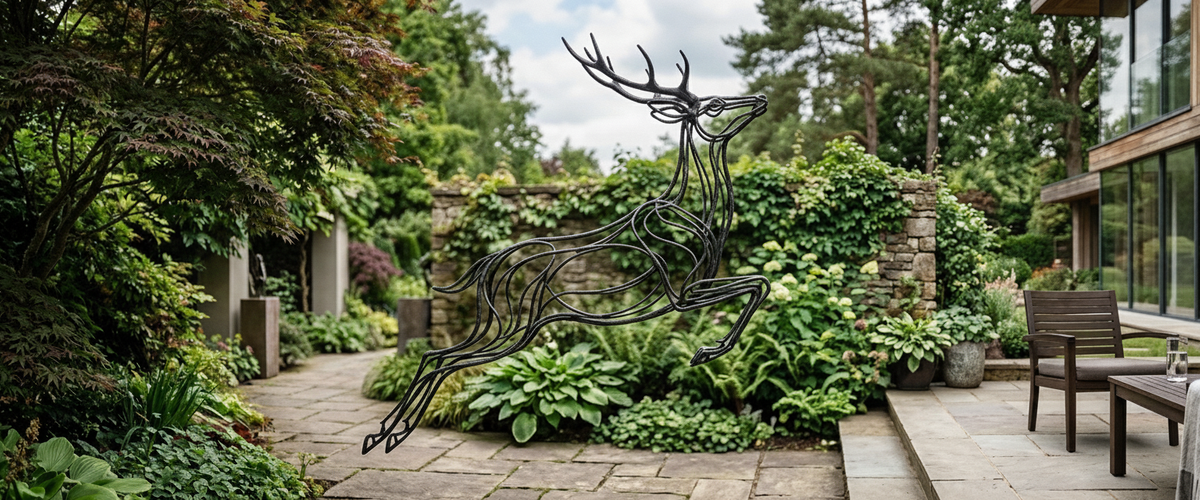
Open, linear forms win at distance because the negative space cuts a hard edge against sky and hedging. Where the backdrop is deep planting or open sky, a wire-built form such as the Black Abstract Grazing Deer Wire Metal Sculpture - 158cm at 158 cm (about 5 ft 2 in) still reads as a deer from a long way off, because the linework separates head, neck and back rather than filling them in. Solid, compact forms can also work at range, but they need a strong profile and a tonal difference from whatever sits behind them. Dark bronze in front of mature yew is a common mistake; the sculpture simply dissolves.
Fifty Feet In: Where Pose, Gesture and Negative Space Have to Hold
Fifty feet is the walking-approach range, the distance across most terraces, courtyards and lobby forecourts. It is also the distance at which most outdoor statues and sculptures are actually judged. Detail is still soft here, but posture is fully legible. This is where a stiff, symmetrical pose starts to look like a garden center product and an asymmetric one starts to look like art.
Look for weight distribution, direction of movement and internal gaps. A diagonal-bodied piece like the Black Abstract Leaping Deer Wire Metal Sculpture - 173cm at 173 cm (about 5 ft 8 in) holds this range because the tension in the pose is readable without any surface information at all. Mid-range also rewards pairing: two figures at different heights, angled so the space between them becomes part of the composition. Landscape designers use that trick constantly on wide lawns, where a single object tends to look stranded.

Arm's Length: The Surface Detail That Decides Whether People Touch It
Close up, everything you ignored earlier becomes the whole experience. Weld lines, tool marks, patina depth, casting seams, the crispness of an edge, whether rainwater has streaked a mineral trail down one flank. Visitors will touch outdoor statues and sculptures that invite touch, and they will not ask permission first.
Within reach, the finish is the piece. Weld lines and patina do the talking.
Bronze is still the reference standard for close-range viewing because patina develops with age instead of degrading, and a waxed surface takes handling well. The American Institute for Conservation's guidance on caring for exterior bronze favors regular washing and re-waxing cycles over aggressive cleaning, and that is worth building into your maintenance budget from day one (see AIC guidance on caring for objects). Stainless steel rewards a fine-finished surface but shows fingerprints on a mirror polish, so a satin or brushed finish is usually smarter within reach of a path. Corten settles into a stable oxide skin and is forgiving of touch, though the first year of runoff will mark pale paving. Cast marble and stone read superbly at close range, especially where carving catches raking morning light. Where a piece will be inspected at arm's length rather than glimpsed down an avenue, the modeling has to earn that scrutiny, which is why a heavily worked animal form like the Fresh Grizz Bear Sculpture - 165cm at 165 cm (about 5 ft 5 in) belongs on a terrace or in an enclosed courtyard rather than at the end of a 300-foot approach.
Where Outdoor Statues and Sculptures Go: Entrance, Open Lawn or Enclosed Courtyard
Each setting makes a different demand on the form.
Entrances are seen head-on and at speed. Frontal legibility matters more than a rewarding walk-around. Symmetry is acceptable here, and often desirable.
Open lawns are seen in the round, from every compass point, and against sky. Every angle has to work. Nothing exposes a weak back view faster than a lawn.
Enclosed courtyards compress viewing distance to 15 to 30 feet, so surface quality and scale discipline dominate. Oversize a courtyard piece and it feels like furniture jammed against a wall.
We shipped a pair of animal pieces to a Napa property where the client originally wanted them centered on the lawn. On site, the sightline from the kitchen window ran straight through a row of olives. Moving the pair 20 feet toward the terrace put them at courtyard distance, and the surface work suddenly earned its keep. Sightlines beat plans.
Hotel Forecourts and Office Grounds: Pieces That Read from a Moving Car
Commercial placement adds motion. A driver approaching a hotel forecourt at 20 mph gets maybe four seconds of viewing, mostly peripheral, and the sculpture is competing with signage, planting and other cars. That argues for greater height, bolder mass and higher tonal contrast than you would choose for a private garden. It also argues against fine detail, which is wasted spend at that speed.
Practical constraints follow. Outdoor statues and sculptures in the public realm need anchoring designed for wind loading and vehicle proximity, drainage that keeps standing water out of the base, and a finish that tolerates de-icing salt in Aspen or coastal air in Malibu. Ask about internal armature and fixing detail before you ask about lead time. The Henry Moore Foundation's decades of siting large sculpture in open landscape make the point plainly: landform and approach route shape a piece as much as the object itself.
Base Height Is a Viewing Tool, Not a Structural Afterthought
Plinths for outdoor statues and sculptures are usually specified last and should be specified early. Base height sets the eyeline, decides how much sky sits behind the form, and controls whether a figure feels grounded or ceremonial. A rough working rule from the studio: for a standing figure viewed from 50 feet on level ground, raising the base by 12 inches lifts the head clear of low planting and changes the whole reading. Raise it too far and you lose the face entirely to foreshortening.
Twelve inches of plinth can lift a figure clear of low planting, or lose the face to foreshortening.
Other base decisions worth making deliberately:
Match the plinth material to the setting, not the sculpture. Local stone usually beats imported polish.
Keep the footprint slightly smaller than the sculpture's visual mass so the piece appears to sit, not perch.
Design in a mow-strip or gravel collar. Strimmer damage at the base is the most common avoidable wear we see.
Confirm footing depth against local frost lines before casting anything.

When Stock Scale Runs Out and a Commission Becomes the Cheaper Answer
Catalog heights solve most residential problems. They stop solving them when the viewing distance is long, the backdrop is tall, or the architecture sets a datum a standard piece cannot meet. If your sightline needs 11 feet and the catalog tops out at 6, buying the 6-foot version and hoping is the expensive route, because you will replace it.
Commissioning through Giant Sculptures usually starts with a site conversation: distances, approach routes, backdrop tone, wind exposure, and whether people will touch the piece. From there we work through material choice, engineered armature, finish samples and base design. Costs depend on material, scale, complexity, engineering, installation and finishing, so the sensible step is a tailored quote rather than a guess. If you want to calibrate your eye first, work through the outdoor sculptures and statues range and the garden statues collection, then measure the actual distance from your main viewpoint. That number will tell you more than any photograph.
Distance Checklist Before You Commit
Run this list before you buy any outdoor statues and sculptures, stock or bespoke.
Measure the primary viewing distance and the secondary approach distance.
Blur the product photo. Does the silhouette survive?
Photograph the intended backdrop and check tonal contrast.
Mock up the height with a plywood cut-out or stacked crates for 48 hours.
Walk the back view. Lawn pieces need four good angles.
Confirm base height, footing depth and mow clearance.
Agree a wash and wax or inspection schedule for the finish you chose.
For wider placement ideas, Large Abstract Garden Sculptures: A Buyer's Guide to Scale, Metal, and Placement is useful companion reading before finalising the setting and sightlines.