





































































































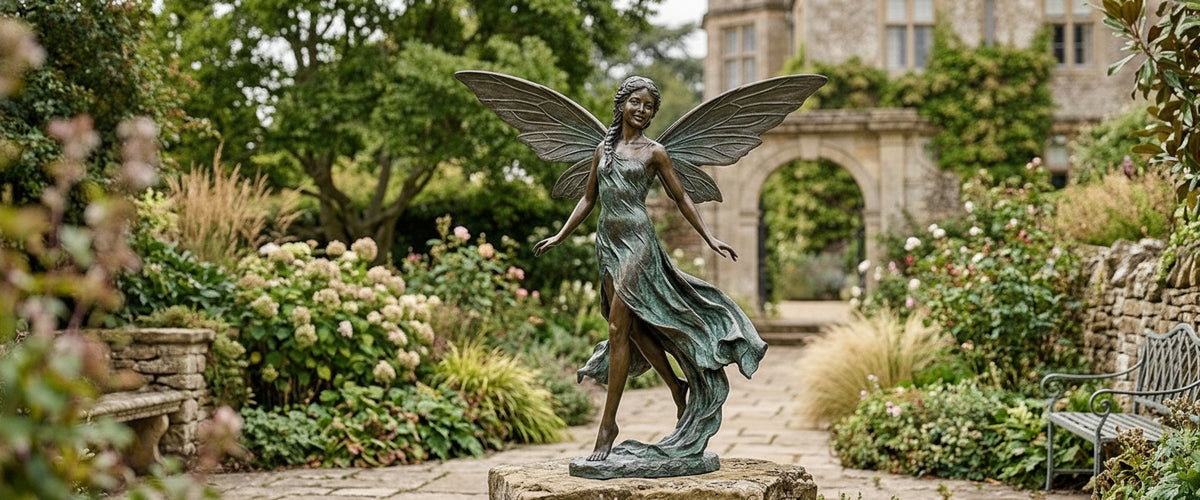

By the second week of July, most garden fairy statues have lost the argument with the planting around them. The hostas double, the ferns arch over, and a figure that looked charming in April is now a pale shoulder poking out of a green wall. It is the single most common complaint we hear from clients who bought their first piece somewhere else, and it almost never comes down to taste. It comes down to pose, scale, material and where the thing was set.
Garden fairy statues live outdoors for decades if they are chosen properly. Here is how to pick one that still earns its place in year five.

At a Glance: What Separates Strong Garden Fairy Statues From Forgettable Ones
Pose beats subject. A figure caught mid-movement holds attention; a passive seated figure blends into foliage.
Wings and fingertips fail first. Thin extremities are the weak point in freeze-thaw climates and in any material that is not properly cast.
Material decides detail retention. Bronze keeps a fingernail crisp for a century; cast concrete softens; resin chalks.
Under two feet (60 cm) stops reading past about ten feet (3 m). Buy for viewing distance, not for the showroom.
Siting gives her a stage. Tree bases, low walls, stepped planting and fern beds all frame a figure that open lawn swallows.
Some weathering flatters. Moss in the shadow lines is good. Uniform green film is neglect.
The Pose Problem: Why Static Figures Disappear
Seated, symmetrical, hands-in-lap figures are the default in mass-market garden fairy statues because they are cheap to mold and easy to stack on a pallet. They are also the first to vanish. A pose with no diagonal has nothing to fight the vertical chaos of a summer border, so the eye reads it as another lump of texture.
Look for asymmetry: a raised arm, a turned head, one leg tucked and the other extended, drapery pulling in a direction. A seated form can still work if the symmetry is broken somewhere, by the tilt of a head or an outstretched hand, so that there is a line of action for the eye to follow from twenty feet away. If you do want a seated figure, plan to raise it. A seated bronze on a low plinth of local stone reads as intentional. The same bronze sitting flat in a bed reads as forgotten.
A raised plinth keeps the silhouette above mature fern height, which is what stops a figure disappearing by midsummer.

Wings, Fingertips and Trailing Drapery Are the First Things Winter Takes
Anywhere with a proper freeze-thaw cycle, from the Hudson Valley to Aspen, punishes thin projections. Water finds a hairline in a wing edge, freezes, expands, and takes a chip with it. Repeat that through a winter's worth of cycles and the edge is gone. Porous cast materials are especially vulnerable because the damage happens inside the body of the material, not just on the surface, which is why durability standards for cast concrete pay so much attention to freeze-thaw resistance and air entrainment.
Cast bronze behaves differently. A wing is a shell of metal with consistent wall thickness, welded and chased by hand, and it does not absorb water at all. We shipped a winged figure to a client outside Bozeman who had already lost two concrete pieces to spalling; the bronze is on its fourth winter with nothing worse than a darker patina where snow sits longest. Where the whole silhouette depends on wings surviving intact, a cast piece such as the Large Classical Winged Fairy Figure at 5 ft (150 cm) is the honest way to buy that outline, because the engineering sits inside the form rather than being applied to it.
Concrete, Resin, Marble and Bronze, Judged on Detail Alone
Almost all garden fairy statues sold today come out of one of four materials, and each one holds a modeled edge for a very different length of time.
Concrete garden statues are the entry point for a reason: heavy, stable, and honest-looking in a shaded woodland setting. But sand-cast concrete cannot hold a fine edge. Eyelashes, feather barbs and finger joints arrive soft and get softer. Sealed properly and kept off wet ground, good cast concrete ages gracefully into something that looks quarried. Left unsealed on a sprinkler line, it grows algae, then it spalls.
Resin and composite hold crisp detail out of the mold and hold it for roughly three summers. UV exposure chalks the surface, colors flatten, and thin sections go brittle. It is a reasonable choice for a covered porch and a poor one for open ground.
Bronze is the reference standard for figurative work outdoors because lost-wax casting captures whatever the sculptor put into the wax, down to a thumbprint, and the patina is a chemically bonded finish rather than a coat of paint. It needs occasional wax, not rescue; the Smithsonian's conservation guidance on outdoor bronze maintenance is worth reading before you commit to any metal piece.
Marble is its own case. It carves to a beautiful edge and takes shade planting well, though it is happier out of hard freeze and away from acidic runoff. For a sheltered courtyard or a Napa terrace, a carved marble figure such as the Fairy Sitting Angel Marble Outdoor Sculpture at roughly 2 ft 8 in (80 cm) is a better fit than the same piece exposed on a hilltop.

Scale Honesty: Buy for the Distance You Will Actually Stand At
Measure from where people will stand. Garden fairy statues under two feet (60 cm) work at conversational range on a terrace and effectively disappear beyond about ten feet (3 m). At the far end of a lawn, on an axis, or terminating a long view, you need real height. Where a figure has to hold the end of a two-hundred-foot sight line, something at the scale of the Monumental Contemporary Dancing Fairy Bronze Sculpture, around 12 ft 6 in (380 cm), is not showing off; it is simply the height at which the piece stops reading as a garden ornament.
A workable rule: the figure should read as at least a third the height of whatever sits behind it. Against a mature hedge, a 5 ft (150 cm) bronze holds. Against a stand of oaks, it will not.
Siting That Gives Her a Stage
Fern beds: the finest foliage texture in the garden, which flatters a smooth cast surface. Set the figure high enough that the fronds break against its base, not its face.
Tree bases: bark gives a dark, matte backdrop that separates a light patina. Watch drip lines and root plates when setting the footing.
Low walls: a fairy seated on a dry-stone wall edge reads as inhabiting the garden rather than being installed in it. This is our favorite placement for mid-scale bronzes.
Stepped planting: set the figure on the upper tier so it clears the mature height of everything below.
Never: dead center of open lawn, or directly in front of a busy mixed border. Both erase the silhouette.
A wall edge in dappled shade lets a seated figure inhabit the garden instead of sitting in front of it.
Moss That Flatters, Green Film That Just Looks Neglected
There is a real difference between selective weathering and grime. Moss and lichen collecting in recesses, under a wing, along the shadow side of drapery, adds age and reads as intentional. A flat green biofilm across the whole face reads as a piece nobody looks after. The fix is usually irrigation, not chemistry: reposition sprinkler heads so the sculpture is not watered daily, and make sure air can move around it.
Annual care is short. Rinse with clean water, soft brush only, dry, then a coat of microcrystalline wax on bronze before winter. Skip pressure washers and acidic cleaners on every material discussed here.
Buyer Checklist Before You Commit
Photograph the site at midsummer, not in spring, so you see the real backdrop.
Pace out the primary viewing distance and set minimum height from it.
Ask what the wall thickness is at wings and fingertips.
Confirm the mounting method: internal armature, threaded rod, dowel pocket, or a fabricated base plate.
Check the plinth is part of the plan and part of the quote.
Ask how the patina or finish is renewed, and how often.
Check access for delivery. Bronze at scale needs equipment, not enthusiasm.

Commissioning a Bespoke Piece
The garden fairy statues we cast can all be adjusted: height, patina color, wing span, the angle of a head, a pose modeled to sit on your specific wall. Clients often start with a catalog form and change the scale so it works with an existing avenue of trees. Budget depends on material, finished height, complexity of the modeling, engineering for wind load, base work and installation, so we quote each commission individually rather than publishing a figure that would be meaningless. Send us the site photographs and the viewing distance, and Giant Sculptures will come back with options that suit the ground you actually have.
For wider placement ideas, Contemporary Garden Art Sculpture: A Buyer's Guide to Getting It Right is useful companion reading before finalising the setting and sightlines.