





































































































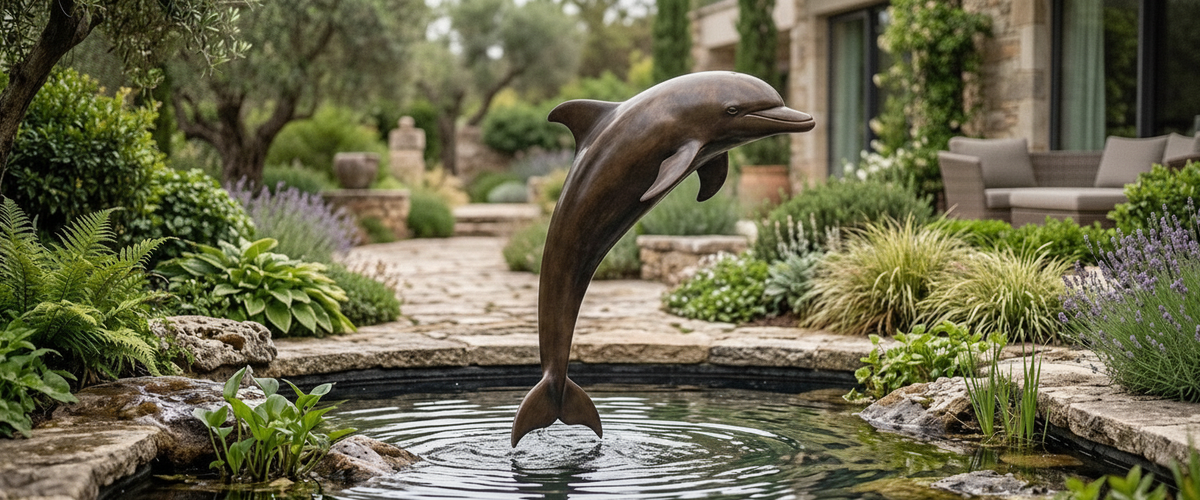

Most dolphin pieces fail for a reason nobody puts in the product description: the pose. A dolphin caught mid-leap, spine arched and tail still low, throws a diagonal your eye catches from the far end of a lawn. A level swimming pose, the kind that photographs beautifully on a studio plinth, flattens into a gray lozenge by the time you stand thirty feet (9 m) back. Choosing a dolphin sculpture outdoor starts with silhouette, then material, then finish. Get that order wrong and you buy a piece that only works from six feet away.

Key Takeaways Before You Buy
Arc over axis. A rising or diving curve holds its shape at distance; a horizontal body does not.
Judge from real distance. Assess a dolphin sculpture outdoor from the terrace door or kitchen window, never from arm's length.
Odd numbers group better. Three or five dolphins at staggered heights look composed. Two matched figures look like bookends.
Chlorine and salt are different problems. Pool chemistry attacks fixings and coatings; coastal air attacks the wrong grade of stainless.
Wall reliefs need a splash-zone plan. Fixings, spacers and drainage decide whether render stays clean or streaks brown in year two.
Budget follows scale, material, engineering and installation, so ask for a tailored commission quote rather than guessing from a size chart.
A Leaping Arc Reads at Thirty Feet, a Level Swimmer Vanishes at Ten
Dolphins are one of the few subjects where movement is the whole point. Sculptors have known this since antiquity; Greco-Roman marine reliefs almost always show the animal curled, not straight, because the curve is what carries the idea of speed. You can see the same instinct across classical marine imagery in the British Museum collection, where dolphins twist around anchors, tridents and Nereids rather than lying flat.
Practically, the test is simple. Stand at the viewing distance you actually care about, usually the terrace door, the kitchen window or the top of the drive. If the sculpture reads as one continuous line against sky or planting, it works. If it reads as a lump, you need more arc, more height, or both. Every dolphin sculpture outdoor that leaves our yard gets that check on the crating floor first. Where the garden needs a standalone diagonal rather than a figure that depends on a water feature beneath it, something like the Leaping Dolphin Marble Outdoor Sculpture at roughly five feet (1.5 m) tall carries the line cleanly against dark yew or box.
A rising arc still reads as one line at thirty feet; a level swimmer flattens out.

Odd-Numbered Pods and Staggered Heights
Pairs feel symmetrical and static. Three feels alive. When we set out multi-figure groups in the studio yard before crating, the arrangement that always wins is one dominant figure, one mid-height, one low and turning away, with no two tails at the same angle. Keep the spacing uneven too. Equal gaps read as a shop display.
For pods that will be seen in the round, walk a full circle before signing off the layout. A group that looks composed from the house can collapse into overlapping shapes from the pool steps. If the piece is intersecting a water jet, plan the arc so the spray lands on the back, not the face; constant water on a modeled snout accelerates streaking on any patinated surface.
Outdoor Dolphin Wall Sculptures Versus Freestanding Figures
There are really only two ways to site a dolphin sculpture outdoor: on a plinth or on a wall. Outdoor dolphin wall sculptures solve the problem freestanding pieces create on a tight terrace: floor space. On a narrow pool surround where loungers already eat the circulation route, a relief group mounted at eye level gives you the subject without another obstacle to walk around. Reliefs also handle rendered walls, pool house gables and courtyard returns where a plinth would look apologetic.
Relief groups free up circulation space on a narrow pool surround.
Freestanding figures earn their place when there is depth behind them. Open lawns, wide coping, lawn-to-water transitions in a Napa or Hamptons garden. If you have less than about six feet (1.8 m) of clear standing space, go to the wall. Where the setting calls for a contemporary reflection rather than modeled realism, a polished piece such as the Dolphin Silver Abstract Steel Outdoor Sculpture - 70/105cm is closer to the right design language, though mirror finishes pick up water reflections and move all day, which is a feature by a pool and a distraction in a small courtyard.

Chlorine, Salt Air and Constant Spray
Bronze is the traditional answer for a dolphin sculpture outdoor because it takes fine modeling, ages predictably and tolerates wet cycles. Patinas near chlorinated water will shift faster than the same piece inland, so plan on a wax refresh at least twice a year and expect the color to warm over time rather than staying fixed.
Stainless steel is the sharper choice for coastal projects, with one caveat: grade matters. In chloride-heavy air, 316 outperforms 304 by a wide margin, and the surface finish affects staining as much as the alloy does. The technical guidance published by the Specialty Steel Industry of North America is worth reading before you approve a spec for a beach house in Malibu or the Gulf Coast. Marble is stable in dry heat but wants sealing and a shaded microclimate where freeze-thaw is a factor. Corten is rarely right for a dolphin sculpture outdoor this close to a pool; the runoff will mark stone coping.
Mounting Over Water Without Rust Bleed Down the Render
Every failure we have been called about with a wall-mounted dolphin sculpture outdoor traces back to fixings, not the sculpture. Mild steel anchors behind a bronze relief will bleed rust through render within a season or two. Specify stainless fixings throughout, isolate dissimilar metals with nylon or neoprene washers, and set the piece off the wall on spacers so water drains behind it instead of sitting in a capillary gap.
Above a pool, treat the first three feet (0.9 m) as a splash zone and detail accordingly. Drill points sealed, no hollow cavity that can trap water, and a stainless backing plate spreading load across the substrate rather than four lonely plugs. On one commission for a client in Scottsdale we swapped a proposed direct-to-render fix for a bolted plate into the blockwork behind. The wall finish looked identical; the sculpture will still be sound in twenty years.
The Kitsch Line and How to Stay on the Right Side of It
Dolphins go wrong in recognizable ways. Cartoon smiles. Eyes with painted whites. Blue-tinted resin. Spiral tail wraps that look like a nightclub logo. The pieces that hold up in a serious garden share a discipline: anatomy taken from the animal rather than from a mascot, a surface that reads as metal or stone rather than plastic, and a single clear gesture instead of three competing ones.
Classical treatments sidestep the problem by pairing the animal with figure work, so a commission on the scale of the Life-Size Classical Mermaid with Dolphin and Sea Turtle Bronze Fountain reads as sculpture rather than novelty, even with moving water involved. At the other end of the scale, a leaping dolphin with an integrated mailbox works precisely because the function is honest and the pose is still doing real compositional work at the head of a drive.

Scale Tested Against Three Real Settings
Scale is where most decisions about a dolphin sculpture outdoor come unstuck, and the right answer changes with the setting.
Pool terrace: roughly three to five feet (0.9 to 1.5 m) freestanding, or a relief group spanning four to eight feet (1.2 to 2.4 m) of wall. Anything taller competes with the water surface.
Walled courtyard: height beats width. A vertical arc lifts the eye up a blank wall; wide horizontal groups make a small courtyard feel smaller.
Open lawn: go bigger than instinct says. Sky swallows silhouettes. Raise the piece on a plinth so the tail clears the mown line and the arc sits against clean background.
Commissioning Checklist
Photograph the site from every viewing distance that matters, including from indoors.
Mock up the footprint and peak height with cane and tape before approving scale.
Confirm material against your water chemistry and distance from salt air.
Agree the finish in writing: patina color, polish level, sealant or wax schedule.
Check substrate and fixing spec with your builder before fabrication, not after delivery.
Plan access for craning or hand-carry; narrow side returns catch out more installs than weight does.
Giant Sculptures makes bespoke marine work at these scales, from single reliefs to multi-figure pods, in bronze and stainless steel. Send site photos and viewing distances with your enquiry and we will quote your dolphin sculpture outdoor against your material, engineering and installation requirements rather than a generic size band.
For wider placement ideas, Large Abstract Garden Sculptures: A Buyer's Guide to Scale, Metal, and Placement is useful companion reading before finalising the setting and sightlines.