





































































































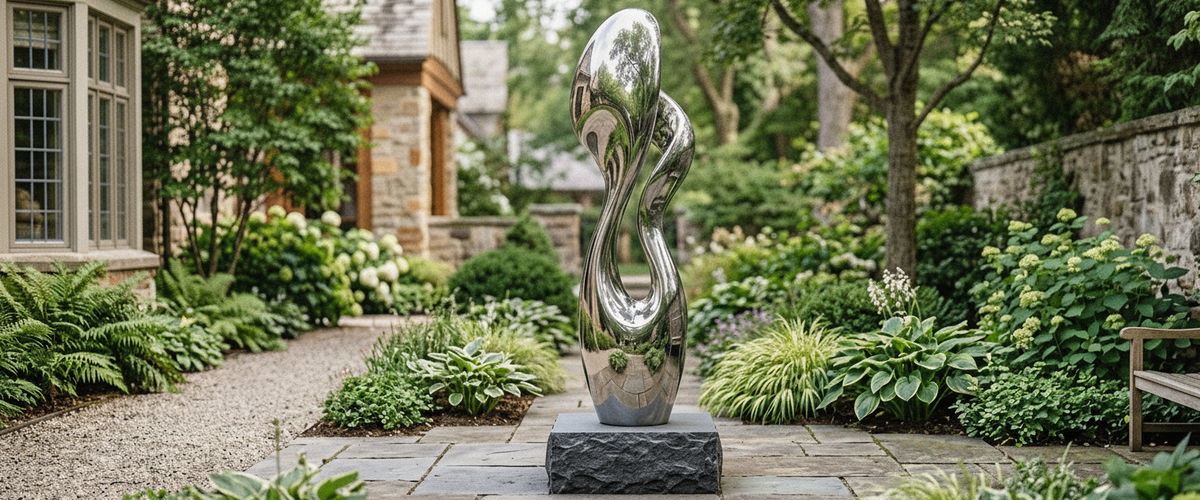

Most stainless steel sculptures that disappoint their owners do it in the first spring. The piece arrived bright in October and sat through a winter of rain, salt air or road grit. Now it carries a faint brown haze and a few freckles along its seams. Large stainless garden sculptures are long-term purchases. Whether a piece still gleams in year five, or needs explaining to every guest, usually comes down to choices made before it left the workshop: grade, finish, welding and siting.
Looking for the full range in this category? Browse our Stainless Steel Sculptures collection for every available finish, size, and configuration.
At Giant Sculptures we commission and ship large stainless steel garden sculptures to waterfront homes, rooftop terraces and hotel courtyards. The same few questions decide how every one of them ages.
Brushed 316 pieces on an exposed coastal site, photographed after their second winter.

Key Takeaways
Grade: specify 316 for coastal gardens, pool surrounds and city sites. 304 suits sheltered inland gardens.
Brown bloom: tea staining is superficial discoloration, usually removable. It is also a warning sign about grade or finish.
Finish: brushed and bead-blasted surfaces hide water marks better than mirror polish. Mirror sheds deposits well but shows every spot.
Welds: poorly treated seams are where staining starts, especially after frost.
Care: a simple routine through the first two winters tells you how your site behaves.
Grade 304 Versus 316: The Molybdenum Coastal and City Gardens Need
Stainless steel resists corrosion because chromium forms a thin, self-repairing oxide film on the surface. Grade 304 handles fresh rain and clean inland air comfortably. Grade 316 adds around two to three percent molybdenum, which makes that film far better at resisting chlorides. Chlorides are the salts carried on sea air, in pool splash and in the de-icing grit thrown up from driveways. The International Molybdenum Association explains why that small addition matters so much.
Our rule is simple. If you can smell the ocean from the garden, or the sculpture sits on a Manhattan terrace above salted streets, specify 316. Sheltered inland gardens, in the Texas Hill Country for example, can do well with 304, provided the piece is not beside a pool or a salted driveway. For large stainless garden sculptures, getting the grade right at commission stage is far less trouble than a refinish three years later.

Tea Staining After the First Winter: The Brown Bloom That Isn't Rust
A client on the North Fork of Long Island sent us photos after her first winter. Her six-foot abstract piece had a tan bloom across its seaward face, and she assumed it was rusting. It was tea staining: superficial discoloration where chlorides and airborne iron particles settle on the surface, not corrosion eating into the metal. Warm water and a nonabrasive stainless cleaner removed most of it in an afternoon. The Australian Stainless Steel Development Association covers the mechanism in useful detail.
What surprises owners is where it appears. Sheltered faces stain worse than exposed ones, because rain never rinses them. Light staining on the underside of a large stainless garden sculpture is normal. Heavy staining that returns within weeks means the grade, the finish or both are wrong for the site.
Mirror, Brushed or Bead-Blasted: Which Finish Still Looks Clean by Year Two
Mirror polish gives the smoothest surface, so deposits have the least to grip. It resists tea staining well but shows every water spot and fingerprint. That makes it best for focal pieces you can reach with a hose. At the end of a lawn axis or beside a hotel entrance, where light arrives from every angle and a quick rinse is easy, a tall reflective form such as Liquid Aura Gold Steel Sculpture, at 238 cm (about 7 ft 10 in), is where a high-shine finish pays for its upkeep.
Mirror polish beside a brushed finish: both sound, but only one hides water spots.
On big outdoor pieces in exposed or busy spots, a brushed finish hides water marks behind its grain. Ask for the grain to run vertically, so rain follows the lines down rather than pooling along them. Bead-blasted satin looks soft and forgiving, but its slightly rougher microsurface can hold coastal deposits unless it is passivated after blasting. Shape matters as much as surface here: on an exposed site, a flowing vertical silhouette such as Flare Silver Abstract Steel Sculpture (173 cm, about 5 ft 8 in) sheds water down its length rather than holding it on ledges, whichever finish you choose.

Weld Lines on Large Forms: Where Cheap Fabrication Shows After Frost
Most large stainless garden sculptures are built from welded panels, and every joint is a potential weak point. That matters most on faceted designs. If you are drawn to a geometric figure such as Noble Deer III Geometric Steel Sculpture - 204cm, standing about two metres tall with dozens of joined planes, ask how the seams were treated before weighing it against a smoother, single-surface form. Welding leaves a heat-tinted zone where the protective chromium layer is weakened. If that zone is not pickled and passivated, it rusts first. Cheap fabrication grinds the bead flat so it looks clean on delivery, then leaves the tint underneath.
Frost exposes the rest. Pinholes and poorly filled seams take in water, which freezes, opens the gap a little further and drains out as a rust-colored streak in spring. In our studio, stainless is worked only with dedicated tools that never touch carbon steel. We learned early that a single shared grinding disc can seed a constellation of rust spots across a perfect surface.
Leaf Litter, Sprinklers and Fertilizer: Garden Habits That Mark Steel
Wet leaves banked against a plinth hold moisture and tannins against the metal for weeks. Sprinklers running on hard or well water leave mineral rings, and iron-rich well water leaves orange marks that look exactly like rust. Fertilizer granules, chlorinated pool water and vineyard sprays in Napa all leave residues that attack the surface over time. Turn sprinkler heads away from the base, add a gravel apron and rake the plinth clear through the fall.
How to Judge Large Stainless Garden Sculptures Before You Buy
Before you commit, ask the supplier for clear answers on these points:
Grade in writing: 304 or 316, confirmed for the specific site.
Finish matched to location: mirror for reachable focal points, brushed or satin for exposed or busy spots.
Weld treatment: pickled and passivated, not just ground flush.
Drainage: weep holes in hollow forms so water cannot sit inside.
Fixings: stainless anchors and bolts, because mild steel hardware causes galvanic staining.
Scale: height proportioned to viewing distance and to the surrounding planting.
Budget depends on material, scale, complexity, engineering, installation and finishing, so a tailored quote is the only honest figure. You can see finished pieces across a range of scales and finishes in our metal sculptures collection, or brief us on a bespoke commission built to your site from the first sketch.

A Simple Two-Winter Care Routine That Keeps a Large Piece Bright
Through the fall: clear leaves from the base weekly.
Late fall: rinse with fresh water, wash with mild soap, rinse again and dry the polished faces.
Midwinter: on coastal or salted sites, give the piece a freshwater rinse on a mild day.
Early spring: inspect the welds and sheltered faces. Lift any bloom with a nonabrasive stainless cleaner, wiping with the grain.
Summer: check sprinkler and pool overspray.
Second winter: repeat, and photograph the same faces to compare with year one.
Never use steel wool, chlorine bleach or abrasive pads. After two winters you will know exactly how your garden treats steel, and most owners of large stainless garden sculptures find the routine shrinks to a spring and fall wash. If your site is unusual, talk to us before you order. Matching the piece to the garden is the part of the work we enjoy most.
For wider placement ideas, Large Outdoor Wall Art That Still Reads From the Far End of the Garden is useful companion reading before finalizing the setting and sightlines.