





































































































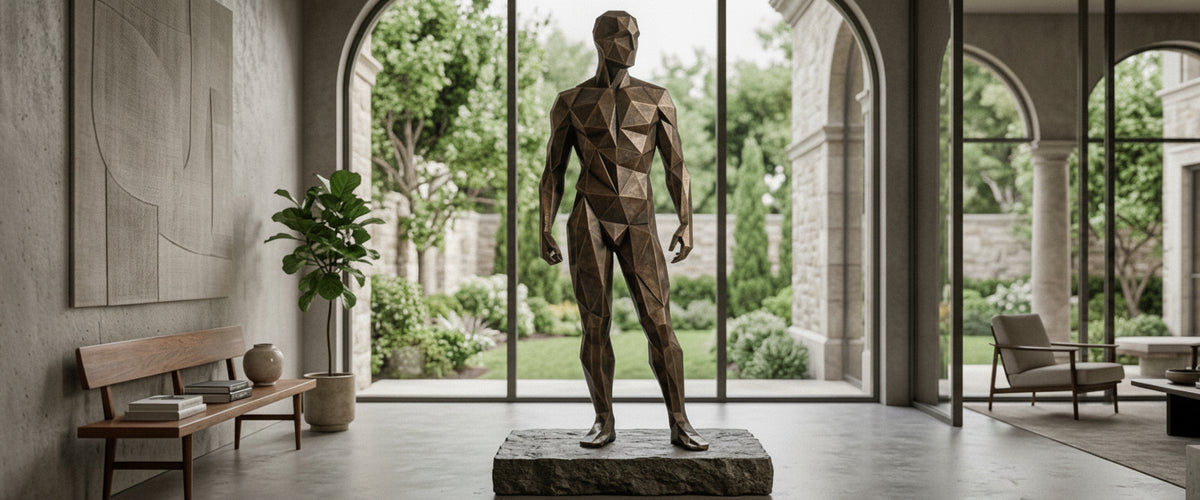

Angular forms play a different game than a classical figure. A geometric art sculpture works by catching light on hard planes, throwing sharp shadows, and shifting its whole read as you walk around it. Get the material and placement right and the piece looks deliberate from every angle. Get them wrong and a faceted bronze can flatten into a shapeless lump under bad light. That gap between success and disappointment is almost always decided before the piece ships, which is exactly what this guide is about.

What Geometric Art Sculpture Means and Who It Is Best For
Geometric art sculpture reduces a subject to planes, facets, and clean angles rather than smooth naturalistic surfaces. A running figure becomes a stack of triangulated forms; a seated pair reads as intersecting volumes. The style borrows from Cubism and from the machine-age confidence of Art Deco, and it sits comfortably in modern architecture where straight lines already do a lot of the talking.
Key takeaways
- Faceted forms live or die on light; angular surfaces need directional light to read as intended.
- Bronze, stainless steel, and Corten each treat those facets very differently.
- Scale needs breathing room; a monumental geometric figure demands a clear sightline, not a crowded corner.
- Bespoke commissioning lets you match facet density, patina, and base to a specific site.
- Budget depends on material, scale, engineering, finishing, and installation, so ask for a tailored quote.
The style suits collectors who prefer restraint over ornament, architects specifying a courtyard focal point, and hospitality buyers who want a piece that photographs well and does not date. If your taste runs to soft romantic figures, geometric abstract art sculptures may feel cold to you. If you respond to structure and clean edges, this is your language.

Key Materials, Finishes, and Scale Decisions
Material choice changes the entire character of a faceted form, so decide it early.
Bronze is the classic route for modern art geometric sculpture. Cast facets hold a crisp edge, and patina gives you control over how each plane reads. A darker patina deepens shadow lines and makes the geometry feel weighty; a lighter or polished patina lets more light travel across the surface. Bronze also ages honestly outdoors, developing a stable surface over decades when maintained. Where a single figure needs to hold every plane distinct at full height, a cast piece such as Monumental Modern Abstract Geometric Figure Bronze Sculpture - 250cm (roughly 8 feet 2 inches) is the kind of form bronze handles best.
Stainless steel pushes the geometry toward reflection. Mirror-polished facets bounce sky and surroundings, so the sculpture partly disappears and partly amplifies its setting. A brushed finish calms that down and reads more architectural. Steel suits cubic and lattice forms, and where the design language leans toward pure planes and clean welds rather than figuration, something like the Cubic Geometric Steel Sculpture at 75cm (about 30 inches) is closer to the right idiom. Steel is a strong pick near water or coastal air, where the right grade resists corrosion well.
Corten (weathering) steel gives you a warm rust-toned surface that stabilizes over time. It reads earthy and industrial at once, and it pairs well with planting and gravel. For a large geometric form in a landscape setting, Corten softens the hard edges just enough without losing them.
On scale, geometry amplifies size. Faceted planes create their own rhythm of shadow, so a large piece can feel busier than a smooth figure of the same height. A monumental sculpture in the 7 to 9 foot range (roughly 2.1 to 2.7 m) needs distance to be read properly; a smaller tabletop or plinth piece rewards close inspection of the facet joins. Decide viewing distance before you decide height.

Where to Place Geometric Art Sculpture for the Strongest Visual Impact
For wider placement ideas, Contemporary Abstract Metal Sculpture: A Buyer's Guide to Form, Scale, and Placement is useful companion reading before finalising the setting and sightlines.
The single biggest mistake buyers make with angular work is starving it of light. Facets only exist because of the shadows between them. Put a faceted bronze in flat, even shade and you lose the drama entirely.
Outdoors, orient the sculpture so it catches raking morning or late-afternoon light across its main faces. In a Napa garden or a Hamptons lawn, a single monumental piece on a low plinth, set against sky or a clipped hedge, gives the geometry room to work. Avoid backing it against a busy planting scheme that competes with the edges.
Indoors, geometric abstract art sculptures do their best work in double-height spaces, gallery-style hallways, and open-plan living areas common in California and New York apartments. A polished steel cube on a console reflects the room and adds depth to a tight space. In a Texas ranch great room with generous ceilings, where a single figure would look lost across the volume, a grouped bronze such as Monumental Modern Trio of Abstract Geometric Figures Bronze Sculpture - 250cm anchors the space without needing a wall of art around it.
For commercial venues, hotels and corporate lobbies use geometric work because it signals contemporary confidence and photographs cleanly. We shipped a faceted bronze figure to a West Coast hotel entrance where the client specifically wanted a piece that looked intentional from the drop-off, from the elevator bank, and from the mezzanine above. That three-view test is a good discipline for any placement: walk the approaches before you commit to an orientation.
Placement Checklist
- Confirm the light direction hits the main faces at least part of the day.
- Give the piece a clean backdrop; sky, hedge, or a plain wall beats visual clutter.
- Check the primary viewing distance and the three most common approach angles.
- For outdoor work, plan a level, load-rated base or footing.
- Leave circulation space so viewers can walk around and read the changing profile.

Budget, Commissioning, and Delivery Considerations
There is no single price for a geometric art sculpture, and any honest supplier will tell you the same. Cost is driven by material, overall scale, the complexity of the faceting, structural engineering for large pieces, the finish or patina, and installation. A mirror-polished steel piece involves far more hand-finishing than a brushed one; a monumental bronze needs internal armature and foundation work. Define the brief, then request a tailored quote rather than anchoring to a number.
Art Deco geometric sculpture, with its stepped forms and stylized figures, often calls for careful edge work and sometimes contrasting finishes, so factor that detailing into the conversation. When a brief calls for movement rather than a static pose, a dynamic figure such as Monumental Contemporary Geometric Sprinting Figure Bronze Sculpture - 260cm (about 8 feet 6 inches) is a useful benchmark for how much faceting a pose in motion actually needs.
On delivery, large geometric work usually ships crated and, for monumental pieces, benefits from professional installation. Think about access early: gate widths, ceiling heights, crane or forklift needs, and the route from the truck to the final position. We would rather discuss access at the quote stage than discover a doorway problem on delivery day. Weight matters too; a cast bronze figure of monumental size can run into the hundreds of pounds (well over 100 kg), so bases and footings need to be planned accordingly.
For outdoor bronze, plan for simple long-term care. Conservation guidance from bodies such as the American Institute for Conservation points to gentle washing and appropriate protective coatings as the backbone of maintaining outdoor metalwork. A light annual clean and a periodic wax on bronze keeps the patina even and slows weathering in exposed sites.
How Giant Sculptures Can Help With Bespoke Projects
Giant Sculptures works as a bespoke supplier of large-scale and monumental sculpture, so geometric commissions are squarely in our wheelhouse. If you have a specific site, we can adjust facet density, height, patina, and base design to suit the architecture and the light. Groups and pairs, like our seated and abstract figure sets, can be spaced and posed for a particular sightline rather than bought off a fixed layout.
A commission usually starts with the brief: the space, the viewing distances, the mood, and the material you respond to. From there we refine the form, agree the finish, and handle the engineering and crating for shipping worldwide. The Geometric Sculptures collection gives a sense of the range of angular forms we produce, and each piece can serve as a starting point for something built to your space. If you already know you want steel, the stainless steel sculptures collection is a good place to compare polished and brushed finishes before you decide.
The best geometric pieces feel inevitable in their setting, as if the architecture asked for them. That only happens when material, scale, and placement are settled with intent. Start with the site and the light, choose the metal that suits both, and let the geometry do the rest.