



































































































A pair of bronze cranes garden statues can hold a whole garden together, or vanish into a hedge, depending on choices most buyers make in the first ten minutes. Cranes are tall, narrow, and dramatic in silhouette, which means bronze cranes garden statues reward thoughtful placement and punish lazy positioning more than a denser piece like a bronze elephant garden statue or a reclining figure would. This guide is for buyers, garden designers, and clients commissioning a pair (or a flock) of bronze cranes garden statues who want the birds to read as deliberate, not decorative.
Looking for the full range in this category? Browse our Bronze Deer Statues collection for every available finish, size, and configuration.
At Giant Sculptures, cranes are one of the requests we get most for water gardens and entry courtyards. Bronze cranes garden statues suit the same kind of project that calls for koi, Japanese maples, or a clean reflecting pool, and they hold their own next to architectural planting. Below is what we have learned shipping bronze cranes garden statues into private gardens from Napa to the Hamptons, plus the choices that matter before you buy.

Quick Answer: What to Decide Before You Buy
Pose: Standing alert, head bowed feeding, or wings spread. Each reads differently from 30 feet (9 m) away.
Pairing: Cranes almost always work better in two or three. A solo crane can look stranded.
Height: Most life-size cranes finish 4 to 6 feet tall (1.2 to 1.8 m). Add a low plinth and you are past most shrub lines.
Backdrop: Bronze needs contrast. Dark hedging or stone walls flatten the silhouette; sky, water, and pale gravel reveal it.
Patina: Verdigris green reads naturalistic near planting; warm chocolate brown reads sculptural near stone and architecture.

How Bronze Cranes Garden Statues Actually Read in Different Settings
The same pair of bronze cranes garden statues can feel ceremonial at a front entrance and almost domestic beside a vegetable garden. Setting matters as much as the casting itself. A few patterns we see repeatedly:
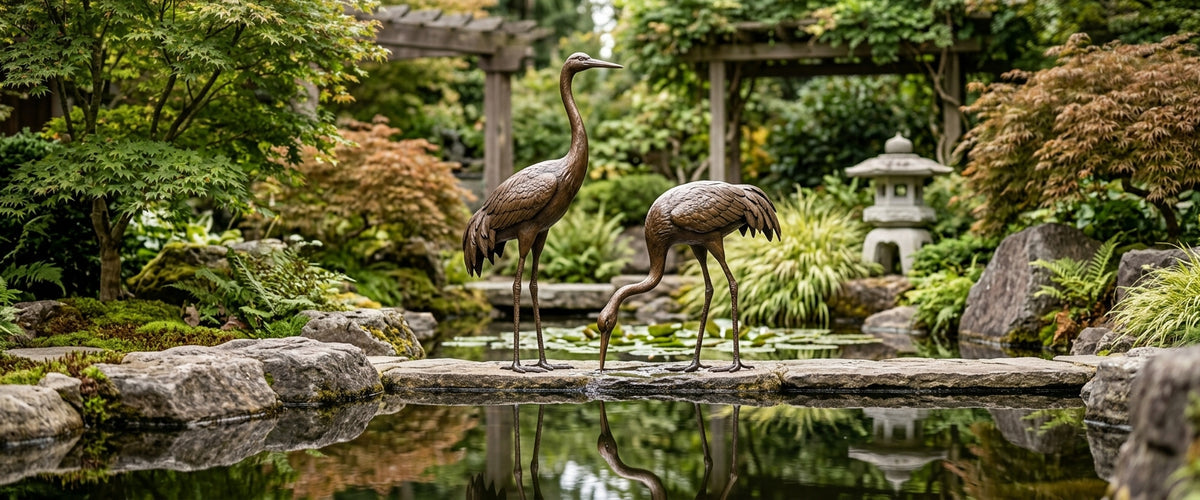
Beside water. This is the obvious choice and the one cranes were sculpturally designed for. A long-legged crane in a feeding pose, head dipped, completes the visual story of a koi pond or a still reflecting pool. The water doubles the piece in reflection, which is why a single bird can sometimes work here when it would fail on a lawn. Position the feet just at the waterline if the pose allows, not stranded a foot back on the bank.
In a gravel courtyard. Pale gravel is the most flattering backdrop bronze has. A warm brown or green patina sits cleanly against gray or buff stone, and the negative space around the legs reads as intentional. This is where bronze cranes garden statues really earn their cost as garden bronze statues, because the silhouette is doing all the work.
On a wide lawn. The trap. Cranes are tall but narrow, so on an open lawn bronze cranes garden statues can read as sticks at distance. If you must place them on grass, group three at varying heights, or set them in a planted island with low grasses, never alone on mown turf.
Indoors, in an atrium or orangery. Less common, but these birds work in large glazed spaces where the ceiling is at least double the sculpture's height. Polished bronze finishes suit interior placement; outdoor patinas can look dusty under interior light. A bronze cat garden statue or smaller animal piece tends to read better in tight interior corners, but cranes need the vertical room.

Scale, Sightlines, and Pedestal Height
Three numbers decide whether a piece reads as sculpture or as ornament: the viewing distance, the pedestal height, and the head height of the finished piece relative to the dominant horizontal line nearby (a wall cap, a hedge top, a water surface).
For bronze cranes garden statues, the rule we use in commissions: the head of the bird should sit either clearly above or clearly below the dominant horizontal, never on it. A crane head exactly level with a hedge top vanishes. Two feet (60 cm) above or below, and it commands the view.
Pedestals on cranes are a stylistic choice more than a structural one. Many of our clients prefer no plinth at all, letting the long legs do their job. If you do raise the piece, keep the plinth low, six to twelve inches (15 to 30 cm), and either match the surrounding hardscape stone or use a dark slate that disappears. A tall classical plinth under a crane fights the natural pose.
Sightlines matter more for cranes than for compact pieces. Walk the route a visitor actually takes. From the gate, from the door, from the kitchen window in winter. A crane that is glorious from the terrace but hidden from the house is half wasted. We have re-sited several pieces post-installation because the client only ever saw them in passing.
Indoor vs Outdoor: When Each Wins
Outdoor placement wins on almost every count for bronze cranes garden statues: weather, scale, patina behavior, and the inevitable association with water and sky. Bronze is built for it. Properly cast and finished bronze can live outside for generations with minimal intervention, which is one reason museums treat it as a permanent-collection material (the American Institute for Conservation's outdoor sculpture guidance is a good starting point if you want to read further).
Indoor placement wins in two cases. First, when the cranes are exhibition pieces, perhaps a polished or gilded finish, and you want a controlled environment to protect the surface. Second, when the winter climate is brutal enough that freeze-thaw cycles will eventually damage the foundation, not the bronze itself. The metal will be fine in Aspen or upstate New York; the concrete pad under it may not be.
If you are moving between the two ideas, consider commissioning a pair of bronze cranes garden statues sized for an indoor atrium that can also live on a covered loggia. We have shipped exactly this brief into a Texas property where the birds summered outside and wintered just inside a glazed garden room.
Light, Backdrop, and Contrast
Bronze is a surface that needs light to perform. A crane in deep shade under mature trees looks like a silhouette cutout; the same piece in dappled morning light shows every modeled feather. Track the sun across the site for a full day before you commit to a final position.
Backdrop is the other half of the equation. Hard rules from the studio:
Dark green hedging (yew, boxwood, holly) flatters warm brown patinas and fights green verdigris.
Pale stone walls work with almost any patina; this is the safest backdrop.
Sky as backdrop (the piece silhouetted against an open horizon) is the most dramatic option, but only works if the silhouette is interesting, which is where pose selection pays off.
Water reflection doubles the visual mass and is the single best treatment for bronze cranes garden statues.
Contrast also dictates patina choice. When the birds share a garden with a second bronze focal point further off, say a Life-Size Bugling Stag and Deer Bronze Sculpture - 290cm (or a bronze deer garden statue) set into a far border, the two patinas should either be deliberately matched or deliberately contrasted. Two different bronzes in two different unrelated browns look accidental.
Common Placement Mistakes We See
For wider placement ideas, Angel Garden Statues: A Buyer's Guide to Scale, Stone and Placement is useful companion reading before finalizing the setting and sightlines for bronze cranes garden statues.
After enough commissions, the same errors come up. Worth flagging:
One crane, alone, on a lawn. They are social birds and they read as social sculptures. A solitary piece needs a strong reason: a memorial, a specific narrative, an architectural anchor. Otherwise pair them.
Placing them too close to the house. Tall vertical pieces compete with architecture if they sit within about 15 feet (4.5 m) of a facade. Push them out into the garden where they have air around them.
Ignoring winter sightlines. Birds set against bare deciduous branches in February can look harsh. Evergreen backing solves it.
Over-pedestaling. Mentioned above but worth repeating. The long-legged silhouette is the point. Do not bury it under a heavy plinth.
Mixing scales casually. A pair of life-size bronze cranes garden statues dropped directly next to a monumental piece such as a Monumental Life-Size Walking Elephant Bronze Sculpture - 360cm needs a designed transition, not a direct adjacency, since the elephant's mass will simply erase the verticality of the birds at close range. Either separate them across the garden or commission cranes scaled up to hold their own.
Forgetting drainage. Bronze is durable, but standing water at the base of the feet (or worse, inside a hollow casting with a blocked drain) will eventually stain surrounding stone. Make sure the piece is sited so water runs away from it.
Commissioning vs Buying From the Collection
Most of the bronze statues for garden settings we sell are available from existing castings, including pieces in the bronze garden statues collection. For bronze cranes garden statues specifically, buyers often want a pair with subtly different poses (one alert, one feeding), or a scale uplift to suit a larger pond. That is a commissioning conversation, not a stock order.
Where the brief involves water rather than a dry plinth, an integrated fountain piece like the traditional elephant and calf bronze fountain is a useful reference for how plumbing, basin engineering, and patina behavior get specified together; the same considerations apply when the bronze cranes garden statues are designed to stand in or beside a working water feature.
Bespoke work changes timeline and budget, both of which depend on scale, pose complexity, patina specification, base engineering, and shipping. Rather than quote ranges that mislead, we ask clients to share site photos and approximate dimensions, and we return a tailored quote. The same goes for a request we get often, a garden statue hebe bronze pairing alongside a pair of bronze cranes garden statues for clients building a classical-meets-naturalistic garden; the design coordination matters more than the price band.
Care Once They Are Installed
Bronze cranes garden statues need very little. An annual rinse with clean water, a soft brush in the joints where dust collects, and a wax refresh every two to three years on exposed pieces is enough for most climates. Coastal sites need slightly more attention to salt deposition. The Smithsonian's Museum Conservation Institute publishes sensible reference notes for owners of outdoor bronze.
Avoid pressure washers. Avoid any cleaner with chlorine or ammonia. If the patina on your bronze cranes garden statues ever looks tired, talk to us before applying anything. The fix is usually small and reversible if caught early.